If you’ve been following Artsy Forager for a while, you may have noticed a few recurring themes in some of the work I write about– man’s relationship with nature, fashion industry and its psychology of influence, and art historical themes being a few. When I first wrote about the work Toronto based artist Amanda Clyne , she was drawing reference from and making connections between historical portraiture and high fashion photography. In her latest series, she continues the fasciation and the lines become even more blurred ( pun intended ).
In this work, she begins with a photograph of a painting. The photograph is then printed onto paper to which it doesn’t stick, creating a wet, workable surface. She then “paints” the photograph, then once the residue dries, the surface is scanned and the painting then once again becomes a photograph of a painting.
The resulting image is ghostly, with an x-ray-ish quality. A nod to the illusory nature of the original portrait? An attempt to find the real person beneath the layers of fashion and facade? In style and palette, these are much softer than Clyne’s previous series. Yet they are still asking the same questions and it seems we, as a society tend to continue to give the same answers.
One of my favorite activities in the world is visiting artists in their studios or even getting a little peek inside through photographs! Whether an artist is working from a light filled loft or a small corner in the kitchen, the way an artist approaches their workspace says so much about their creative process. I suspicion you enjoy studio visits, too.. And so dear Artsies, I thought I would treat us to a little jaunt to the studio of Deann Hebert website You may recognize Deann’s work from the City Mouse | Country Mouse show currently online at Found Gallery here at Artsy Forager.
Everyone, say hello to Deann!
Deann and I decided this trip to her studio would give us the perfect opportunity for you to get acquainted a bit better. So she indulged me by answering a few questions inquiring Artsies might like to know..
Artsy | You have such a unique style of applying paint to canvas! Can you tell us a bit more about your process?
Deann | My process has definitely evolved over the years. I have always been attracted to texture, and palette knife painting. I wanted to create a style that married these two together. A key factor in this was the opportunity I had to study abroad while receiving my formal training. It exposed me to different cultures, ways of thinking and creating art. It was really just a trial and error type of thing. It’s a process of applying layers on top of layers. With each layer reacting with another. Once I got into my “groove” of painting, it just felt right. I literally had an “ah-ha” moment, of “this is who I am!”
AF | How have you seen yourself grow as an artist over the years?
DH | Oh I have changed so much over the years. I think it’s only a natural progression that a fine artist changes and grows. I hope I am always changing and evolving, not being static. I think this is where true creativity comes from. Over the years my work has gone from bright, bold colors and still lifes, to more muted tones of blues, creams, greys, and landscapes. Who knows what the future will bring!
AF | What is the most exciting part of painting for you?
DH | The most exciting part of creating for me, is watching the painting literally become something right before my eyes as it is on the paint table. But, the créme de la créme, is evoking an emotional reaction from the viewer, for whatever reason.
AF | What is it about the country that captures and holds your imagination?
DH | Well, this little country mouse grew up in a small town and my family always owned horses and cows. So growing up “in the country” was our way of life, and I absolutely loved it. The texture of an old barn or fence, or grass growing in the fields remind me of my childhood days. Unfortunately, many of these old structures are falling victim to time and neglect, but still are a direct link to the past, and the present. These barns tell a story, too, if we could only listen to them, to me, they are the heart and soul of the South. Even my studio walls are made from reclaimed wood from a historic barn that was torn down, so my inspiration, is quite literally, everywhere. Now, I am lucky enough to call Tennessee home, and the rolling hills and landscape are truly inspiring to me and beautiful. In my own little way, I want to pay homage to that.
Margaret Britton Vaughn, Poet Laureate of Tennessee, says it best in her poem:
BARNS OF MY YOUTH
I miss the barns of my youth,
The ones that read, “See Rock City.”
Hungry Caterpillars ate them alive,
Spitting out nails
To become thorns in the side
Of crawling asphalt,
Erasing small towns
To link big cities
They die hard, these old barns,
Leaning on the everlasting
Shoulders of Time
That cushion the fall of rotting boards.
Light seeps through decaying skeletons,
Causing shadows to tiptoe
Like ballerinas dancing the waltz of the wind.
In our hurry to get there
We destroyed the landscape:
Masterpieces of America.
AF | You are very involved in children’s art activities, like Art Camp. What do you see as the most important creative lesson a child can learn?
DH | Since I have two children myself (2 and 6), exposing children to the arts is very near and dear to my heart, and I think the most important creative lesson a child can learn is that art can be used to express yourself in ways that nothing else can. That you can actually say something with your art.
AF | Obligatory question. If you weren’t an artist, what would your dream job be?
DH | It’s so hard to answer that question because I am living my dream job…. but let’s see, since I love to travel, I always thought Samantha Brown had the coolest job ever to tour the world and work for the Travel Channel show, “Great Hotels”. How cool would that be?!
That would be a pretty sweet gig, but I have a feeling most folks would trade with you in a heartbeat! Thanks so much for opening up your studio to us, Deann!
To see more of Deann’s work, please visit her Deann Hebert website and the City Mouse | Country Mouse online show and sale in Found Gallery here at Artsy Forager. Big thanks to Ray Sanduski of With an Eye Photography for the gorgeous shots of Deann’s creative space and process. Be sure to check out Ray’s website!
While Mr. Forager & I are on the road, making our way to California, we’re rerunning Artsy Forager’s most popular posts. This post originally published on May 2, 2011, when the blog was barely two months old. Enjoy!
In honor of Cinco De Mayo this week, I thought we’d focus today on the amazing Frida Kahlo. When I was in painting classes in college, I remember there being this older Bolivian lady who was auditing the classes and she was obsessed with Frida Kahlo. She was sweet but somewhat obnoxious. For a long time, the fact that she was so obsessed with Kahlo managed to turn me off on her artwork. Weird how our minds work sometimes.
But then, somewhere along the line, I let go of this irrational bias and took another look at Kahlo and her work. And I was quickly won over. Health problems plagued Kahlo from a young age, suffering first from polio and then being severly injured in a horrific car accident which left her in a full body cast and bedridden for three months. Though she eventually recovered from her injuries, extreme pain would torment her for the rest of her life.
Two Fridas
Before the accident, Kahlo was studying to become a physician, but she dealt with the boredom of being confined to bed by taking up painting with her father’s watercolors. And so, Frida Kahlo, the artist was born.
Kahlo’s work often included symbols of Mexican mythology, as well as those of Christian and Jewish faiths. Though she is perhaps best known for her self-portraits, often depicting events in her own life, such as the accident, subsequent miscarriages, etc.
She married renown Mexican muralist, Diego Rivera in 1929 and their life together was a tumultous one.
Her work has been described as surrealist, but I think it is the unvarnished depiction of her real life pain and struggle that makes her work so interesting and relatable. We may not have all been through the kind of physical pain Kahlo experienced, but perhaps it is that we can all certainly relate to her emotional pain and the need to express it on canvas.
Be sure to check out the official Frida Kahlo website. A beautifully designed site full of interesting information about the artist.
I have always been a voracious reader, nerd that I am. Summers were often spent with my nose in a book and summer reading contests were usually won handedly. These days, with so much time spent reading blogs and articles online, I don’t pick up a book nearly as often as I’d like. When I do, sometimes it’s an artist biography or other art/art history related tome, with the occasional fun & easy fiction read thrown in. Since some of my artsy reads might be of interest to you, I thought I’d begin posting my thoughts on my latest conquests.
Tom and Jack: The Intertwined Lives of Thomas Hart Benton and Jackson Pollock by Henry Adams
While I’ve always admired Thomas Hart Benton’s work for its sweeping nature and subtly satirical voice ( though it is still widely criticized by many as too provincial ), I’ll admit my main draw to the book was Pollock.
Arts of the West ( 1932 ) by Thomas Hart Benton
Remembering back to my earliest forays into art history, I wasn’t especially intrigued by Pollock. At the time, I was drawn to the more feminine abstractions of Georgia O’Keeffe and Helen Frankenthaler. It wasn’t until I came face to face with a Pollock canvas during an Abstract Expressionism show at The Cummer Museum of Art in Jacksonville. I was completely blown away.
Convergence by Jackson Pollock ( 1952 ), oil on canvas, 155×93.5
The texture, the seemingly randomness that once you really stare at it, is not so random, the thick build-up of paint.. I was now officially hooked. The book details the rise of Thomas Hart Benton, paying special attention to his influences, as these would trickle down to ultimately influence Pollock. Benton’s theory of “the hollow and the bump” becomes especially important to Pollock’s artistic growth. Once studied side by side, it’s interesting to map how Pollock went from devoted student of Benton’s to the development of his own unique, groundbreaking style while still utilizing theories taught to him by this mentor and father figure.
I confess, this one took me several library renewals to get through.. The first half of the book, which focuses heavily on Benton and his contemporaries is a bit of a challenge, perhaps because I was more interested in Pollock. But once you begin to see it all culminating in the explosion of Pollock’s career, the transition from the Modern movement to Abstract Expressionism and the shifting of the center of the art world from Paris to New York, the book is impossible to put down. Yes, there’s plenty of speculation regarding Pollock’s alcoholism, mental and emotional battles, but the focus comes back to how he dealt with those demons through his work. A fantastic read if you are at all interested in modern art, abstract expressionism, Benton or Pollock. I just wish I’d bought it instead of checking it out of the library!
Anyone else out there read this book? What were your thoughts?
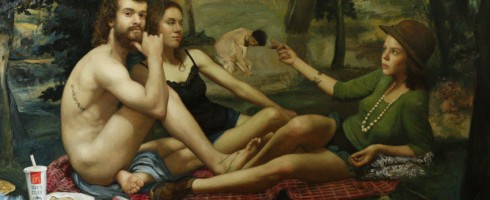
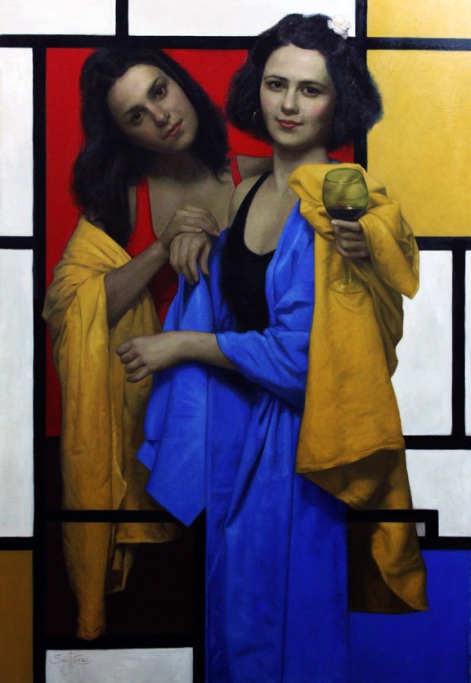
If you’ve ever taken an art class, I’m sure you’ve copied the work of a “master”. Redrawing and painting great works of art is one of the tried and true methods used to teach basic skills. I love the way some artists are taking masterworks and recreating them in fun and interesting ways. Check ’em out!
Out of the Square by Cesar Santos ( via artrenewal.org )Frida Dog by Clair HartmannMan Ray by Jocelyn GrivaudGirl With a Pearl Earring by Sarah Ashley Longshore ( via Gallery Orange )
Have a fantastic weekend, Artsies! Any plans for museum visits this weekend?
Featured image is Picnic in Central Park by Cesar Santos ( via Art Renewal Center ). All images are via the artist’s websites, unless otherwise stated.
Kicking off artsyF A S H I O NWeek here at Artsy Forager! Fashion and art have long been intertwined. For centuries, artists have, perhaps at times unwittingly, been the recorders of the history of fashion and style. It is in thanks to artwork that we can track what was worn by whom hundreds of years ago. Paintings weren’t just art, but were the fashion magazines and blogs of their day. For instance, thanks to Vermeer, we see a glimpse of the difference in the daily costume of the classes in a Mistress and Maid.
Mistress and Maid by Johannes Vermeer, c. 1666-1667
Today’s artists seem to have a bit more freedom to interpret instead of record. Fashion is such an integral part of our modern culture, it is no surprise that it still holds a fascination for contemporary artists. For some artists, the fashions themselves are worthy focal points. Denver artist Roxanne Rossi elevates a simple dress’s silhouette into an artistic statement, a sculptural fashion plate, clean but heavy in texture, it seems like it could come to life at any moment.
Afternoon Delight by Roxanne Rossi, acrylic, 36×60
Sometimes the fashion media becomes a literal component to a piece of fashion-influenced art, such as in the collage work of Melbourne, Florida artist Derek Gores. His imagery has the composition of a Vogue magazine spread and the collaged photos, magazine, labels, etc give each piece a painterly depth.
All Summer Long by Derek Gores, mixed media collage
Painter Kelly Reemtsen uses the constraints of mid-century era mindsets about fashion and juxtaposes them with garden tools and hardware, producing visual statements about the expectations placed on women, by themselves and the world at large.
Throwback by Kelly Reemtsen, oil on panel, 36×36
Celebrating the female form, both physically and spiritually, Leigh Pennebaker’s wire sculptures reveal designs that are sensuous and soft, despite their industrial materials.
Madeline by Leigh Pennebaker, wire sculpture
Like many fashion-forward artists, Megan Cosby began with an interest in fashion design, but decided she was more interested in the people themselves and what their style said about their personality, who they are, where they’ve been and where they are going.
Better by Megan Cosby, mixed media on canvas, 14×12
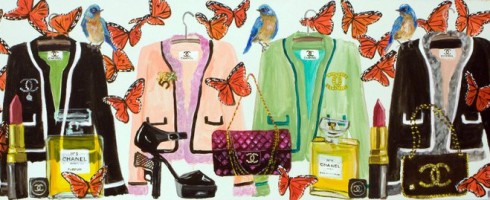
And then there’s the smart and cheeky work of Sarah Ashley Longshore, at once playing homage and poking fun to our culture’s obsession with fashion. I’ve featured her Audrey Hepburn paintings several times on the blog, but she also has this fabulous series focused on fashion and pop culture.
Trophy Wife Junk Drawer by Sarah Ashley Longshore, acrylic and high gloss reisn on canvas, 48×72
More fashiony-artsy goodness to come this week! Stay tuned.
Featured image is Major Poontang by Sarah Ashley Longshore.
She has been a source of fascination, scandal and intrigue for over a century.
Madame X, 1884
John Singer Sargent’s masterpiece, Madame X, while initially a source of pain and frustration to the artist, proved to be his most recognizable and memorable work. The portrait’s subject, Virginie Amelie Avegno Gautreau, was a Paris socialite renown for her beauty and though it is a remarkably beautiful work to contemporary audiences, at the time of its Paris salon debut, the portrait was greatly criticized by critics, the public and Gautreau’s family ( her mother was outraged ).
The characteristics that appeal to our modern eyes are some of the same characteristics by which it was condemned upon its debut. The elegant lines of her simple black dress create a decidedly contemporary feel to Madame Gautreau’s ensemble, but this would be years before Coco Chanel’s “little black dress” would become ubiquitous with timeless fashion. The expanse of almost translucent white skin may not seem provocative to our 21st century eyes, to show such a sweep of bare skin, especially the beautifully turned neck and decolletage would have been quite provocative in 1884. Though artists had long been painting nudes of mythical and fictional figures, showcasing the body of a real person in such a seductive way would have been scandalous. ( Even if said person was infamous for her infidelities.. ).
Madame X, detail
The most scandalous component of all though may be her dress strap. The strap as pictured above laying rightfully upon her shoulder is not how Sargent originally painted it. In looking at his sketches for the portrait, it would seem that her strap had a tendency to slip off her shoulder..
Sketches for Madame X
So, painting the truth in beauty, Sargent originally depicted the strap as having fallen casually from Gautreau’s shoulder.
Madame X, recreated as may have originally been painted
This detail caused such a backlash, that when Sargent picked the painting up after the Salon showing, he took it back to the studio and repainted the strap well stationed upon her shoulder. Despite the outrage the painting incited when it was first shown, Sargent would eventually come to realize the importance of the portrait, describing it in a letter to the director of the Metropolitan Museum of Art as “..the best thing I have ever done”. He would sell it to the museum in 1916 and it is there that I saw it in person in 2007 during the “Americans in Paris” exhibition. Photographs online do not do this painting justice in any way. In person, it is commanding in scale, mesmerizing in presence and breathtaking in beauty.
Do you have a certain outfit you wear when you need a pick-me-up? Or maybe there is a particular piece of music that always gets your blood pumpin’ and instantly uplifts your mood? The work of Henri Matisse does the same for me.
Sorrows of the King
From his beginnings as a Fauvist, Matisse was never afraid of exploring expression through color.
Open Window
And like his friend and rival, Pablo Picasso, Matisse loved painting figures and still lifes, but it is the way he paints interiors that get me. Maybe it is my love of interior design or the fact that I too, went through a “let’s paint pictures of fun & pretty rooms” phase. Whatever the cause, Matisse gets the joy of painting rooms full of life and color and I dig it in a big way.
Dance(I) by Matisse, 1909
It is that brilliance of color and exuberance of design that draws me to his work. As the artist himself said, “With color, one obtains an energy that seems to stem from witchcraft”.
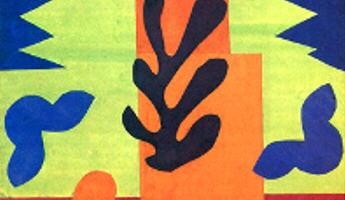
Les Codomas for Jazz, 1944
If that be the case, I am under the spell of Matisse’s color and hope to never be awakened.
Check out more of Matisse’s work at the MOMA website.
Thanks to our next door neighbor, who creates “sculptures” out of found objects and has a rotating display in his front & side yard, I’ve been thinking a lot about sculpture lately. Which has led me to discover an egregious error here at Artsy Forager and that is the incredible, unforgiveable lack of sculptural work on this blog! I am here to rectify the situation, beginning with one of my favorite contemporary masters, Constantin Brancusi.
Sleeping MuseBird in Space
In his work, Brancusi breaks down the forms of his subject into simple, geomtric shapes, so that the end result is less a representation of the actual subject, but rather the essence of the feeling that subject’s form evokes.
Mademoiselle Pogany, 1912The Newborn, 1920
The elegance of Brancusi’s lines and the restfulness and peace his forms suggest, even when depicting a screaming baby ( see The Newborn, above ), help to quiet my spirit. What about you? Any artists whose work “quiets your spirit”? Or maybe you’re not in to Brancusi ( and that’s OK ).. Whose sculptures do you love?