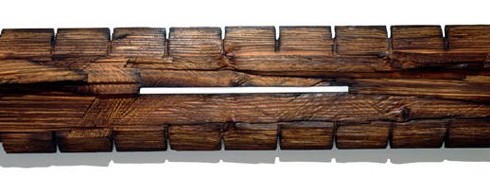
Here in the Northwest, the trees are so spectacular that they grab your attention and demand to be noticed and admired. St. Augustine, Florida artist Joe Segal’s work does the same. His sculptures are a celebration of these kings of the forest, their textures, patterns, their cycle of life.
Instead of a literal translation of branches and limbs, Joe instead chooses to focus on the core of what gives a tree its strength, character and economic value, the hard, fibrous wood.
By cutting, stacking, carving, painting, even burning the wood, Joe re-envisions the pattern of the tree’s life. He takes the normal processes for which and by which wood is harvested and calls our attention to the beauty of the materials in their simplest forms.
The steel used to cut the tree becomes instead, the connecting force that holds the wood together. Pieces of stacked wood, recalling a firewood pile, are juxtaposed with charred wood creating an interesting “before and after” effect.
Working with the nature of the materials, rather than against them, going with the grain, if you will, Joe is exploring the rhythms of the natural world and reinterpreting them into beautifully designed works of art.
To see more of Joe’s work, check out his Pick of the Crop page here at Artsy Forager, where you’ll find a link to his website. I hope you love it as much as I do.
Thanks to our next door neighbor, who creates “sculptures” out of found objects and has a rotating display in his front & side yard, I’ve been thinking a lot about sculpture lately. Which has led me to discover an egregious error here at Artsy Forager and that is the incredible, unforgiveable lack of sculptural work on this blog! I am here to rectify the situation, beginning with one of my favorite contemporary masters, Constantin Brancusi.
Sleeping MuseBird in Space
In his work, Brancusi breaks down the forms of his subject into simple, geomtric shapes, so that the end result is less a representation of the actual subject, but rather the essence of the feeling that subject’s form evokes.
Mademoiselle Pogany, 1912The Newborn, 1920
The elegance of Brancusi’s lines and the restfulness and peace his forms suggest, even when depicting a screaming baby ( see The Newborn, above ), help to quiet my spirit. What about you? Any artists whose work “quiets your spirit”? Or maybe you’re not in to Brancusi ( and that’s OK ).. Whose sculptures do you love?
Yesterday I went out searching for some artsy inspiration in the area around Aberdeen. I’m sorry to say that, though I visited a couple of galleries in Ocean Shores, I found only one artist’s work that caused me to take a second look. Unfortunately, most of what was there was pretty touristy, not-great-art-but-there-must-be-a-market-for-it kind of stuff. So I came home feeling a tiny bit defeated.
To give myself a pick-me-up, I watched an episode of So You Think You Can Dance ( guilty pleasure confession time! ). While the commercials were playing, I found myself glancing out of the windows of my office/studio and found myself inspired. So I started sketching– for the first time in a long time. It turns out I did find some artsy inspiration yesterday, from a surprising combination, the view of Aberdeen out of our windows and my own inner spirit.
So today, we’re celebrating other artists who’ve inspired me to make the most out of my current view! On with the show!
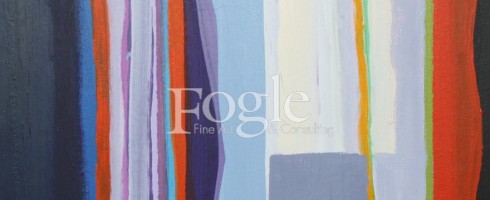
Vertical Horizontal Break I by Hamish MacEwanEarly Morning Breeze by Camille EngelWindowpane by Sharon SprungParthenon I by Lisa Ernst
Hope you all have a fantastic weekend! Take the time to enjoy your view, whatever it may be.
A polarizing persona in the art world, Jackson Pollock, called “Jack the Dripper” by some, figured largely in the Abstract Expressionist movement in America. His work is such of the “love it” or “hate it” variety and it can often strike a chord with those who least expect it.
Untitled, No. 3 by Jackson Pollock
I remember taking a basic Art Appreciation class early on in college, with a good friend from high school. Said friend was very conservative in most aspects and usually preferred the more realistic artwork we studied– but she loved Pollock’s work. There was just something about it that she responded to.
Untitled, No. 8 by Jackson Pollock
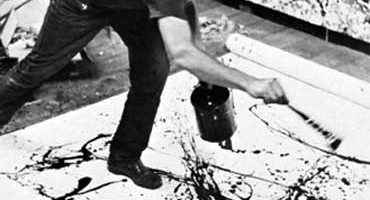
Pollock’s process, referred to as “action painting”, involved several aspects that were innovative at the time– Pollock laid his canvases unstretched out on the floor, instead of stretched on an easel, utilizing household paints instead of more traditional oils and instead of brushing the paint on, dipped whatever was on hand into the paint and then slashed & dripped it onto the canvas.
Green Silver by Jackson Pollock
I remember being intrigued by Pollock and his work, but it wasn’t until I saw one of his pieces up close & personal, in an Abstract Expressionist exhibition at the Cummer Museum in Jacksonville, that I truly became a fan. Seeing the monumental scale of the work, the depth of the paint and being able to recognize that yes, there truly was a method to his madness in all those drips and splatters, sealed the deal for me.
I know it’s been quiet around here the last few days. George & I are down to less than two weeks left in Florida and things are getting a bit harried. But I didn’t want to skip this Friday Faves, due to its importance. Unless you’ve been living under a rock, you’ve seen the headlines that earlier this week US Navy Seals found and killed 9-11 mastermind Osama Bin Laden. While I am glad that this evil has been removed from the world, I would prefer to focus attention on those who give their lives so that we may be free. So, here are a few favorite images that, for me, evoke the emotion of what it means to risk your life so that others gain freedom.
CONFESSION TIME: One of my biggest pet peeves is artwork hung incorrectly. And by this I mean too high, too low, staggered when there is no reason for staggering ( i.e., up a staircase wall ), etc. While there are no set rules when it comes to hanging artwork, there are guidelines. Knowledge is power, ya’ll, and you’ll thank me for it when my eyes aren’t twitching uncontrollably when I come over and see how your artwork is hung. I’m too polite to say anything, though.. I am a Southern girl, after all.
Guideline #1: Normal height for hanging artwork is to center it at eye level.
But whose eye level? You may be 4’11” but your husband is 6’4″– how do you decide? Law of averages, my friends. I’m 5’5″ ( ok, 5’4 1/2″ ), so my eye level is actually spot on. The safest height at which to hang artwork is 60″ from the center of the artwork to the floor.
Guideline #2: Use picture hooks and D-rings for hanging whenever possible
Plain ol’ nails might be super cheap, but picture hooks are the best way to go to get your artwork to hang levelly and securely. The weight of a piece of artwork will drag down a nail, but the picture hooks are designed to set the nail at an angle so that the laws of physics hold the picture up, instead of putting all the weight on the nail. There are different size hooks available according to the weight of what you’re hanging, so if you’re in doubt about the weight, go with the heaviest weight hook so you’ll be sure your artwork won’t fall on someone’s head.. or toes.
D-rings are God-sends for hanging artwork and should be used instead of wire, if possible. Simply install two d-rings at the same horizontal level on the back of the picture frame. It’s true, you’ll need to put two holes in the wall instead of one, but your artwork will be more secure and won’t have that annoying habit of going crooked anytime it get’s bumped a little or someone closes a door a bit too hard.
Guideline #3: When hanging multiple pieces together, be aware of the space between them and how they relate to each other
If you’re hanging a pair or series of artwork above a piece of furniture, measure and treat the pieces as if you were hanging one solid piece– taking into account a bit of space between them and center the overall size horizontally above the furniture and center each piece vertically at 60″.
Guideline #4: Some rules were made to be broken
Not Guideline #2, the picture hook thing is always important, not just for aesthetics, but for safety. The other two, however, might be flexible depending on the situation.
Broken rule #1– It is OK to hang artwork lower ( or higher, I guess, though this is less common ) than eye level if it helps the work relate to its surroundings
Broken rule #2– Sometimes extending a grouping of work outside of the borders of a piece of furniture or other furnishing helps the artwork to make more sense within the room, as in the case of the room below. In this instance, more is more, yes?
Broken rule #3– The rules are, there are no rules.. Sometimes the positioning of artwork doesn’t really need to relate to the surroundings at all.. randomness & asymmetry can be beautiful! If done well, of course.
If you ever find yourself unsure of how to hang your latest acquisition, I hope these guidelines are helpful. If you’re really stuck, drop me a line– I’m happy to help! Happy hanging!
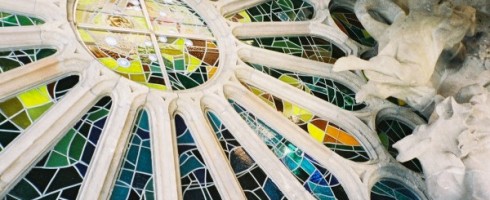
In my daily reading of Artinfo.com this morning I came across two articles, seemingly unrelated, until the Facebook comments regarding one of the articles tied them together for me. The first article, found here, poses the question, “Should Gaudi’s Sagrada Familia Remain Unfinished?” The Barcelona basilica, begun in 1882 by renown artist-architect Antonio Gaudi is still under construction eighty-five years following the architect’s death.
Though Gaudi left plaster models and drawings, many of his notes were destroyed during the Spanish Civil War, leaving his vision open to interpretation by current sculptors, architects and designers. While some critics feel the current direction doesn’t jive with Gaudi’s original vision, even during his lifetime, there were many sculptors working on the basilica. Like any monumental undertaking, “it takes a village” to bring Gaudi’s creation to life.
Should Gaudi’s original design be so open to interpretation? He gave artistic license to those working under him while alive, would he so object to modern interpretations now being imposed? Unlike other types of sculpture, cathedrals are often the product of centuries worth of work by multiple architects, artists and craftsman.
As Gaudi was aware he would not be alive to see it to completion, wouldn’t he have known his original design would be open to interpretation by those who came after him? Does the fact that Gaudi is not here to personally oversee the work negate the additions?
Artists using apprentices and assistants is nothing new. The art world of the Renaissance era, which produced such celebrated masters as Michelangelo and DaVinci was built upon the concept of apprenticeship. But what about now? The second article I read this morning was regarding the approval of a Dale Chihuly museum at the site of a former amusement park in downtown Seattle ( now the Seattle Center ).
The museum in itself is the subject of controversy, but that isn’t what I’d like to address here. Instead, I’d like direct attention to another Chihuly controversy– his use of others to craft his designs. One Facebook poster thought it necessary to point out that since losing the use of his left eye due to a car accident, he is no longer the person actually blowing the art glass he is so famous for. ( In reality, Chihuly continued to blow glass for three years following the accident, until a body surfing incident dislocated his shoulder, so he was no longer able to manually manipulate the glass ). The poster’s statement that “His employees make everything. Just sayin’.” seems to somehow fault Chihuly for continuing to create in the only way he physically could, by having others help him. The artist himself has said that his role, more of a director, allows him better perspective on the work.
As stated above regarding Gaudi, the practice of using assistants and apprentices to create monumental works of art has been done for centuries ( and yes, many of Chihuly’s creations are monumental in scope ). So as long as the artist himself continues to design the creations with his name on them, what’s the big deal?
And what about so-called “production originals”? You might be thinking of the ones advertised as “hand painted original works of art”, usually being sold out of a hotel ballroom. But what I’m talking about are the production art studios– where perhaps one “lead artist” is creating original works of art, which are then being recreated & reproduced by the hand of “assistant artists”. There are more of these studios around than people realize and the work can be found in galleries, corporate and private collections all over the world. While the savvy gallerist, art consultant, designer and art afficionado knows production art when they see it, what about the collector who thinks they are buying a true original work of art, only to spot an almost exact replica when in their hotel while on vacation in Hawaii? Do we lump Chihuly in with these?
These are three examples of artwork being completed and accomplished without the direct hand of the creator. What are your thoughts? Is it ever OK to put your name on something you didn’t actually physically create? This is definitely a gray area.. would love to hear your thoughts!
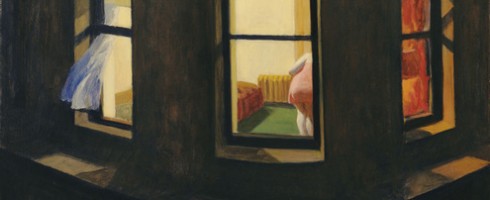
Happy Monday, Artsies! Hope everyone had a wonderful holiday weekend. This week’s Masterworks Monday artist is one of my all-time faves, American Realist painter Edward Hopper. A feeling of melancholy tends to pervade most of Hopper’s work, but maybe that is why they appeal to me. His scenes seem so very real, not just in their sense of time and of place, but in the capturing of a moment. Early mornings in small towns DO feel desolate, being an attendant at a gas station on a far off country road WOULD be lonely.
Despite the lone figures or desolate landscapes, Hopper’s images are filled with light and in that, create a sense of hope within the isolation. Early morning means it is a new day.. light coming in a window means that there is an escape from the darkness. Whether this is what Hopper intended or not, it is what I personally take from his work.
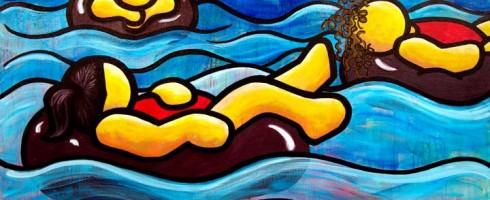
A little girl with brown pigtails makes a trip with her family to Colombia and there, befriends two chickens. And so begins the story of “What Happened to the Chickens?”, the latest exhibition of Yvonne Lozano’s work at The Art Center in Jacksonville.
Yvonne Lozano’s work is autobiographical, each painting telling the story of a particular childhood memory or even just the memory of the feeling of being a kid. Upon first glance at her style, you may think “A child could have done that”, which is exactly the point! Her simple, faceless figures look initially like a child’s creation, but look a little more closely and you will see a layering of glazes and accomplished drawing skills.
Yvonne has created a storyboard format for these works, some finished paintings, some watercolor sketches, so that it seems that you are “reading” a book in progress. The small sketches reiterate the childlike quality to the work and the “story” itself reads like a wonderful children’s book! ( I personally think it is only a matter of time until we see Yvonne as a children’s literature author & illustrator! ).
“What Happened to the Chickens?” is a story after all, so I don’t want to give too much away. If you’re in Jacksonville, please make some time to visit The Art Center gallery downtown to see & “read” this charmingly familiar childhood story.
The Art Center Cooperative gallery space is located at 31 W. Adams Street in downtown Jacksonville, FL. Gallery hours are Tuesday through Saturday, 11am-3pm.
To see more of Yvonne’s work, visit her website, YCLArt and be sure to “fan” her Facebook page!
OK, the fashion loving girl in me is coming out! Check out this amazing show opening at the Legion of Honor in San Francisco. “Pulp Fashion: The Art of Isabel de Borchgrave” is a study in fashion and sculpture, meticulously recreating garments from the annals of art history out of paper. Wonder if George will let me take me a detour through San Fran on our trip to the NW?