Category: Artsy Abroad

  • Artsy Abroad. The Bottega Tours Venice.

    Artsy Abroad. The Bottega Tours Venice.

    Hiya, Artsies!  Artist Candice Smith Corby recently took a group of students on a little artsy tour of Venice and is here to share her experience with you!  I’ll be checking in and letting you know what’s been happening in my world soon, I promise.  Without further adieu, here’s Candice!

    I was delighted when asked to do a guest post for the Artsy Abroad column!

    Recently, my colleague, Bill Pettit, and I led a cultural and artistic tour in Venice, Italy. We’ve been partnering up over the last couple of years through our arts collective, The Bottega, to offer fresco painting in Italy for students, as well as collaborate on projects that revolve around our shared interest in pigment and material origins. With the sea being so influential, we decided that watercolor painting and the cuisine of the Veneto region would be ideal themes for our workshop in Venice. It was also a great opportunity for us to share what we love- art, travel and good food!

    Artsy Abroad. The Bottega in Venice. | artsy forager #art #travel #venice

    Venice or La Serenissima as it is lovingly known, is magical and undoubtedly one of the most serene cities in the world. There are no cars on the island and you quickly become accustomed to a more humane speed of life than we are normally used to. The pulse of the city, which actually feels much more like a large close-knit town, is dictated by your own heartbeat. Everyone walks, especially Venetians, and even though the Grande Canal is a highway of motorized boat traffic, the hundreds of small interlacing canals are quiet and much less travelled. The combination of silent footsteps, a slower pace, and an ancient city plan with its small-scale architecture, makes it easy to suspend time.

    In addition to sampling the local flavor of Venetian dishes and expressing a particular moment through paint, we also wanted to offer an experience beyond a typical tourist’s visit to Venice. Piazza San Marco was certainly on our list but the surprises found around an empty corner or the restaurant where all the gondoliers seemed to be having lunch were our favorite finds.

    Artsy Abroad. The Bottega in Venice. | artsy forager #art #travel #venice

    We avoided the crowds and chose canals with their small bridges to sit and paint the light as it changed across the water’s surface.

    Artsy Abroad. The Bottega in Venice. | artsy forager #art #travel #venice

    The act of observing with all of your senses while you are painting alfresco can whet your appetite and we enjoyed finding a nearby bàcari for cicchetti and a Spritz to rejuvenate ourselves. [A bàcari is a small wine bar to have cicchetti, which are little plates of yummy food.  A typical drink is the Venetian Spritz- made with prosecco and a splash of Aperol.]

    Artsy Abroad. The Bottega in Venice. | artsy forager #art #travel #venice

    Our workshop also allowed us to share our personal research and experiments on historical pigments, which often have direct links to ingredients in the kitchen; such as the way chicken bones can be fire roasted and ground to make a bone white pigment. With the sea nearby, we chose to show how the ink sac from a cuttlefish (or seppia in Italian) has been used for Sepia ink for hundreds of years and is also commonly used as a food colorant. We spent the morning visiting and painting at the famous Rialto markets where we also gathered ingredients for a communal dinner. Later that night, Bill and I made our guests various dishes such as fried anchovies and sardines, octopus salad, and of course Risotto al Nero di Seppia.

    Artsy Abroad. The Bottega in Venice. | artsy forager #art #travel #venice

    In addition, artist Luca de Gaetano who teaches at Boston University’s Venice studio arts program graciously invited us to spend an afternoon talking about natural pigments including cochineal, verdigris, and saffron, while doing an egg tempera demonstration.

    Artsy Abroad. The Bottega in Venice. | artsy forager #art #travel #venice

    Our last day was spent visiting a couple of the other islands in the lagoon. Although we ended with Murano, famous for its glass-blowing factories, we began on quiet Torcello. The original inhabitants of Venice settled here and you will find their marvelous Cathedral of Santa Maria Assunta preserved there. It dates from the 6th century with glorious 9th century mosaics that feel oddly medieval and contemporary at the same time. As we all painted in the courtyard, each of us immersed in the pleasure of looking, we were acutely aware of the layered centuries that surrounded us.

    Artsy Abroad. The Bottega in Venice. | artsy forager #art #travel #venice

    Perhaps because it was our final day together, or because the sunlight was perfectly warm, and perhaps because we all realized how lucky we were, this was the highlight of our tour.  To quote one of our participants–

    “I see it as a movie, with disparate characters, a lot of philosophy, wit and humor,…culminating in Torcello, where the meaning of life, destiny, faith, and human interaction at its best was evident in our conversation, silent and vocal communication. What a gift!”

    While next year the world famous Biennale will be part of our itinerary, we’ll continue to take you off the beaten track, letting the magic of Venice slow you down to paint a sunrise over the lagoon, listen to un-ending church bells, and discover your own newfound delicacy from the sea.

    Artsy Abroad. The Bottega in Venice. | artsy forager #art #travel #venice

    Thank you so much, Candice for sharing your Venetian experience!  I don’t know about you, Artsies, but I’m ready to book my 2015 trip this minute!  For more information on The Bottega and next year’s trip, check out The Bottega website and look for updates on their Facebook page.

    Images courtesy of The Bottega and Emily Cure.

  • Artsy Abroad. In Situ: Spiral Jetty and the Utah Salt Flats.

    Artsy Abroad. In Situ: Spiral Jetty and the Utah Salt Flats.

    by Stephanie Clark

    The scale of the Spiral Jetty tends to fluctuate depending on where the viewer happens
    to be. Size determines an object, but scale determines art. A crack in the wall if viewed
    in terms of scale, not size, could be called the Grand Canyon. A room could be made to
    take on the immensity of the solar system. Scale depends on one’s capacity to be
    conscious of the actualities of perception.

    From the center of the Spiral Jetty
    North—Mud, salt crystals, rocks, water
    North by East—Mud, salt crystals, rocks, water
    Northeast by North—Mud, salt crystals, rocks, water
    Northeast by East—Mud, salt crystals, rocks, water
    East by North—Mud, salt crystals, rocks, water
    East—Mud, salt crystals, rocks, water
    East by South—Mud, salt crystals, rocks, water
    Southeast by East—Mud, salt crystals, rocks, water
    Southeast by South—Mud, salt crystals, rocks, water
    South by East—Mud, salt crystals, rocks, water
    South—Mud, salt crystals, rocks, water
    South by West—Mud, salt crystals, rocks, water
    Southwest by South—Mud, salt crystals, rocks, water
    Southwest by West—Mud, salt crystals, rocks, water
    West by South—Mud, salt crystals, rocks, water
    West—Mud, salt crystals, rocks, water
    West by North—Mud, salt crystals, rocks, water
    Northwest by West—Mud, salt crystals, rocks, water
    Northwest by North—Mud, salt crystals, rocks, water
    North by West—Mud, salt crystals, rocks, water

    The Spiral Jetty (Arts of the Environment, edited by
    Gyorgy Kepes, 1972) as written by Robert Smithson from
    The Writings of Robert Smithson. Edited by Nancy Holt,
    1979

    Artsy Abroad. Artist Stephanie Clark shares her experience painting at Robert Smithson's Spiral Jetty | artsy forager #art #artists #spiraljetty #environmentalart

    After driving from New Mexico to Colorado, and through the night into Utah, the morning was clear as we made our way through golden fields. Hawks flew overhead, landing on fence posts. We drove onward onto graveled dirt roads, stopping the car to run on these roads and stretch our legs and arms in the expanse surrounding us. The September sky was crisp and clean.

    We drove on as the red road curved.

    We saw no one.

    Finally, in the distance a blueish gray line paralleled a pink line below it. Spiral Jetty was just below these visible lines. It appeared small from our aerial view. We parked and the three of us parted ways, bounding up the hill above, or toward the salt flats below. Everything was bright as the sun radiated off of the films of salt that covered the land.

    Artsy Abroad. Artist Stephanie Clark shares her experience painting at Robert Smithson's Spiral Jetty | artsy forager #art #artists #spiraljetty #environmentalart

    “Mud, salt crystals, rocks, water”, as Robert Smithson described in his 1972 essay on Spiral Jetty, were in every direction.

    Artsy Abroad. Artist Stephanie Clark shares her experience painting at Robert Smithson's Spiral Jetty | artsy forager #art #artists #spiraljetty #environmentalart

    Our dog ran far into the distance. A red dot running as if she were born to, yet at some point, the smell of salt became noxious for her senses. The salt was much too potent for her keen sense of smell. She came sprinting back to me and we walked Spiral Jetty together slowly and calculated.

    Artsy Abroad. Artist Stephanie Clark shares her experience painting at Robert Smithson's Spiral Jetty | artsy forager #art #artists #spiraljetty #environmentalart

    Darting back up the hillside, I set up my studio on the rocks near the car—which provided some minimal shade from the glaring sun. Here I painted.

    Artsy Abroad. Artist Stephanie Clark shares her experience painting at Robert Smithson's Spiral Jetty | artsy forager #art #artists #spiraljetty #environmentalart

    Figures appeared on the salt flats below. Appearing to be hiking in from another field. After some time three travelers appeared also via car. One man and two women, all from Belgium were curious about us. They were impressed by how very much our dog appeared to “enjoy art” and upon us asking revealed that they were taking a land art tour of the Southwest. I mentioned Erin Hogan’s book, Spiral Jetta, which was a resource for us as we planned our trip to Spiral Jetty and previously to Marfa, Texas.

    Artsy Abroad. Artist Stephanie Clark shares her experience painting at Robert Smithson's Spiral Jetty | artsy forager #art #artists #spiraljetty #environmentalart

    After being in the bright sun and intense heat from early morning until mid-afternoon we decided to move on. The colors of the salt flats had shifted displaying more pinks and washed out Payne’s grays than the deep silvers and slate blues of the morning.

    We moved on.

    Artsy Abroad. Artist Stephanie Clark shares her experience painting at Robert Smithson's Spiral Jetty | artsy forager #art #artists #spiraljetty #environmentalart

    Thank you so much, Stephanie, for sharing your experience of painting at Spiral Jetty!  I think I’ll start planning my own land art tour ASAP!

    Images by Stephanie Clark and Andrew Yost.

  • Artsy Abroad. Ni Nyoman Sani’s Balinese Studios and Art Spaces.

    Artsy Abroad. Ni Nyoman Sani’s Balinese Studios and Art Spaces.

    by Ellen C. Caldwell

    1. Sani studio 1Ni Nyoman Sani’s studio at Muja Art Studio, Sukawati, Bali. Photo courtesy of Ellen C. Caldwell and the artist.

    Over the past five months, Artsy Forager has been nice enough to welcome my guest posts about my arts residency in Bali. During this time, I have shared some of my favorite experiences, artists, studio visits, and reflections.

    To end this series on a high note, I saved the best for last. One of the nicest and most welcoming artists and people I met during my residency is woman named Ni Nyoman Sani. She welcomed me to her home, to Mother Art Space (then called Seniwati Art Space), and to her family’s shared creative workshop and gallery Muja Art Studio. Sani also helped to arrange multiple interviews with talented female artists ranging from internationally known painters like Mangku Muriati to younger emerging artists like Emy Triani and Ni Ketut Ratnasih.

    2. Sani studio 2

    Ni Nyoman Sani’s studio at Muja Art Studio, Sukawati, Bali. Photo courtesy of Ellen C. Caldwell and the artist.

    Part of Sani’s charm and charisma is that she seems to always put others first in such a generous and heartfelt way. She shied away when I focused questions on her, instead always insisting on highlighting the work of her fellow artists and family members.

    With this in mind, I am going to take a few moments introduce her work with Mother Art Space and her multi-generational family studio, and then I will share my interview with Sani about her own work and art practice, in order to turn the tables and reflect some of her light back onto her art, work, and passion.

    Sani collage

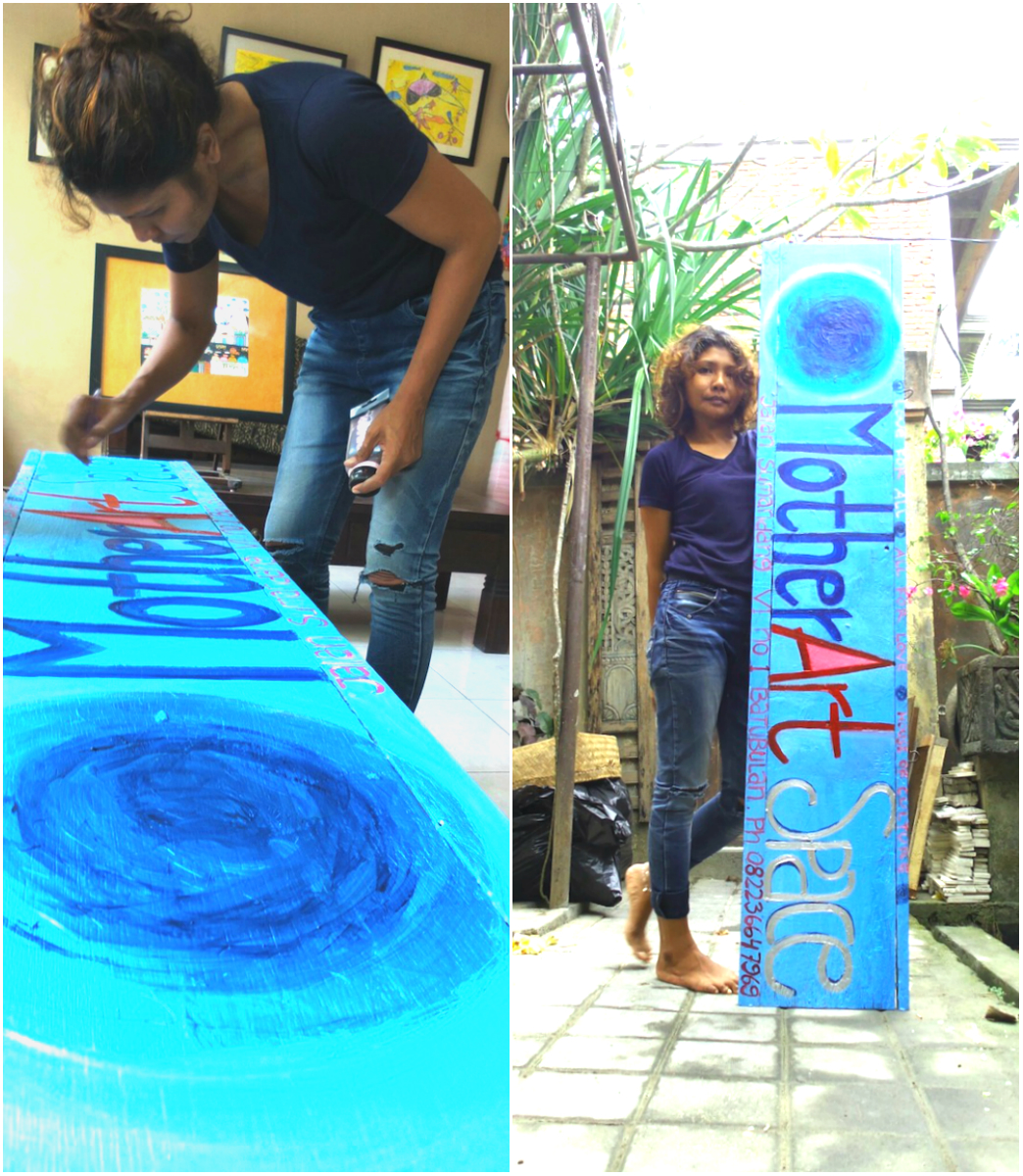
    Ni Nyoman Sani with new sign Mother Art Space, Batubulan, Bali. Photo courtesy of the artist.

    Mother Art Studio originally started as Seniwati Gallery in Ubud, and then later transitioned into Seniwati Art Space under Sani’s guidance and direction. There, she created a nurturing creative space that encourages collaborative workshops, exhibitions, and studio gatherings with women—both locally and internationally. In this sense, it is not just a gallery space, but a center for collaboration and shared support between women. Since there are not as many female artists practicing art in Bali (particularly in the more contemporary scene), this is really special and important.

    However, Sani has recently cultivated some new changes in the space, changing its name to Mother Art Space and casting a wider net of participants to include male and female artists of all generations. Sani felt that there was a wider group of artists she could reach if they expanded their scope in this way and they are now planning exhibits, collaborations, and international residencies there.

    Mother art space collage

    left | Façade of Muja Art Studio, Sukawati, Bali. Photo courtesy of the artist.

    right | Made Supena, Balinese stone, 2004. Muja Art Studio, Sukawati, Bali. Photo courtesy of Ellen C. Caldwell and the artist.

    Another endeavor Sani helps to manage is her multi-generational family art space called Muja Art Studio. Muja features the work of six family members from three different generations – including sculpture, painting, carving, performance art, and more.

    Kent Muja collage

    top right | Ketut Muja, Bhima, carved wood. Muja Art Studio, Sukawati, Bali. Photo courtesy of Ellen C. Caldwell and the artist.

    top left | Ketut Muja, The story of knowledge, carved wood. Muja Art Studio, Sukawati, Bali. Photo courtesy of Ellen C. Caldwell and the artist.

    bottom right I Ketut Muja, The story of knowledge – detail.

    bottom left | Sculptural works by I Wayan Jana. Muja Art Studio, Sukawati, Bali. Photo courtesy of Ellen C. Caldwell and the artist.

    Here, there is a range of working studios and gallery spaces so that one can visit this creative center and see art in process in addition to the finished work on display. The studio is a delightful and inspirational place to visit, featuring the work of:

    • I Ketut Muja, sculptor, age 71
    • I Wayan Jana, sculptor, age 46
    • I Made Supena, painter and sculptor, age 42
    • I Ketut Sugantika Le Kung, painter, performer, and sculptor, age 38
    • Ni Nyoman Sani, painter, poet, clothing designer, and photographer, age 38

    Together, they are a family of artists showing their works internationally in exhibits ranging from locally in Bali and Jakarta, and going to Singapore, Australia, Spain, Holland, Belgium, and Germany.

    Supena collage

    left | Made Supena, The Mountain Series. Muja Art Studio, Sukawati, Bali. Photo courtesy of Ellen C. Caldwell and the artist.

    right | Made Supena, Embryo Series 2, Muja Art Studio, Sukawati, Bali. Photo courtesy of Ellen C. Caldwell and the artist.

    And last but not least, I would like to end by sharing my interview with Sani, as we discussed her work and process. Her paintings satisfy and explore a cosmopolitan sense – focusing on smart fashion, both international and Balinese. There is a clear strength in the women she depicts and after meeting Sani and learning about her work, this all makes perfect sense. She is all about supporting artists – both young and old, male and female, local and abroad. And it is a privilege to know her.

    Ellen Caldwell | When did you start painting/practicing your art?

    Ni Nyoman Sani | I started painting on canvas in 1990. I loved to paint from when I was a little girl. And I became a member of Seniwati Gallery in 1994, when it was in Ubud. I continued my education at the Art Institute in Denpasar from 1995 – 2000. Until now still acting with my art creatively and I also lead the Seniwati Art Space [now Mother Art Space, as of July 2014] and in the future, Muja Art Management.

    EC | Have you always painted or did family teach you?

    NNS | Art is my second soul, and none of my family is doing the same. I feel blessed with my art life and love to continue it, for giving and sharing some changes with other women.

    EC | Please tell me a little bit about your process. What is unique about it?

    NNS | I love to look at in every moment of life, and focus my eyes on people and what they do to grow up. Their life, especially the specifics…not too far from daily life. And all becomes unique and accumulates in my mind. At this time, then a new idea will follow in my art process.

    Studio collage

    left |  Ni Nyoman Sani’s studio at Muja Art Studio, Sukawati, Bali. Photo courtesy of Ellen C. Caldwell and the artist.

    right | Ni Nyoman Sani’, painting detail. Photo courtesy of Ellen C. Caldwell and the artist.

    EC | Do you have a signature style or look that is unique to you?

    NNS | I paint with my own style…fashion and women. And it’s become unique with the head cropping I do.

    EC | What are you currently working on? 

    NNS | I usually work with my ideas, and I love to combine poetry, art, photograph, fashion, and also video art…My husband always supports me, our children give us time, and our family mostly support it. My friends, we are always sharing about what we are doing to increase Balinese art.

    EC | How do you think that living in Bali has impacted your own artistic practice?

    NNS | Bali for me is a good place and all my life has been here. I am a totally Balinese woman. But part of myself belongs to the art world. I mean, I feel free to become who I am. But it is also hard, because I am a Balinese—with full social and traditional life.

    I enjoy my life; I have a kind husband, two children who understand my life, family who always back up me, and a lot of friends who really care about and love me.

    ***

    Many thanks to Sani for her creative inspiration and for all of the work she does to encourage and cultivate the arts in Bali.  Contact Sani to find out more about visiting her studios or applying for art residencies, workshops, and collaborations.

    To learn more about my time researching and writing about art in Bali and to see more of Sani and Muja Art Studio, please view the video below.

    Ellen C. Caldwell “Bali to Cali: Bridging the Distance through Writing and Art,” 2014. Produced by Kate Johnson and Michael J. Masucci, with support from Yayasan Bali Purnati Center for the Arts; 18th Street Art Center, Santa Monica; and the Los Angeles Department of Cultural Affairs.


    Ellen C. Caldwell is an LA-based art historian, writer, and editor. For links to all of her Bali-related writing (and future writings), please visit the Bali portion of her website.  Many thanks to Lesley for featuring my posts and welcoming my writing and creativity to find a home here these past five months.


  • Artsy Abroad. Toronto Island. The Deep at Night.

    Artsy Abroad. Toronto Island. The Deep at Night.

    by Stephanie Clark

    “I love going out of my way, beyond what I know, and finding my way back a few extra miles, by another trail, with a compass that argues with the map…nights alone in motels in remote western towns where I know no one and no one I know knows where I am, nights with strange paintings and floral spreads and cable television that furnish a reprieve from my own biography, when in Benjamin’s terms, I have lost myself though I know where I am. Moments when I say to myself as feet or car clear a crest or round a bend, I have never seen this place before. Times when some architectural detail on vista that has escaped me these many years says to me that I never did know where I was, even when I was home.”

    -Rebecca Solnit, A Field Guide to Getting Lost

    I arrived in Toronto, ON at well past midnight. The nights have become my most favorite times both on and off of Toronto Island, where I was a resident artist for the first two weeks of August at Artscape Gibraltar Point Centre for the Arts. I was greeted during my first twenty-four hours in my travels by painter, Genevieve Robertson, carpenter and leather worker, Shane Trudell, and of course Finn, their trusty marble-eyed hound. Robertson is a community-based visual artist and painter who paints abstract landscape paintings. We first met in 2012, when we were in residence at The Homestead in Willow, Alaska. It was here that we bonded over a mutual obsession with Payne’s grey, mountains, migration, and abstraction. We began what is now a collaborative, durational project entitled Call and Response.

    Stephanie Clark, Artsy Abroad | artsy forager #art #artists #travel #paintings

    Binary, 2014

    As day became evening during my first twenty-four hours residing and working on Toronto Island, I made my way over to the Toronto Island Fire Parade, an annual celebration organized by Shadowland Troupe. By far, this had to be the best introduction to a locale and residency that I have encountered at this time. The fire had to be at least 25 feet tall, which, we arrived at after following a troupe of paper lantern wielding gymnasts who fire danced as a crowd of onlookers followed them to the beach. Later in the evening as young beach dwellers took to splashing in the blue-black lake, samosas in a pan rested over the coals of what once was the raging bonfire. The sparks flew up as we prodded the glowing coals with sticks and added logs to the fire to keep it going. Not that the fire needed much encouragement.

    Stephanie Clark, Artsy Abroad | artsy forager #art #artists #travel #paintings

    “Could you paint that campfire?” … “No, it is too beautiful.”, 2014

    Lake Ontario appeared to push forward, endlessly into the night, and the moon and stars were covered by clouds. Everything glowed orange, yellow, and red, as light reflections danced across the water’s surface. Everything was at once open and insulated. As I walked away from the fire that night and into the darkness, all felt surrounded in blackness and the soft sounds of laughter and ocean. My walk back to studio was shrouded in green leafy trees whispering softly as if in conversation with the waters that sloshed rhythmically in the distance. This was how my trip began and I thought of Alex Katz’s night paintings. Of temporality, ephemerality, the fleeting nature of night, and the intense shroud that night surrounds you in: a veil that encompasses both comfort and uncertainty.

    The days that followed were filled with planning and making. Robertson and I prepared ten works from our Call and Response series for the opening at Milk Glass Co. Since meeting at The Homestead, we had mailed each other small triangular paintings and responded to what was sent by the other. A result of this on-going durational project is some 40 sets of triangles that represent a painterly dialogue between Robertson and myself over the course of two years.

    Stephanie Clark and Genevieve Roberston, Call and Response | artsy forager #art #artists #galleries

    Exhibition install at Milk Glass Co., Toronto, ON, Canada
    Images courtesy Genevieve Robertson and Stephanie Clark

    Stephanie Clark and Genevieve Roberston, Call and Response | artsy forager #art #artists #galleries

    Exhibition install at Milk Glass Co., Toronto, ON, Canada
    Image courtesy Genevieve Robertson and Stephanie Clark

    I spent three days in Toronto aiding in the install of the show. After the opening and a few days spent in the city, I returned to the Island and my studio.

    The air on Toronto Island was often thick with water and rain. Through the tall windows of my studio at Gibraltar Point Centre for the Arts—which was once a classroom—I could see the full trees. As I made my way to the shore in the early mornings and late evenings, I watched the gulls migrate in traffic patterns across the skies while drifting on air currents. During these evenings, the sun receded into the horizon again and again and night beckoned. The fires along the beaches jumped and popped, exploding into the night’s cool and heavy air. These were nights filled with campfire smoke, hazy purples, murky blackish blues and clean, deep blueish greens that were bordered by horizons that seemed to stretch deeply. It is a darkness that at once retreats and pushes forward into the distance.

    Thanks so much, Stephanie for sharing your experience with us!  If you’d like to see more of Stephanie Clark’s work, please visit her website.  You can also read my thoughts on the Call and Response series in this post, just in case you missed it!

  • Artsy Abroad. The Plastic Elephant in the Room & Art in Bali Now.

    Artsy Abroad. The Plastic Elephant in the Room & Art in Bali Now.

    by Ellen C. Caldwell

    1. GFIVE-plastic rice fieldsG-Five, Plastic Attack, 2013 (rice fields installation view); plastic bottles and metal frames; 2 meters high. Courtesy of the Artists. Photo: G-Five Art Management.

    Something is in the air in Bali. As I was interviewing a long string of artists during my writing residency there, one topic that kept coming up was plastic and the environment. Several of the artists I met and interviewed brought it up specifically, while many others merely danced around the subject and spoke of the environment more vaguely.

    As time went on during my month’s stay, common themes and unifying strings clearly started to emerge between various artists and their work. But plastic and its place in our environment and culture was a big theme that I truthfully didn’t see coming. I consider myself an environmentalist (beginning with my dad’s teaching the Boy Scout rule to always leave your campsite [or hiking trail] cleaner than you found it, and leading all the way to my co-founding a residence hall recycling program at my university), so it wasn’t something I was unaware of or blind to, but I simply wasn’t expecting it.

    Many of the artists I met in Bali brought up the problems of plastic degradation in a plethora of ways – from painter Federico Tomasi’s aside about the rainwater run-off flooding the ocean with plastic from one-time-use packaging to Made Aswino Aji’s laments about the changing landscape of Bali with its tourist growth. Or, in Ketut Jaya Kaprus’ plans to feature an entire gallery exhibit about the dangers of plastic, while showcasing its redemptive and transformative power as art.

    Kaprus collage left | Ketut Jaya Kaprus, photo of Kaprus painting pillars made from found plastic bottles, 2014; paint on plastic bottles. Courtesy of the Artist.
    right | Ketut Jaya Kaprus, installation view of plastic bottle pillars, 2014; paint on plastic bottles. Courtesy of the Artist.

    I couldn’t ignore this recurring theme, but what intrigued me most was that the majority of the artists I spoke with were quick to un-identify with an environmental movement. Many artists informed me quite specifically that they were “not activists,” or god forbid, “environmentalists.”

    I wasn’t sure exactly where this fear of labeling was coming from, but what I did know was that all of this art spoke loudly with its impact and aesthetics (though at times ambivalently with its message), much like its creators. I think part of the fear for these painters must be that they would lose their title as “artist” if they were simply seen as an activists – a fear I can sympathize with. For years, I have had business cards that vary between self-identifying as a “writer” or “art historian” because I don’t want one label chosen over another. But, with these artists, it seemed there was something more brewing below the surface.

    So I decided to investigate some of the bigger, (non)environmental art projects I encountered in Bali.

    Gfive collage

    top | G-Five, Plastic Attack, 2013 (beach installation view); plastic bottles and metal frames; 2 meters high. Courtesy of the Artists. Photo: G-Five Art Management.
    bottom | G-Five, Plastic Attack, 2013 (gallery installation view); plastic bottles and metal frames; 2 meters high. Courtesy of the Artists and Tonyraka Art Gallery. Photo: G-Five Art Management.

    G-Five, a group of five younger artists on the contemporary art scene in Bali, has come together to produce a number of successful group exhibitions. Individually, they are artists in their own rights with unique styles and distinctive techniques, but together they aim to tackle broad and fluid subject matter and experimental work. All from Gianyar, a region known as the artistic capital of Bali, I Wayan Upadana, Wiguna Valasara, Made Gede Putra, Kadek A. Ardika, and I Wayan Legianta formed this talented group in 2009.

    In their 2013 show “Plastic Attack” at Tonyraka Art Gallery, G-Five focused on plastic as their medium, and in some respect, message. This followed a trend of their prior exhibitions wherein they had focused on using and featuring a specific medium, be it rubber, thread, wood, or resin.1  Here, they created and joined five large walls of plastic bottles. First they filmed and photographed these walls out in nature on the iconic shores of Bali and in the equally picturesque and emblematic Balinese rice fields. Then they moved this large wall structure and installed it in the front of the gallery, with backlights that made it feel more paranormal and artistic than a foreboding environmental message. Inside the space, one hallway was completely blocked off with an enormous inflatable bulbous plastic ball, made up of taped plastic and powered by a fan, timed to inflate and deflate as if it was a living, breathing creature. They also showcased installations of found dirt, layered with plastic debris and refuse from the rice paddies in Ubud. These cutout segments were made into spectacles and “ready-mades,” as they were displayed in pristine glass boxes that would more typically be reserved for a rare and valuable artifact.

    6. bali not for sale

    Bali Not For Sale, Bali Not for Sale, 2011; bamboo and acrylic signage. Courtesy of the Artists. Photo: Bali Not For Sale.

    Another art collective entitled Bali Not For Sale is comprised of three young artists from Ubud: Gede Suanda Sayur, I Wayan Sudarna Putra, Pande Putu Setiawan. In 2010, they used bamboo and acrylic paints to form large three-dimensional letters that spelled out “NOT FOR SALE” and installed these signs in the remaining rice paddies at Jl. Sriwedari, in the Junjungan rice fields of Ubud.

    These installations (and digital photographs of the installations that now float around the web) call attention to the growing number of residents who have sold their families’ rice fields to developers. Many families have been doing so to accommodate a growing hospitality industry, succumbing to the demand of the ever-growing tourist population, who would like to stay overnight and retreat amongst the picturesque rice fields in Ubud. Over time, these sales and developments have damaged a long-standing farming tradition in Bali, leaving families with a massive sum of money up front from property sales, but one that does not last over time or reap a steady income, as tending to the rice fields once did. Bali Not For Sale’s message is clear and humble, carrying visible force through art installations, “Bali is better simpler.  Paradise ‘soul and pride’ is not for sale!”2

    7. Suja-Plastic RhetoricWayan Suja, Plastic Rhetoric, 2011-2012; oil on canvas; 150 x 150 cm. Courtesy of the Artist and Tonyraka Art Gallery.

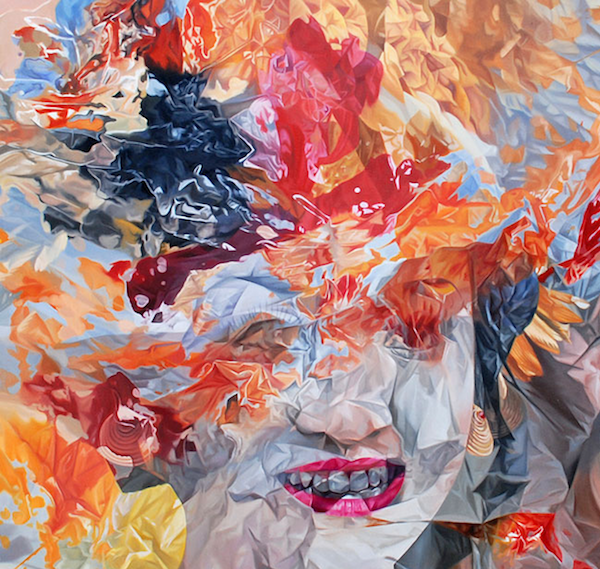
    Wayan Suja paints intimate portraits of people, but he separates their faces from that of the viewer with obtrusive veils of wrinkled plastic. This creates an opposing dynamic wherein the detailed and naturalistic portraiture draws viewers in and creates an intimate feeling and setting, while the plastic intercedes between the depicted sitter and the viewer, thus superseding the very subject of the painting. In many of Suja’s series such as “Plastic Rhetoric,” are the paintings about portraits or are they in fact about plastic as the titles would suggest? It seems that plastic is both the subject and non-subject of his work, as the viewer’s eye oscillates between focusing only on the plastic veil while also shifting only to the veiled face behind it.

    When I asked him about why he would use plastic in this way, Suja said he is not an activist. It is not about being for or against plastic, but about saying that plastic is here and using it quite literally as a lens through which to view the world. The figure wears traditional Balinese dress and is veiled in plastic so that she challenges what it means to be 100% Balinese. Suja compared it to the same way that he painted a Coca-Cola can in Untitled 2005. It is here; plastic is here; a Western influence is here in Bali and Suja is not saying that things need to remain traditional, but he is commenting and observing an ever-changing and adaptive culture.

    And perhaps this fluidity of culture is the real heart of the subject matter I had been dancing around all along. In an essay on G-Five’s show “Plastic Attack,” Wayan Seriyoga Parta writes that their dirt and trash installation shows “packaging repackaged.”3  And in my interview with Legianta and Valasara, they were quick to tell me that this show was about “art for art’s sake” and not about the environment. But to me (admittedly an American abroad bringing my own ingrained ideas in tow), it was hard to consider the exhibit without reading an environmental message. They explained that they were exploring “plastic as new media,” so that it is both a medium and experience.

    In light of Suja, Bali Not For Sale, and G-Five’s art and aims, perhaps these works are actually less environmental and more about influence. Truly a message and medium repackaged. And perhaps some of this work is less of a protest and more of a proclamation of prevalence. An “I see you,” kind of acknowledgement towards the impact, union, and delicate merger of Balinese and Western culture.

    8. Suja - Being a colorful balinese 3 Wayan Suja, Being a Colorful Balinese #3, 2012; oil on canvas; 160 x 150 cm. Courtesy of the Artist and Tonyraka Art Gallery.

    Ellen C. Caldwell is an LA-based art historian, editor, and writer.

    1 “Press Release: Plastic Attack,” GFiveArt.weebly.com, last modified October 13, 2013, http://gfiveart.weebly.com/plastic-attack.html

    2 “Bali Not For Sale: Biography,” Facebook: Bali Not For Sale, 2010, https://www.facebook.com/balinotforsale/info

    3Wayan Seriyoga Parta “Plastic Attack,” GFiveArt.weebly.com, last modified October 13, 2013, http://gfiveart.weebly.com/plastic-attack.html


    &nbsp

  • Artsy Abroad: On the Artistic Ledge with Federico Tomasi

    Artsy Abroad: On the Artistic Ledge with Federico Tomasi

    by Ellen C. Caldwell
    Federico Tomasi studio | artsy forager #art #artists #studios In my series of guest posts for The Artsy Forager, I have been writing about my time in Bali during an arts residency earlier this year. I was introduced to painter Federico Tomasi by another artist Giovanni Lovisetto on a trip to Bali in 2012 and upon my return, I was lucky to revisit Tomasi’s studio and discuss his current works.

    As many of us in creative fields know, artistic inspiration is always something of a process. As artists, we are constantly pursuing new creative styles, mediums, subjects, narratives, and voices. Through this process of searching for ourselves, we get used to the circle of finding our grounding, losing our footing, and continuously rebuilding our foundations.

    This process can feel painful, isolating, and challenging, but it can also offer creative redemption, freedom, and inspiration. As I discussed in an earlier essay The Writer’s Ledge, these moments on the creative “ledge” are simultaneously terrifying, jarring, and exciting, ultimately yielding the most creative and unique results. It was a joy to visit with Tomasi and discuss the pitfalls and roadblocks we all endure during the creative process—while also seeing the moving and dynamic results coming from this beautiful struggle.

    In discussing the beauties and beasts of the unknown, the cycle of returning back to our roots and formal training, and the bounty of this very endeavor, Tomasi and I explored the ongoing challenges that come with living the creative process.
    Federico Tomasi studio | artsy forager #art #artists #studios Ellen Caldwell | Please tell me about the large-scale, monumental portraits you are working on in your studio now.

    Federico Tomasi | The large, vertical-scaled portraits are simply the desire to make them have a monumental aspect even if they are paintings—more as sculptures, huge and oversized for a different perspective. The chromatic choice of colors goes from that marbled, transparent feeling to the copper and bronze. And of course the unusual dimension (3 meters tall and 1 meter wide) helped me to reach what I had in my mind. I actually like them leaned on the wall rather than hung so they look more three dimensional, as sculptures are. It’s still an open chapter for me so let’s see how it will end.

    Federico Tomasi studio | artsy forager #art #artists #studios

    EC | How do they differ from your previous bodies of work?

    FT | I don’t think those particular ones are very different from my previous paintings in terms of technique and apart from what I mentioned before, of course. There is a step forward or a research of something different, chromatically speaking, and there are more visible parts of the body instead of the close up facial portraits I used to focus on. There are so many elements that occur to me in this process so it’s a bit difficult to give a harmonic answer…
    Federico Tomasi studio | artsy forager #art #artists #studios
    EC | Who are you painting in your portraits now? Could you tell me a little bit about how you have chosen your current subjects or is it still too soon to discuss?

    FT | I really don’t know where I’m going right now! I’m trying different things at the same time and the subjects just come either from pictures or movies or my own sketches. I’m still waiting for that sparkle to arrive and a bit of anxiety made me just paint without thinking too much! I have been working on two large portraits of my grandmother who passed away last year. She was incredible, so that brought me to another level. I remember working day and night on those pieces as they where so personal to me. I painted them with oils, which also made it very intense.
    Federico Tomasi studio | artsy forager #art #artists #studios

    EC | We talked a lot about artistic background and training – how often an artist will learn to paint by copying and mimicking the masters. And you were saying that in some ways you felt like you had to return to this time and go back to more of your original training. What inspired you to move in this direction?

    FT | Well each artist has his masters and backgrounds to actually admire and learn from—it depends on your goal—for sure not by copying, but what I was saying was that there are skills when it comes to figurative art that have to be there and it’s important to feed those skills to be able to move on. I believe you have to know how to do things in a traditional way to be able to do something very different in the future. I guess it’s the technique that matters in my case… When I feel it’s time to move forward, I always start from some basic skills (traditional) and from there find my own direction

    EC | Where do you see yourself moving, having circled back to this original training? Do you see it taking you in an entirely new direction now?

    FT | I see myself in moment of transition—a bit frustrating when things are not always coming out how I thought. But that’s part of the game; persistence will take me to a new direction.
    Federico Tomasi studio | artsy forager #art #artists #studios EC | Yes, that’s part of the beauty and agony of the process, right? How has living and practicing your art in Bali impacted your work—or has it?

    FT | Unconsciously probably, it’s more the lifestyle—the freedom and the beauty everywhere that makes the difference but not more than that. Bali is not the same as when I arrived; the tourism and the development of businesses became very chaotic in the last years so it’s not really inspiring me anymore. And I’ve been here for 14 years almost so maybe it’s time to move again!

    EC | When did you first start painting and how did you learn or train?

    FT | My father was studying at the Academy of Arts in Stockholm when I was around eight years old and I was always surrounded by creative people, so that was my first introduction to that world. After I decided to study five years of art school in Rimini, Italy, and that’s where I started to take my first steps… I’m still learning and hopefully I will learn more in the future.
    Federico Tomasi studio | artsy forager #art #artists #studios EC | Regarding plastic in Bali, we discussed the over-packaging of products and how there is such a vast amount of plastic debris all over – in the rice paddies, on the streets, and filling the ocean and beaches after big rains… Could you discuss this a bit?

    FT |This is a global problem not only about Bali, and it’s very sad. It’s about a lack of education and personal responsibility towards mother nature. For sure there are solutions, but there are too many businesses involved to change unfortunately. It’s incredible, sometimes I manage to see such a perfection and beauty in nature compared to what we humans have been able to do …we are terrible! Sometimes I feel ashamed to be a human being.

    EC | Do you feel like you address this plastic problem as an artist or activist – or more simply just on an individual level?

    FT | It’s difficult as an individual to change the world but you can always be aware of things in your little microcosm. I collect stuff on the beach, just walking with my dog, for example. I do it even if I know it will not solve the problem, hoping someone sees and gets the message. I said before it’s all about education so let’s start ASAP. It will take a generation to change if we are lucky…
    Federico Tomasi studio | artsy forager #art #artists #studios
    Born in Stockholm, Sweden, Federico Tomasi began showing his work in 1997 after moving to Asia. Since then, he has shown internationally in Italy, Indonesia, Malaysia, Singapore, Lebanon, and the U.S.

    Ellen C. Caldwell is an LA-based art historian, writer, and editor. Read about her last interview with Tomasi in “History Revisited: Federico Tomasi’s Puputan Paintings” for New American Paintings.

    All images are courtesy of Federico Tomasi; all display works in progress in his studio.

  • Artsy Abroad, Ellen Caldwell in Bali: Ketut Jaya Kaprus, Made Budhiana, and Wayan Sunadi

    Artsy Abroad, Ellen Caldwell in Bali: Ketut Jaya Kaprus, Made Budhiana, and Wayan Sunadi

    by Ellen C. Caldwell

    In my guest post “Artsy Abroad: Fear, Frustration, and the Art of the Forage” last month, I described the time I spent at the beginning of the year in Batuan, Bali, seeking out artists to interview during a month-long arts writing grant. I was lucky to find an abundance of artistic inspiration during this time and am excited to share this with you now…

    1. Kaprus studio Ketut Jaya Kaprus’ studio in Batubulan, Bali, Indonesia. Photo by: Ellen C. Caldwell.

    One of the first artists I was introduced to was Ketut Jaya Kaprus. Kaprus brought a sampling of images and videos with him (see the video at the end of this post) and this meeting sparked a wonderful and ongoing conversation about art, the environment, and our artistic inspirations.

    Soon after this initial meeting, Kaprus invited me to his home studio in Batubulan and then to his friend Made Budhiana’s studio in Denpasar. I spent the day with Kaprus, Budhiana, another artist Wayan Sunadi, and my friend and translator Sudipa Yasa from Bali Purnati. Together, we discussed their experiences at art school, their artistic community and arts collectives in Bali, and their work.

    2. Kaprus offerings 3. example of offerings

    top | Ketut Jaya Kaprus, detail from one of offering paintings. Photo by: Ellen C. Caldwell.
    bottom | Kaprus’ examples of physical offerings, the inspiration for much of his work and color palette. Photo by: Ellen C. Caldwell.

    When I arrived at Kaprus’ studio, he began by showing me a handful of his smaller framed works – all of which were naturalistic in style and depicted detailed paintings of the daily offerings one sees all over Bali. As a Hindu priest in his home village, Kaprus is inspired and motivated by traditional Balinese customs and ritual symbols – all of which he incorporates into his work. These smaller paintings beautifully capture the details of the offerings that are an integral part of everyday life in Bali. Kaprus became interested in making these offerings at a young age, and later, he began transforming the physical offerings into representations of them as well.

    AA_Kaprus studio collage

    left | Interior of Kaprus’ studio in Batubulan. Photo by Ellen C. Caldwell
    right | Kaprus painting in his studio during the interview. Photo by: Ellen C. Caldwell

    Besides these realistic paintings, Kaprus is more known for his loud, colorful, and abstract paintings. Monumental and larger than life, in many cases, these paintings covered every inch of his walls—a physical symbol of the way in which art and the creative process takes up every aspect of his spiritual and psychic being. Seeing both of his painting styles together shows how the colors and symbology from the offerings are the literal inspiration for and translation of the larger abstract paintings. In this way, the smaller works shed a light on the meanings and jumping off points for his larger works.

    After a wonderful studio visit and interview with Kaprus, we headed to Budhiana’s studio in Denpasar. Simply put, Budhiana’s studio is the stuff of dreams.

    6. exterior of Budhiana studio

    The entryway to Made Budhiana’s studio in Denpasar. Photo by Ellen C. Caldwell.

     A large, two-story barnlike structure, it has all the right lighting, large open spaces for his huge canvases, an amazing sound system and movie projection setup, books and music to inspire the mind, and art to inspire the senses.

    9. Budhiana studio 3
    Budhiana is an established international artist and he sees part of his role in Bali as being a mentor for fellow artists. He invites artists to apply for short residencies to share his lovely studio space while working on their own practice. He is also a lover of classic rock, so much of our day was cast to a soft pulsing soundtrack of Hendrix, Zeppelin, and Clapton: an undercurrent, as if the studio’s lifeline.

    AA_Budhiana studio collage

    left | Inside Budhiana’s studio. Photo by: Ellen C. Caldwell.
    right | Inside Budhiana’s studio. Kaprus, Sunadi, and Yasa pictured from left to right. Photo by: Ellen C. Caldwell.

    Budhiana’s work is generally large (a minimum of about 4-6 feet wide) and very colorful. Steady lines of bright reds, yellows, and oranges pack the canvases’ frames and tell a larger story. Humor and visual narrative, both large and integral parts of Balinese culture, are as much his medium as the paint and canvas themselves. Their friend and colleague from Indonesian Institute of the Arts Yogyakarta (Institut Seni Indonesia Yogyakarta/ISI Yogyakarta), Wayan Doel Sunadi, was also there to show me his paintings. Sunadi’s work takes the comedy up a notch too, as he plays around with humorous subjects and viewers’ expectations for contemporary Balinese painters (as with Mystery of Sunglasses).

    AA_Sunadi collage

    left | Wayan Doel Sunadi, Mystery of Sunglasses ( detail ), 140 x 200cm, mixed media on canvas, 2013. Photo courtesy of the artist.
    right |  Wayan Doel Sunadi, Tarbang, acrylic on canvas. Photo courtesy of the artist.

    12. Budhiana studio 4

    A final interior of Budhiana’s studio. Photo by Ellen C. Caldwell.

    None of these artists paint in the older, traditional Balinese styles in any conventional sense, but they all show their artistic roots in different and distinct ways. Through symbology, humor, and narrative, they all ground their practices in older and existing elements of Balinese painterly traditions and themes while experimenting with new and distinct styles that highlight contemporary Balinese culture.

    Ketut Jaya “Kaprus”: Artwork and Inspiration from eclaire on Vimeo.

    “Ketut Jaya Kaprus: Artwork and Inspiration,” 2014, Film director and editor: Dadi Reza Pujadi, Music by: Jeff Schmidt: live solo, and Marcus Miller: solo bass, A Free Parking Working Film. Video posted courtesy of the artist.

    Are you loving these little virtual foraging trips through Bali as much as I am?  Thanks so much to Ellen for sharing her adventures and to the artists for opening their studios.  More to come from Ellen next month!  

    Are you an artist, arts writer, or blogger who is planning a residency or trip abroad and would like to share your own Artsy Abroad story?  Shoot me and email via the Contact page and let’s chat!  

  • Artsy Abroad: Fear, Frustration & the Art of the Forage

    Artsy Abroad: Fear, Frustration & the Art of the Forage

    Oh Artsies, have I got a treat for you!  Can you imagine traveling to a tropical locale solely for the purpose of meeting and discovering artists?  Sounds like an exhilarating heaven to me!  That’s exactly what arts writer Ellen Caldwell did and she will be guest foraging in a new Artsy Abroad column and sharing her discoveries with us!  You can read more about Ellen here.  Now let’s see some of the fruits of her Balinese artsy foraging!

    Artsy Abroad | Ellen Caldwell #art #artists #travel #bali

     The Lush Yayasan Bali Purnati grounds hosting the writer’s arts residency. Photo by Ellen C. Caldwell.

    In February of 2014, I departed for Bali on a month-long arts writing residency, sponsored by the Los Angeles Department of Cultural Affairs. This residency included a month’s stay at the beautiful, lush grounds of Yayasan Bali Purnati – and when I arrived I could tell it would be magical.

    My grant proposal laid out my goals of scouting local artists in the contemporary scene, interviewing them, and writing about them. I proposed to use my writing to make a small bridge between the art of LA (my hometown-with-my-heart) and Bali. When I found out I had won the grant, I was ecstatic until it dawned on me that I did not have a any real plan for finding artists there – at all.

    Artsy Abroad | Ellen Caldwell #art #artists #travel #bali #artiststudio

    Federico Tomasi’s studio and untitled puputan series, featured in New American Painting’s “History Revisited: Federico Tomasi’s Puputan Series” after Caldwell’s trip to Bali in 2012

    Knowing from my experience with arts writing, whether here in LA or abroad on previous trips to Australia and Bali, though, I rest assured that I would find the artists, or that the artists would come to me. And as it happened, something right in the middle of those two potential outcomes occurred…

    My first week there, I spent my days rising early to write – first just opening thoughts about traveling and leaving home and then the more arduous task of scouting artists to meet in my coming weeks. I decided to use a three-prong approach: email gallerists I found online, reach out to artists I liked individually via social media outlets like Instagram and Facebook, and ask friends of friends to put me in touch with people. Sounded like a great plan, right?

    Flash to two weeks later, though, and I had one interview on the books. An emotion that lay somewhere between fear and frustration was starting to sneak up on me.

    Thankfully, I met a couple of artists and one gallerist who ended up acting as artistic hubs for me, putting me in touch with other artists, and serving as the key (saviors) to my success in artsy foraging abroad.

    Artsy Abroad | Ellen Caldwell #art #artists #travel #bali #artstudios

     Made Budhiana’s beautiful and airy studio in Denpasar.  Photo by Ellen C. Caldwell.

    First, I was introduced to artist Ketut Jaya Kaprus. He then introduced me to the famed Made Budhiana and talented Wayan Sunadi. I spent a day at Kaprus’ studio and then at Budhiana’s ethereal, light-filled barn-like studio, listening to classic rock, playing with puppies, and talking about art.

    Artsy Abroad | Ellen Caldwell #art #artists #travel #bali #artstudios

    Ni Nyoman Sani’s studio space at her family’s Muja Art Studio. Photo by Ellen C. Caldwell.

    Next I met the talented, gracious, and contagiously happy Ni Nyoman Sani of Seniwati Art Space. She introduced me to three more wonderful female artists including Komang Emy Agustriani, Ni Ketut Ratnasih, and the eminent Kamasan-style painter Mangku Muriati. Sani also showed me around her family’s art collective, Muja Art Studio. Here, three generations of family members work in their studio and gallery spaces to showcase their work, ranging from paintings to sculpture to carving.

    Artsy Abroad | Ellen Caldwell #art #artists #travel #bali #artgallery

    Paintings by Ketut Teja Astawa and I Made Wiradana showcased at Tonyraka Art Gallery in Mas, Ubud. Photo by Ellen C. Caldwell.

    And finally I met Tony Hartawan, owner of Tonyraka Art Gallery, who helped me to line up interviews with six artists represented in his gallery, including Ketut Teja Astawa, I Made Wiradana, and Wayan Suja. I also reconnected with painter Federico Tomasi whom I had met on my first trip to Bali, about 16 months prior.

    Through this international foraging foray, I was able to explore artworks I would have never otherwise seen and get to know artists I would have never otherwise met. In a nutshell, it was an aesthetic experience of a lifetime.

    6. Kaprus

    Ketut Jaya Kaprus painting Caldwell’s portrait in his studio in Batubulan. Photo by Ellen C. Caldwell.

    9. Tomasi studio

    Federico Tomasi’s studio space and current projects. Photo by Ellen C. Caldwell

    My next guest posts will more fully explore the art and studios of Ketut Jaya Kaprus and Made Budhiana, Ni Nyoman Sani and her family’s Muja Art Studio, and Federico Tomasi’s current projects – and I look forward to having all of you fellow artsy foragers along for the ride!

    All image credits listed above.