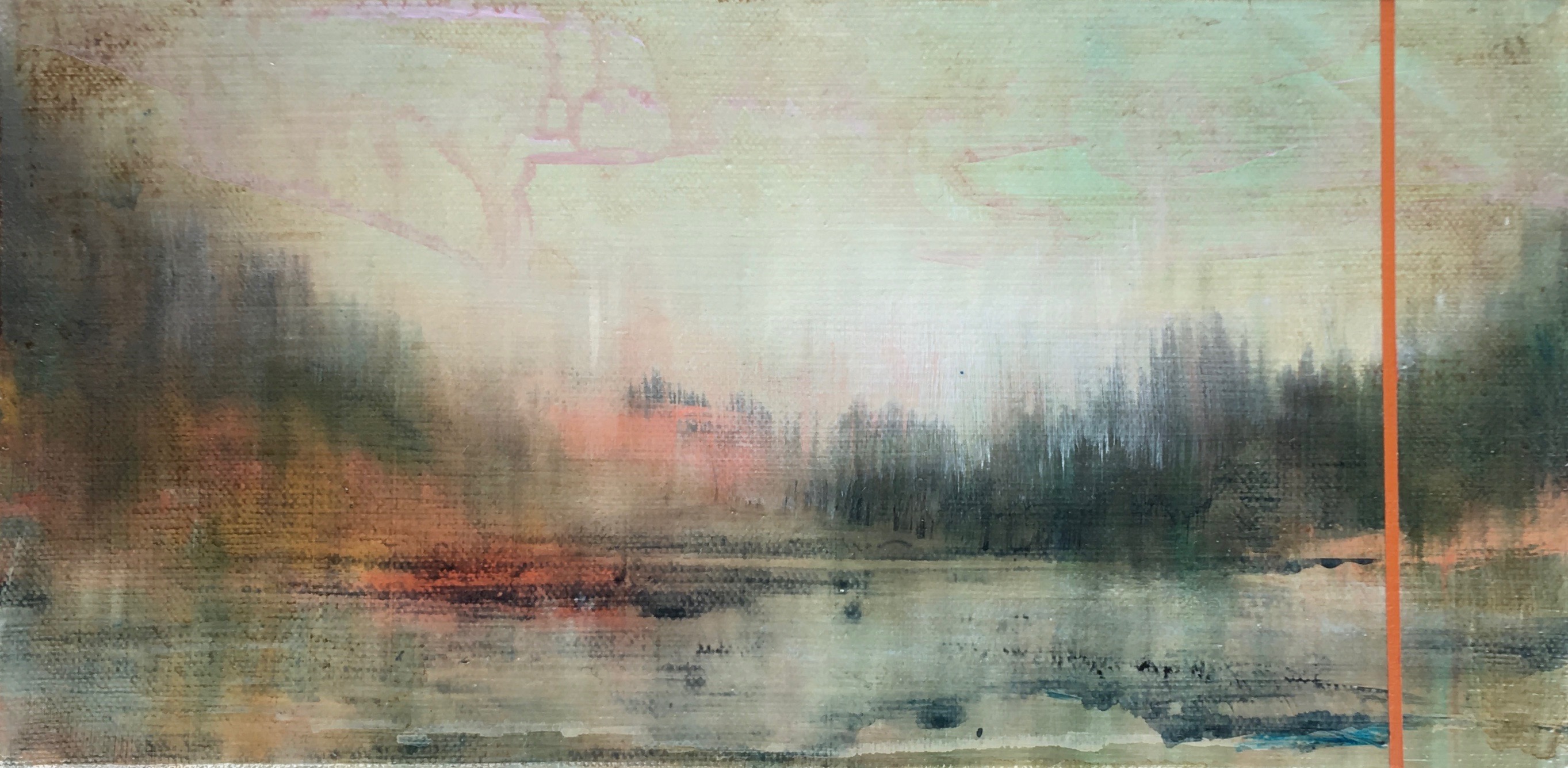
October and November were a couple of crazy busy months for me in the studio, as I fielded requests from galleries for lots of new, smaller works in time for the holiday gift giving season. They’ve been so good to me, I couldn’t dare let anyone down!
The autumnal season has always been a favorite time of year for me, so I let the palette and feeling of Fall in the Pacific Northwest inspire and guide new LEMOLO and ECHOES acrylics and watercolor paintings.
What began with more vibrant tones of early Fall, grew into more desaturated hues as the colors began to fade. Those late Fall colors have always spoken deeply to me, with their velvety, jeweled colors, less bright and brassy, more elegant and quiet.
painting- Land I Grew In, acrylic on canvas, 12×6, available at Lark & Key
painting- Ramble I, watercolor and cold wax on cradled wood panel, 14×11, available at Art & Light
painting- My Heart in Tow (detail), acrylic on canvas, 12×12, available at Elliott Fouts Gallery
Despite being two different mediums and different series, these new works all feel like a cohesive collection and a time capsule of this wonderfully sparkly time of year!
If you’re in Greenville, Charlotte or Sacramento, I hope you’ll check out each gallery’s offerings in person or peruse my website for all the new beauties!
Every artist has their own style, not just in the work itself, but in the way they work. What we wear in the studio has as much to do with our personal style as it does with our working style. Messy painters and sculptors probably don’t wear precious clothing or jewelry in the studio!
My own personal studio style is an extension of what I like to wear every day. I don’t like changing clothes throughout the day and since I work freelance from home, I can pretty much wear whatever I like. I do, however, like to feel “ready” to work– I never roll out of bed in my pjs and get to work. Putting on my studio clothes is as much a signal to get down to painting as putting on my favorite music.
So what do I wear in the studio? Comfy clothes and shoes for a start.
My favorites are a t-shirt or tank under an oversized flannel or chambray with stretchy leggings.
I layer up because mornings here in the PNW are usually chilly but if I’m working hard, I’ll soon need to strip off that top layer. Fashion faux pas or not, leggings let me move easily and comfortably and they are my fave. I buy the cheapies from Target so I don’t feel guilty when they end up with paint on them.
Since living in the PNW, I can wear my most comfy old boots in the studio for most of the year.
In the warmer summer months, I opt for cheap flip flops I don’t mind getting paint and medium all over. Although, this year I’ve noticed a difference in the way my legs feel after wearing the flip flops in the studio all day so think I need to find a more orthopedically friendly choice.. ugh. Getting old is for the birds, ya’ll.
I always wear an apron in the studio– since we’re traveling light, my clothes need to be able to do double duty, so I can’t really have a set of clothes just for the studio. A sturdier apron works best for me, since I tend to use a lot of glazing medium, which has a heavy, glue like consistency and will go right through thinner aprons (which I discovered the hard way).
I rarely remember to remove my rings and watch before I start working, but find that acrylics clean up off them easily enough if I get super messy.
How about you? What’s your best get down to work wear?
Side note: All those artists I see on Instagram painting in bikinis or cute dresses and heels? No way you’re actually painting in that. Let’s be real with ourselves and each other.
Subtle. Melodic. Mellow. A few of the keywords describing one of my favorite songs to listen to when painting my ECHOES series.
Music plays an important role in my creative process. Putting on my favorite Pandora station triggers my brain that it’s time to paint. Listening to music that suits the feeling of the work I’m creating helps me get lost in the act of creating, to find that state of flow.
I wanted my ECHOES work to be peaceful but luscious, deep and mysterious. The music I listen to has a lot to do with how those pieces come to be. Here are a few of my favorites that help me realize just the right atmosphere to create an ECHOES painting–
Creating and choosing art for healthcare environments is about much more than just beautifying a space. People in those environments are often worried, stressed, sad, and in need of healing. Experts have found that through evidence-based design, these places can become much more warm and welcoming and certain design choices can actually aid the healing process. Carefully chosen artwork in these settings not only has a positive impact on the patients, visitors, and staff, but also on the perception of care given by the facility.
I’ve had several artists, designers, and publishers ask about placing artwork in healthcare environments. They want to be a part of creating a healing environment, but aren’t sure how to go about it. So considering evidence-based design and my own experiences in curating art for healthcare, I’ve put together a few guiding principles when creating or choosing art for healthcare environments–
1 | happy, engaging imagery
Nine times out of ten, unless you’re there for the entrance of a new baby into the world, being in a hospital or other type of healthcare environment is not a happy or joyful occasion. And with all the weird smells, strange noises, and necessary sterility of these settings, no wonder they can be seen as such cold, intimidating places! Creating and curating art for healthcare environments that fosters a more warm, welcoming atmosphere goes a long way toward making patients and visitors feel more at ease in their surroundings. Work that makes us smile, reminds us of family and love, and calls to mind memories of happy times all can work together to ease the mind and spirit.
Often when you ask a hospital patient how they’re doing, you may get an answer that begins with “I’d rather be…”. Patients and visitors often wish they were anywhere but where they are. Artwork that creates a sense of voyeuristic escape can lessen anxiety by giving the viewer a means of liberation from their current situation. They’re able to think less about their pain or circumstances as their mind wanders and wonders what might be over that hill or around that bend.
3 | create a sense of calm, peacefulness and positivity
By using natural, organic imagery as symbols of peace, restoration, and comfort, the artwork in healthcare environments can become instruments of healing. Studies have shown that patients shown nurturing scenes of nature required lower strength pain medication. These kinds of images also foster a sense of the world outside the walls of the facility and the goal to get back to where the skies are blue and the waters peaceful.
Hospitals can be lonely, scary places. Choosing artwork that may garner conversation goes a long way toward creating connections among patients and visitors, as well as providing a much needed mental escape. Sculpture and interactive digital artwork do well to give patients and visitors a purposeful sense of exploration and the unexpected and abstract can create a path to solving a puzzle and thereby, a means of distraction.
5 | create reflections of community
Each hospital or healthcare facility has an important role to play as a part of a community. Honoring the history, landmarks, and atmosphere of that community can create a sense of familiarity and connection in places where we often feel helpless and alone.
Creating and curating art for healthcare environments is about so much more than simply manufacturing a pleasing looking space. Instead of merely being places of clinical procedures and processes, through art and design hospitals and other medical facilities are becoming places of nurturing and healing. Artists, designers, and consultants are looking more and more not at what the artwork speaks to them, but how it promotes positivity and restoration to the visitor and patient.
You can read more on evidence based design in this Guide to Evidence Based Art by Kathy Hathorn, MA, and Upali Nanda, Ph.D.