Category: museums

  • Artsy Spot: Palm Springs Art Museum

    Artsy Spot: Palm Springs Art Museum

    While Mr. Forager and I had originally made plans to trek to Big Bear over the weekend, a thick blanket of snow and us sans the CA law required snow chains, along with a sick-with-a-cold Mr. Forager led to a change in plans.  So following our Saturday ritual of breakfast in Joshua Tree ( at Crossroads Cafe— their “piggy pancakes” are my favorite indulgent breakfast ) and stocking up on victuals at the little JT Farmers’ Market, we drove through the wind farms to Palm Springs.

    We wandered around the shops and a few galleries in downtown PS ( note: Stark + Kent Gallery— best contemporary selection in PS, including a few artists featured here on Artsy Forager! ).  After doing the requisite touristy photo-op under Anish Kapoor’s Marilyn statue, currently installed in downtown Palm Springs, we decided to make our way over to the Palm Springs Art Museum. Now I normally have pretty low expectations for small town art museums, knowing they don’t usually have the financial support of big city institutions, so we were pleasantly surprised by what we found there.

    Jim Isermann installation
    Jim Isermann installation

    Palm Springs being a hot bed of modern architecture and design, it was no surprise that one of the current special exhibitions featured the design-art hybrid work of Fernando and Humberto Campana in the exhibition, Antibodies.  Their functional yet incredibly artistic designs take inspired living to an entirely different level.

    Antibodies_Fernando and Humberto Campana_photo by David A. Lee
    Antibodies, Fernando and Humberto Campana ( photo by David A. Lee )

    source

    But it was the museum’s contemporary collection that delighted us most.  As we walked up the stairs past the giant yellow Isermann installation ( see above pic ), so the magic began.  Marina Abramovic’s The Kitchen V, Carrying the Milk, held us spellbound, as we watched the artist as she stood, she the very subject of the Vermeer-esque vignette, holding a bowl of milk, at times struggling to hold her pose.

    The Kitchen V, Carrying the Milk by Marina Abramovic
    The Kitchen V, Carrying the Milk by Marina Abramovic

    source

    Moving away from the Abramovic video installation, our eyes were caught by what from a side angle looked to be an interesting light sculpture installation, but then I stood in front of it and that’s when something bewitching and delightful happened.. see the video!

    Exploded View ( Birds ) by Jim Campbell
    Exploded View ( Birds ) by Jim Campbell

    Here are a few more of our favorite highlights from the contemporary collection–

    Casualty in the Art Realm by Robert Arneson
    Casualty in the Art Realm by Robert Arneson
    Exploded Crystal Chandelier Headache by Ed Ruscha
    Exploded Crystal Chandelier Headache by Ed Ruscha
    Rainbow Picket by Judy Chicago
    Rainbow Picket by Judy Chicago
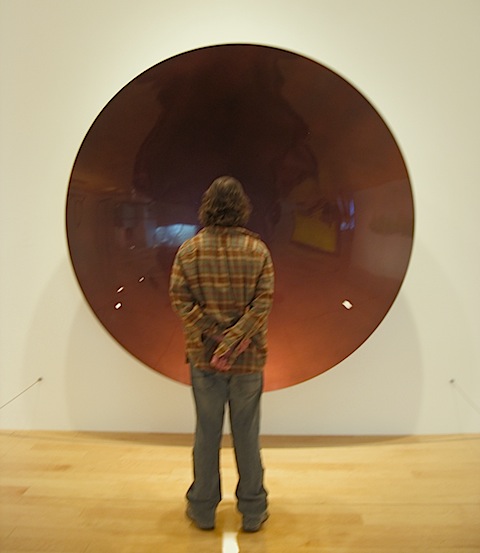
    Corona 2003 by Anish Kapoor
    Mr. Forager, contemplating Corona 2003 by Anish Kapoor

    Corona 2003 by Anish Kapoor ( above ) with its beautifully disorienting reflective surface and its acoustic properties ( when standing in front of it, as Mr. F is above, someone a few yards behind can hear what is being said into it ), we found it much more interesting than his giant Marilyn Monroe sculpture getting so much attention outside.  I’m glad we took the time to escape the masses huddled around her upended skirt to experience something much more satisfying.

    Unless otherwise identified, all images are by Artsy Forager.  Other image sources are linked above.


  • The Designers Who Would Be Artists

    The Designers Who Would Be Artists

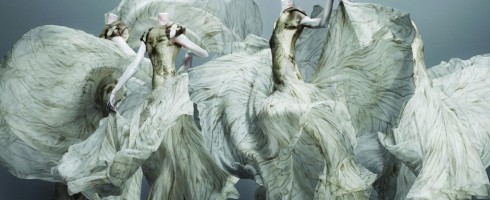
    It seems that the art world is embracing fashion and its cultural influence.  The Metropolitan Museum of Art’s recent Alexander McQueen exhibit, Savage Beautybroke attendance records for fashion exhibits at the institution.  Designers, especially ones specializing in couture fashion, seem to have more freedom than ever to create uniquely artistic forms.  We see designers such as the late McQueen taking inspiration from the art world and creating masterpieces in their own way.

    Dress, VOSS, Alexander McQueen, razor clam shells stripped and varnished

    Are these practical clothes?  No.  But then, art isn’t created for practicality’s sake.  It is created to be an outlet and a source of inspiration.  McQueen and other designers like him have taken inspiration from the forms and textures of ancient and modern sculpture to develop glorious garments that inspire.

    Jean Paul Gaultier
    Mary Katrantzou
    Stephane Rolland
    Manish Arora, Autumn/Winter 2011-2012

    On a simple dressmaker’s form, these could be mistaken for museum-worthy sculptures, but when worn, they become a moving work of art.

  • Museum Hopping

    Museum Hopping

    Though our time in the cities we visited on our cross-country tour was short, we managed to hit a couple of wonderful, yet very different museums along the way.  In Tulsa, we spent a few hours exploring the Philbrook Museum of Art.

    Front facade of the Philbrook Museum of Art

    My Jacksonville readers will be familiar with the Cummer Museum of Art in Jax.  The Philbrook is, to me, like the Cummer on steroids.  Like the Cummer, the Philbrook was once a private residence, which was donated to the city of Tulsa by its owners, oilman Waite Phillips and his wife Genevieve.  Once we entered the museum doors, we found ourselves in a gorgeous, domed center hall, light streaming through the oculus in the center of the dome.
    Center hall at the Philbrook
    Philbrook oculus

    Just walking the halls of this Renaissance style villa, built in 1927 and designed by architect Edward Buehler Delk for the Phillips as “a place where there two children could entertain friends” ( Imagine the sleepovers you could have! ), is a pleasure in itself.

    Corridor at the Philbrook

    The museum houses a varied and extensive permanent collection of art, ranging from African & Asian collections, Native American art to Italian Renaissance and a surprising and delightful modern collection.

    Bougereau at the Philbrook, a favorite artist of the Frenz’s
    Lovely little Picasso at the Philbrook
    Fabulous modern design collection at the Philbrook

    While the museum collections are enjoyable, it is the museum grounds that really steal the show.  Though we visited on a gray and rainy day, it didn’t stop us from exploring the extensive gardens behind the museum.  The original formal gardens extend from the rear colonnade of the museum down to the tempietto.  Let’s take a little walking tour..

    Rear collonade at the Philbrook
    View from the colonnade down to the tempietto
    Wonderful stepped fountain
    Beautiful, naturalistic water feature
    No formal garden is complete without a koi pond!
    View from the tempietto back toward the museum
    Yours truly in the tempietto ( wouldn’t this be a romantic spot to pop the question? )
    Contemporary sculpture walk beyond the formal gardens

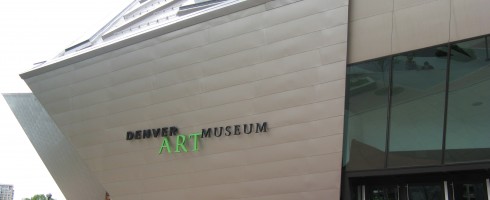
    Let’s switch gears now, fast-forward through another 12 hour day on the road and pay a little visit to Denver.  While in the mile-high city, we spent some time downtown including a tour through the Denver Art Museum.  While the Philbrook is classically ornate, the DAM’s Hamilton Building, where we spent our time, is splendidly contemporary.  Designed by Daniel Lubeskind, the structure represents the Rocky Mountain peaks surrounding Denver.

    Denver Art Museum

    We started at the top and worked our way down, discovering lots of fun & interesting contemporary work along the way.

    Noguchi sculpture and Motherwell painting **Sidenote: Motherwell was born in Aberdeen, WA, the town where we are living for the summer.
    Ceramics at DAM

    Did you notice in the pictures above how the walls are slanted?  The angled walls created a very interesting visual space, especially in the 4th floor gallery where they were prominent.   They were a bit disconcerting when walking down the main stairs, though!

    Artist: Mark Tansey

    We were all fascinated by the piece above, by Mark Tansey.   Another highlight was the Fox Games installation by Sandy Skoglund.  I first saw Skoglund’s work in Jacksonville and am always fascinated by the environments she creates.

    Fox Games by Sandy Skoglund

    And there was just something about “Minotaur with Brushstrokes” that appealed to us.  What can I say, we like work that makes us smile.

    Minotaur With Brushstrokes by Richard Patterson

    Speaking of making us smile, George & I also loved the piece below, although I’m sad to report that I don’t recall the name of the artist.  But it reminded me of spring in the Northwest.

    Kicking myself for not writing down the title & artist for this piece! Anyone have any clues?

    The museum also boasts an impressive Western American Art Collection, as well as African, American Indian, Oceanic, Pre-Columbian and Spanish Colonial Collections.  We toured through the current special exhibition, Cities of Splendor: A Journey Through Renaissance Italy, but alas, no photography allowed in the exhibit, so you’ll have to check out the DAM website for a taste.  As you can see, our art experiences on this trip were widely varied and we are looking forward to more such experiences here in the Northwest.

  • Hands-On vs Hands-Off Artistry

    Hands-On vs Hands-Off Artistry

    In my daily reading of Artinfo.com this morning I came across two articles, seemingly unrelated, until the Facebook comments regarding one of the articles tied them together for me.  The first article, found here, poses the question, “Should Gaudi’s Sagrada Familia Remain Unfinished?”  The Barcelona basilica, begun in 1882 by renown artist-architect Antonio Gaudi is still under construction eighty-five years following the architect’s death.

    Sagrada Familia under construction in Barcelona, Spain

     Though Gaudi left plaster models and drawings, many of his notes were destroyed during the Spanish Civil War, leaving his vision open to interpretation by current sculptors, architects and designers.  While some critics feel the current direction doesn’t jive with Gaudi’s original vision, even during his lifetime, there were many sculptors working on the basilica.  Like any monumental undertaking, “it takes a village” to bring Gaudi’s creation to life.

    Close-up of one of La Sagrada Familia's spires. Barcelona, Catalonia, Spain.

    Should Gaudi’s original design be so open to interpretation?  He gave artistic license to those working under him while alive, would he so object to modern interpretations now being imposed?  Unlike other types of sculpture, cathedrals are often the product of centuries worth of work by multiple architects, artists and craftsman.

    The star-studded ceiling of the east wing of La Sagrada Familia under construction. Barcelona, Catalonia, Spain.

    As Gaudi was aware he would not be alive to see it to completion, wouldn’t he have known his original design would be open to interpretation by those who came after him?  Does the fact that Gaudi is not here to personally oversee the work negate the additions?

    Artists using apprentices and assistants is nothing new.  The art world of the Renaissance era, which produced such celebrated masters as Michelangelo and DaVinci was built upon the concept of apprenticeship.  But what about now?  The second article I read this morning was regarding the approval of a Dale Chihuly museum at the site of a former amusement park in downtown Seattle ( now the Seattle Center ).


    The museum in itself is the subject of controversy, but that isn’t what I’d like to address here.  Instead, I’d like direct attention to another Chihuly controversy– his use of others to craft his designs.  One Facebook poster thought it necessary to point out that since losing the use of his left eye due to a car accident, he is no longer the person actually blowing the art glass he is so famous for.  ( In reality, Chihuly continued to blow glass for three years following the accident, until a body surfing incident dislocated his shoulder, so he was no longer able to manually manipulate the glass ).   The poster’s statement that “His employees make everything.  Just sayin’.” seems to somehow fault Chihuly for continuing to create in the only way he physically could, by having others help him.  The artist himself has said that his role, more of a director, allows him better perspective on the work.

    As stated above regarding Gaudi, the practice of using assistants and apprentices to create monumental works of art has been done for centuries ( and yes, many of Chihuly’s creations are monumental in scope ).  So as long as the artist himself continues to design the creations with his name on them, what’s the big deal?

    And what about so-called “production originals”?  You might be thinking of the ones advertised as “hand painted original works of art”, usually being sold out of a hotel ballroom.  But what I’m talking about are the production art studios– where perhaps one “lead artist” is creating original works of art, which are then being recreated & reproduced by the hand of “assistant artists”.  There are more of these studios around than people realize and the work can be found in galleries, corporate and private collections all over the world.  While the savvy gallerist, art consultant, designer and art afficionado knows production art when they see it, what about the collector who thinks they are buying a true original work of art, only to spot an almost exact replica when in their hotel while on vacation in Hawaii?  Do we lump Chihuly in with these?

    These are three examples of artwork being completed and accomplished without the direct hand of the creator.  What are your thoughts?  Is it ever OK to put your name on something you didn’t actually physically create?  This is definitely a gray area.. would love to hear your thoughts!

  • Behind the Museum Walls: Thoughts From a Curator

    Good morning, all!

    Do you ever wonder how pieces are chosen for museum exhibits?  Why one work makes the cut but another doesn’t?  I just read this interesting little article written by Katharine Stout, curator of the new exhibit, “Watercolour” at the Tate in London.  A fascinating look behind the choices of work and use of watercolors today.   Although traditional watercolor landscapes have a long history in Britain, Stout chose to focus on contemporary work, making the exhibit more relevant for today.

    Hope you enjoy this little peek behind the museum walls!

    Tate curator Katharine Stout on the contemporary works in ‘Watercolour’ | Tate Blog.

  • Masterworks Monday: The Cubists

    Sorry for the late post today– we’ve had some big things happening, so I’ve been a bit preoccupied.  More on that later!  For this week’s Masters Monday, we’re going a little more modern– enter Pablo Picasso and cubism.  Cubism is an early 20th century art movement that was begun by Picasso and Georges Braques in which objects were depicted from a multitude of viewpoints in a seemingly random fashion.

    Juan Gris. Breakfast. (1914)

    Breakfast by Juan Gris

    For me, cubism was a quite a breakthrough while taking figure drawing classes in college.  Once figure drawing started clicking for me, ( it was horribly frustrating at first, but my professor at UNF, Paul Ladnier, told me that one day it would just “click” and it would be smooth sailing– I didn’t believe him until it actually happened that way! ) it was then that Paul suggested I try a little cubism.  That’s when things REALLY started to get more fun and interesting!  I loved exaggerating the planes and forms.

    Pablo Picasso. Girl with a Mandolin (Fanny Tellier). Paris, late spring 1910

    Girl With a Mandolin ( Fanny Tellier ) by Pablo Picasso

    I realize Cubism isn’t everyone’s cup of tea, but for me, it was the introduction into a different way of seeing, a new perspective on how we look at the things we see.

    Images via http://www.moma.org

    Read more about Cubism on MOMA’s website!

  • A Velázquez in the Cellar?

    OK, perhaps not exactly your grandmother’s attic, but it seems that a previously unattributed, damaged work stored at Yale University is thought by many experts to be a Velazquez.

    A Velázquez in the Cellar?.

  • Masterworks Monday:  Vermeer

    Masterworks Monday: Vermeer

    I love modern & contemporary art.   Artists who find a new way of translating our reality fascinate me.  But the Art History geek in me also loves to look back at what was groundbreaking eons ago.  We have so much to learn from those who came before us, so each Monday will be dedicated to a work by one of the “Masters”.

    First up, one of my favorite artists whose work I’ve seen in person when visiting the Frick Collection in New York.

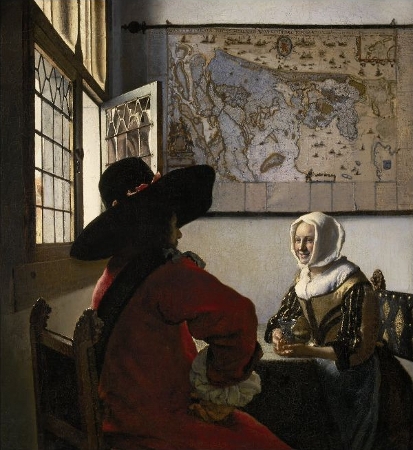
    Officer and Laughing Girl  by Johannes Vermeer, Dutch painter 1632-1675.

    Most of us are familiar with what may be Vermeer’s best known work, Girl With a Pearl Earring, but for me, he is at his best in his “slice of life” compositions such as Officer and Laughing Girl.  In this captured moment, Vermeer gives us a glimpse into a private, shared conversation.  Is this a young girl being courted by a gallant officer?  What is their relationship?  Vermeer leaves us in wonder.

    Vermeer’s paintings are usually much cooler in tone than those of his contemporaries and this one is no exception.  The light coming in through the leaded glass windows is clear, but feels frostly, especially in contrast to the warm tones of the officer and girl’s clothing and the looks being exchanged.

    For more information on Vermeer, here are a few sources:

    The Essential Vermeer

    The Frick Collection, which houses several Vermeers, including the one above

  • First ( Art ) Love

    First ( Art ) Love

    We all remember our first love, the intensity, the drama, it stays with us forever.   How a certain song or place will always remind you of those precious feelings.  But what about your first ART love?   That one painting or sculpture or photograph that drew you in and made you long for more?

    My hubby George & I took advantage of the Free Family Day at the Cummer Museum of Art in Jacksonville on Saturday and walking through its beautiful rooms & gardens reminded me  that the Cummer is where my real appreciation for art first blossomed.


    Image of the Cummer Gardens via Cummer Museum of Art & Gardens

    The stately, elegant rooms and gardens seemed alive with history and mystery.  To me, there is something so lovely and enchanting about old stone, brick and iron in a garden.   The Cummer Garden paths lead me down a lane of memories that aren’t my own.. memories of others who have walked these gardens before, of Ninah Cummer lovingly attending her flowers, of characters in novels who walked similar garden paths, of lovers declaring themselves forever.

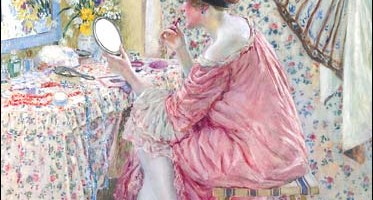
    Inside the Cummer, the beauty of the architecture draws me in but it is the artwork that keeps me coming back again and again.   As a young girl, my first memory of visiting the Cummer is the enchantment I discovered there, focused upon one particular piece of artwork, “Before Her Appearance” by Frederick Carl Frieseke.

    Image via Cummer Museum of Art & Gardens

    I’m sure it is no surprise that this Impressionistic painting would be the early favorite of a young girl who loved the romance of dancing and all things girly.   I wanted to BE her, to be the talented beauty preparing to take center stage.  When I look back at this piece as an adult, I still love the feminine glory of it all.  The pink toe-shoes, ruffled dressing gown, floral vanity skirt and draperies.. In an age where showing this kind of feminitity seems sometimes verboten,  it is lovely to think back to a time when it was truly celebrated.  ( Not that I would want to go back to other aspects of being a woman in that age! )

    Each time I revisit the Cummer, I am drawn back in time to my younger days, of sitting and gazing upon this lovely piece, waiting for her to stand up from her stool and begin pirouetting around the room.   As with any first love, there are others who have come behind, touched me in different ways, but that first passion will stay with me always.

    Do you remember your first ( ART ) love?  Please share in the comments, I adore a good ( ART ) love story!