Category: Artsy Advice

  • Art Inspired Design: Modern Reflections

    Art Inspired Design: Modern Reflections

    I love art.  I love design.  Why not put the two together on the blog?  There was a time in my life when I thought my career path lay ( Thank you, Suzanne Decuir for the grammatical help ) in Interior Design.  I took courses, devoured design and shelter magazines.   As often happens in life,  circumstances got in the way and the path detoured.  But that’s a story for another time.  Let’s focus on the fun stuff today!

    One of my absolute favorite things while designing ( OK, it was THE absolute favorite thing ), was creating moodboards.  To begin with an inspiration and build a room or facility around it was thrilling to my color, texture and pattern lovin’ soul.  And for me, it always began with the artwork.  While doing project management/art consulting, I worked with a lot of designers and many ( but by no means all! ) viewed the artwork for a design as an after-thought.  Like adding sprinkles to a cake.  Still a cake without the sprinkles, but oh, if we add them, won’t that be pretty!  But if we don’t have sprinkles, it’s OK.  It’s still a nice cake.  Instead, I think of the artwork as the frosting– not just smoothed across the top, but spread between the layers and all over.  It is what holds the cake together and gives it the extra texture and sweetness that keeps us going back for more.

    ( Wow, anyone else craving cake now? )

    So you’ve purchased this beautiful painting by Christina Foard.  You love it, it speaks to your heart and reflects your style and everything you love about life.  But maybe you live at the beach and are unsure how to design a room around it.  Aren’t all beach houses supposed to be full of palm trees & seashells?

    Seaside Reflections by Christina Foard, oil on canvas, 60×48

    This piece to speak more to the feeling of being on the beach just after a storm, while the skies are still a bit gray but the sun is beginning to peek through, warming up the sand to both the eye and the touch.  So let’s take our cue from that and begin with soft, grayish tones, layering on the warmth of the sun in our accent chair, rug and window coverings.  An important component in Christina’s work is texture, so we’ll make sure there are plenty of interesting surfaces to draw our eyes in, just as Christina’s painterly build up does in her work.

    Modern Reflections, a beachside home for a contemporary art lover

    Have you ever designed a room around a piece of artwork?  Or bought a piece of artwork not knowing where exactly to hang it in your home but you couldn’t live without it?  Have a beloved piece of art sitting in a closet somewhere because you don’t think it “goes” or can’t figure out how to incorporate it with your current furnishings?  Um, yeah, me too. 🙂

    Sources:  Painting:  Seaside Reflections by Christina Foard; Paint color ( board background color ): Skimming Stone by Farrow & Ball; Sofa: Charlotte Collection by Mitchell Gold Bob Williams; Chair & Ottoman:  Rhys Chair & Ottoman by Anthropologie; Rug:  Festival by Anthropologie; Coffee table:  Monarch Coffee Table by Anthropologie; Lamp:  Malaya Large Coral & Zinc Lamp by Arteriors Home; Round side table: Riveria Side Table by Ralph Lauren Home; Mirror:  Venus Mirror by Anthropologie; Square side table: Duotone Side Door Table by The Painted Cow Furniture Co. on Etsy; Window covering:  Coqo Floral Curtain by Anthropologie;  Bowls:  Tatara Zukuri Bowls by Ashes & Milk      

  • Have You Exploited an Artist Lately? (via YCL Art: The Art of Yvonne C. Lozano)

    Wonderful post by Jacksonville artist, Yvonne Lozano. Very well articulated, Yvonne!

    Have You Exploited an Artist Lately? The exploitati­on of artists seems to be an ongoing topic of conversati­on lately. The more these conversati­ons pop up, the more upsetting it is to hear how so many people prosper from the very existence of artists yet the majority of artists continue to be in “starvatio­n mode.” I think the problem starts even earlier than most people realize. Think about the general life of an artist, most start dabbling in arts & crafts even before they c … Read More

    via YCL Art: The Art of Yvonne C. Lozano

  • Hang ‘Em High..Not TOO High

    Hang ‘Em High..Not TOO High

    CONFESSION TIME:  One of my biggest pet peeves is artwork hung incorrectly.  And by this I mean too high, too low, staggered when there is no reason for staggering ( i.e., up a staircase wall ), etc.   While there are no set rules when it comes to hanging artwork, there are guidelines.  Knowledge is power, ya’ll, and you’ll thank me for it when my eyes aren’t twitching uncontrollably when I come over and see how your artwork is hung.  I’m too polite to say anything, though.. I am a Southern girl, after all.

    Guideline #1:  Normal height for  hanging artwork is to center it at eye level. 

    But whose eye level?  You may be 4’11” but your husband is 6’4″– how do you decide?  Law of averages, my friends.   I’m 5’5″ ( ok, 5’4 1/2″ ), so my eye level is actually spot on.  The safest height at which to hang artwork is 60″ from the center of the artwork to the floor.

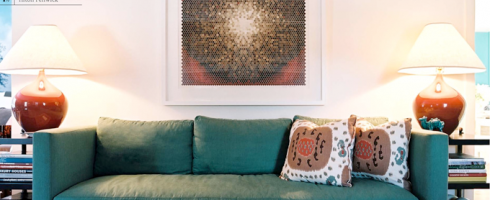
    I couldn’t resist adding in this image from Traditional Home ( via House of Turquoise ).  Recognize the work of our very own Pick of the Crop artist, Christina Baker?!  Girl’s got skilz.

    Guideline #2:  Use picture hooks and D-rings for hanging whenever possible

    picture-hooks-ready-for-d-ring-hangers

    Plain ol’ nails might be super cheap, but picture hooks are the best way to go to get your artwork to hang levelly and securely.  The weight of a piece of artwork will drag down a nail, but the picture hooks are designed to set the nail at an angle so that the laws of physics hold the picture up, instead of putting all the weight on the nail.  There are different size hooks available according to the weight of what you’re hanging, so if you’re in doubt about the weight, go with the heaviest weight hook so you’ll be sure your artwork won’t fall on someone’s head.. or toes.

    D-ring hanger

    D-rings are God-sends for hanging artwork and should be used instead of wire, if possible.   Simply install two d-rings at the same horizontal level on the back of the picture frame.  It’s true, you’ll need to put two holes in the wall instead of one, but your artwork will be more secure and won’t have that annoying habit of going crooked anytime it get’s bumped a little or someone closes a door a bit too hard.

    Guideline #3:  When hanging multiple pieces together, be aware of the space between them and how they relate to each other

    If you’re hanging a pair or series of artwork above a piece of furniture, measure and treat the pieces as if you were hanging one solid piece– taking into account a bit of space between them and center the overall size horizontally above the furniture and center each piece vertically at 60″.

    Guideline #4:  Some rules were made to be broken

    Not Guideline #2, the picture hook thing is always important, not just for aesthetics, but for safety.  The other two, however, might be flexible depending on the situation.

    • Broken rule #1– It is OK to hang artwork lower ( or higher, I guess, though this is less common ) than eye level if it helps the work relate to its surroundings

    • Broken rule #2– Sometimes extending a grouping of work outside of the borders of a piece of furniture or other furnishing helps the artwork to make more sense within the room, as in the case of the room below.  In this instance, more is more, yes?

    • Broken rule #3– The rules are, there are no rules.. Sometimes the positioning of artwork doesn’t really need to relate to the surroundings at all.. randomness & asymmetry can be beautiful!  If done well, of course.

    If you ever find yourself unsure of how to hang your latest acquisition, I hope these guidelines are helpful.  If you’re really stuck, drop me a line– I’m happy to help!  Happy hanging!

  • 15 Things an Artist Should Never Say

    Good morning, artsies!  A little wisdom for all you artists out there and things we art supporters need to remember, as well.

    15 Things an Artist Should Never Say – ArtBistro.com.

    Most artists I know aren’t guilty of these transgressions, but I’ve seen some who are.  Artists, what’s the been hardest one for you to overcome?