Thanks to this gypsy-like lifestyle we’ve chosen, Mr. Forager and I find ourselves on frequent road trips. Whether journeying to our next destination or exploring our current spot, we’ve put a lot of miles on our little Hyundai! Each stretch of highway has its own personality and Seattle artist Matt Sawyer beautifully captures the atmosphere of the view from four wheels.
An analog fine art photographer, Sawyer’s work has this beautiful signature palette– desaturated yet strong color and light that is reminiscent of those mornings when you rise before the sun to hit the road and evenings when you decide to just try to make it a little bit farther before stopping for the night. There is a quietness about this series, as if you’ve turned the radio off, stopped talking and just listened to the road as it passes. It has stories to tell, we just have to listen.
*This post contains affiliate links. As curator of the Artsy Forager for Mantle Art Collection, I receive a small commission on each piece sold from the collection.
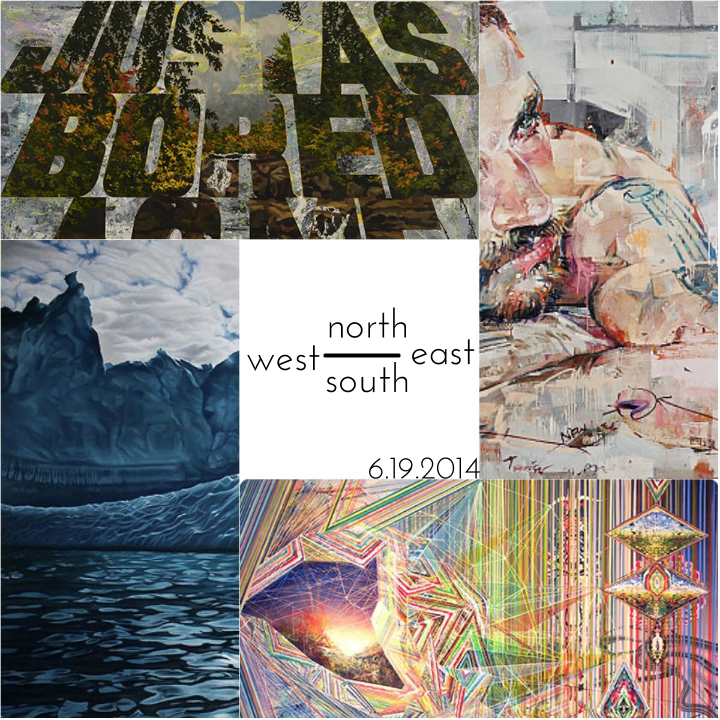
In this week’s round up of gallery shows and museum exhibitions, I am so bummed that I’m nowhere near any of these spots because each of these shows looks amazing!
Click through the gallery links above for more information about each show. If you check ‘em out, tag me ( @artsyforager ) on Instagram with the hashtag #dontmissartsiness! If you go I’ll be totally jealous!
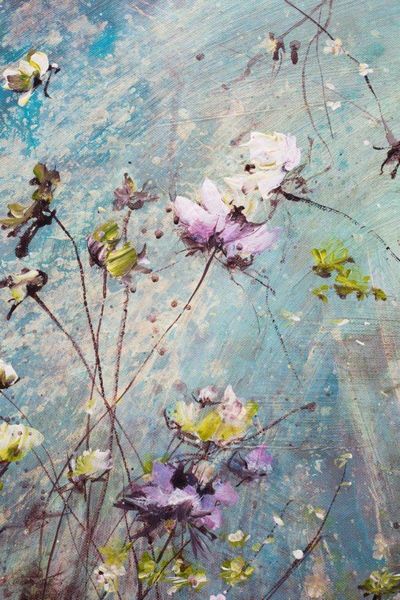
It seems I’ve been more obsessed with flowers this spring than ever. Perhaps because here in Northern California, everything has been blooming like crazy! I’m constantly discovering new floral delights, both of the cultivated and wild varieties. Our favorites are the wildflowers that can only be discovered by hiking into the woods, where they grow freely and without abandon. These paintings by French artist Laurence Amelie capture the untamed beauty of flora unleashed.
When we’re hiking, I often wonder how a certain flower came to be in the place we find it. Was it’s seed dropped by an overhead bird? Or carried on the wind to arrive at its destination? Whatever the method, the result is a beautifully haphazard garden where flowers grow content and untethered. On her website, the artist refers to this as “poetic disorder”. Such a lovely turn of phrase for the way in which wild things grow.
Three posts in one day?! What’s going on? I’ll tell you what– I am joining with the folks at Great.ly to celebrate the first ever White House Maker Faire! America has always been a creative nation, but in recent years, as technology has become accessible, we’ve seen the rise of a Maker’s Movement, creating opportunity where there were once just dreams. Today, the White House celebrates our #nationofmakers and so do I!
To honor just a few of the amazing makers out there, I thought I’d share a handful of the creative entrepreneurs you can find in The Trove, my boutique gallery at Great.ly—
Emily Jeffords
Jennifer Steen Booher
Meredith Aitken
Romina Bacci
Deb Haugen
Find more from these amazing artists in The Trove! I’m so honored to play even a small part in helping to build up these creative careers! Happy Maker’s Day!
This post contains affiliate links. As a Great.ly Tastemaker and curator of The Trove, I receive a small commission on each piece sold from The Trove boutique gallery.
In my guest post “Artsy Abroad: Fear, Frustration, and the Art of the Forage” last month, I described the time I spent at the beginning of the year in Batuan, Bali, seeking out artists to interview during a month-long arts writing grant. I was lucky to find an abundance of artistic inspiration during this time and am excited to share this with you now…
Ketut Jaya Kaprus’ studio in Batubulan, Bali, Indonesia. Photo by: Ellen C. Caldwell.
One of the first artists I was introduced to was Ketut Jaya Kaprus. Kaprus brought a sampling of images and videos with him (see the video at the end of this post) and this meeting sparked a wonderful and ongoing conversation about art, the environment, and our artistic inspirations.
Soon after this initial meeting, Kaprus invited me to his home studio in Batubulan and then to his friend Made Budhiana’s studio in Denpasar. I spent the day with Kaprus, Budhiana, another artist Wayan Sunadi, and my friend and translator Sudipa Yasa from Bali Purnati. Together, we discussed their experiences at art school, their artistic community and arts collectives in Bali, and their work.
top | Ketut Jaya Kaprus, detail from one of offering paintings. Photo by: Ellen C. Caldwell. bottom | Kaprus’ examples of physical offerings, the inspiration for much of his work and color palette. Photo by: Ellen C. Caldwell.
When I arrived at Kaprus’ studio, he began by showing me a handful of his smaller framed works – all of which were naturalistic in style and depicted detailed paintings of the daily offerings one sees all over Bali. As a Hindu priest in his home village, Kaprus is inspired and motivated by traditional Balinese customs and ritual symbols – all of which he incorporates into his work. These smaller paintings beautifully capture the details of the offerings that are an integral part of everyday life in Bali. Kaprus became interested in making these offerings at a young age, and later, he began transforming the physical offerings into representations of them as well.
left | Interior of Kaprus’ studio in Batubulan. Photo by Ellen C. Caldwell right | Kaprus painting in his studio during the interview. Photo by: Ellen C. Caldwell
Besides these realistic paintings, Kaprus is more known for his loud, colorful, and abstract paintings. Monumental and larger than life, in many cases, these paintings covered every inch of his walls—a physical symbol of the way in which art and the creative process takes up every aspect of his spiritual and psychic being. Seeing both of his painting styles together shows how the colors and symbology from the offerings are the literal inspiration for and translation of the larger abstract paintings. In this way, the smaller works shed a light on the meanings and jumping off points for his larger works.
After a wonderful studio visit and interview with Kaprus, we headed to Budhiana’s studio in Denpasar. Simply put, Budhiana’s studio is the stuff of dreams.
The entryway to Made Budhiana’s studio in Denpasar. Photo by Ellen C. Caldwell.
A large, two-story barnlike structure, it has all the right lighting, large open spaces for his huge canvases, an amazing sound system and movie projection setup, books and music to inspire the mind, and art to inspire the senses.
Budhiana is an established international artist and he sees part of his role in Bali as being a mentor for fellow artists. He invites artists to apply for short residencies to share his lovely studio space while working on their own practice. He is also a lover of classic rock, so much of our day was cast to a soft pulsing soundtrack of Hendrix, Zeppelin, and Clapton: an undercurrent, as if the studio’s lifeline.
left | Inside Budhiana’s studio. Photo by: Ellen C. Caldwell. right | Inside Budhiana’s studio. Kaprus, Sunadi, and Yasa pictured from left to right. Photo by: Ellen C. Caldwell.
Budhiana’s work is generally large (a minimum of about 4-6 feet wide) and very colorful. Steady lines of bright reds, yellows, and oranges pack the canvases’ frames and tell a larger story. Humor and visual narrative, both large and integral parts of Balinese culture, are as much his medium as the paint and canvas themselves. Their friend and colleague from Indonesian Institute of the Arts Yogyakarta (Institut Seni Indonesia Yogyakarta/ISI Yogyakarta), Wayan Doel Sunadi, was also there to show me his paintings. Sunadi’s work takes the comedy up a notch too, as he plays around with humorous subjects and viewers’ expectations for contemporary Balinese painters (as with Mystery of Sunglasses).
left | Wayan Doel Sunadi, Mystery of Sunglasses ( detail ), 140 x 200cm, mixed media on canvas, 2013. Photo courtesy of the artist. right | Wayan Doel Sunadi, Tarbang, acrylic on canvas. Photo courtesy of the artist.
A final interior of Budhiana’s studio. Photo by Ellen C. Caldwell.
None of these artists paint in the older, traditional Balinese styles in any conventional sense, but they all show their artistic roots in different and distinct ways. Through symbology, humor, and narrative, they all ground their practices in older and existing elements of Balinese painterly traditions and themes while experimenting with new and distinct styles that highlight contemporary Balinese culture.
“Ketut Jaya Kaprus: Artwork and Inspiration,” 2014, Film director and editor: Dadi Reza Pujadi, Music by: Jeff Schmidt: live solo, and Marcus Miller: solo bass, A Free Parking Working Film. Video posted courtesy of the artist.
Are you loving these little virtual foraging trips through Bali as much as I am? Thanks so much to Ellen for sharing her adventures and to the artists for opening their studios. More to come from Ellen next month!
Are you an artist, arts writer, or blogger who is planning a residency or trip abroad and would like to share your own Artsy Abroad story? Shoot me and email via the Contact page and let’s chat!
I remember being fascinated by a pair of geodes that were one of my grandmother’s travel souvenirs. The ugly, nondescript rocky surface hiding inside it a magical, sparkly surprise. Los Angeles artist Elyse Graham shares my childhood fascination, creating her own sculptural geodes from layers of latex and urethane.
When we first arrived here in Eureka, we experienced our very first California earthquake. It reminded me, as do the geysers and mud pots of Yellowstone, that this planet we live on is a living, moving, breathing entity. So it seems only fitting that Graham creates her geodes around the void left by her own exhaled breath. She adds each layer, one on top of the other, the resulting effect unknown until the geode is finally split.
How often do we, too, work blindly only to discover something amazing when all is revealed?
We’ve all been there. Those incredible moments when we first fall in love– like walking on clouds, floating on the gentle rock of a warm ocean. We are consumed in total by our love, seeing the world through a veil of ardor. In her large scale abstract paintings, New Orleans artist Mallory Page allows thoughts of the different kinds of love we experience to guide her through the mystical world of abstraction.
From the passion of first love to the warmth of a lasting friendship, Page captures the way our emotions flow into and out of one another, gradual shifts often happening before we even notice them. Intense, dark color gives way to translucent light. Aren’t these just stunning? Just like love, they’ve totally drawn me in.
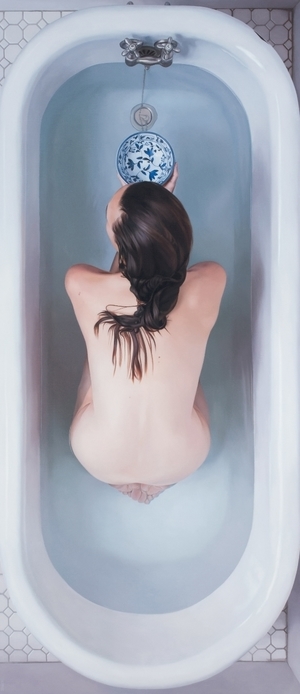
This artist’s work always gets me. Not just because it’s incredibly gorgeous and highly skilled, it is. But each piece is filled with so much emotion and narrative, it’s like a beautiful punch in the gut. I first featured the paintings ( that’s right, paintings!! ) of Lee Price way back in January 2012 while I was writing Artist Watch posts for Escape Into Life. The work effected me so much that it took another three months before I could write a full feature for the blog.
These new pieces are similar to Price’s older work, in that we still see isolated women in the bed or bath, but the work has evolved to either a more positive or more sinister perspective, depending on your interpretation. We still seem to see a woman in struggle, yet these seem much more subversive. Instead of a woman surrounded by the detritus of a cupcake binge, instead, we’re confronted with women enveloped by artificial representations of treats or even more telling, an empty bowl.
We have such a powerful relationship with the food and drink we consume. It literally has the power to nourish or destroy. And in the world of fast, highly processed food and GMOs, the choice of what we eat has never seemed more fraught with danger.
Most of us, from an early age, develop a fascination with animals. Whether it’s a little girl’s obsession with horses or a man’s desire to come face to face with a grizzly, we find ourselves identifying with the other species that share the planet. In her encaustic collage work, New Orleans artist Miranda Lake uses a visual vocabulary of animalistic ephemera to explore our relationship with and understanding of our fellow creatures.
Like the fantastical illustrations of a children’s book, Lake juxtaposes her creatures into incongruous landscapes and situations, giving her encaustics a bewitching whimsicality. I mean, a bunny riding a canon? What could be better?
But thinking more deeply about the work, I’m struck by the thought that from the time we’re young, we tend to imbue wild animals with human characteristics and playfulness. We forget that they are simply living by instinct and how very much our own behavior effects theirs. Just like us, they are trying to survive as best they can.
In our travels, Mr. F and I have moved into and out of nine homes so far. Each move in day is filled with excitement and a bit of nervous energy in finding ourselves in a new place and each move out being filled with a bit of sadness in leaving what’s been home. In her work, artist Caroline Sharpless paints empty spaces that seem to anticipate the departure or arrival of their inhabitants.
The perspective of the paintings are often looking through the room and out the window view, that can give them a slightly melancholy feeling, and the muted palette seems to long for human vibrancy. After all, buildings are merely vessels of steel and concrete until they are brought to life by people wandering their halls and gazing out their windows.