Although we technically don’t have a home of our own these days, the idea of home is on my mind a lot. Just this morning I was browsing through realtor.com, as you do, checking out what’s around in our price range. I find the need to remind myself that home isn’t always about the roof over your head. The Trailers Collected series by the late photographer Nan Brown prove that often home is in the eye and heart of the beholder.
It might sound corny, but it’s so very true. Home is where the heart is. If a place is filled with the people we love, it provides us shelter, not just in the physical sense but in the emotional and spiritual senses. By capturing these humble abodes, some well cared, for others, barely hanging on, Brown captures the essence of what home can be.
To see more of Nan Brown‘s work, please visit her website. The artist passed away earlier this summer after a long illness. She leaves behind a legacy of thoughtful, sensitive work.
After spending the past two years going from small town to small town, I’m still kind of in awe of Seattle buildings. From what I happen to think is one of the prettiest skylines in the country ( if not THE prettiest! ) to the fantastic examples of modern architecture and traditional storefronts. The paintings of Massachusetts artist Hannah Richman explores the facade of the urban landscape, man’s touch upon the terra.
Fulkserson Street II, oil on canvas, 30×24
Especially here in this city surrounded by such amazing natural beauty ( Hello, Cascade Mountains! Hello, Olympic Mountains! Holy cow, you are huge, Mt. Rainier! ), it’s interesting to note how some buildings seem to perfectly fit into the landscape. For instance, as I type this, I’m looking out the window at a Mid-Century apartment building that perfectly hugs and nestles into the landscape, it’s lines mimicking the hills beyond.
Untitled, oil on canvasFelton Street VI, oil on canvas, 55.5×42.75Fulkerson Street I, oil on canvas, 18×14
Then there are other examples, where we see the hand of man has rushed in and decimated everything in its path for the sake of commerce. Wonderful old neighborhood storefronts are abandoned for the lure of the shiny new strip mall. It happens in most cities in all states and more and more, many countries.
Earle Street, oil on canvas, 36×24
Richman’s work illuminates these man made structures as she catches them in mother nature’s light. And for a moment, they seem to have been there always.
To see more of Hannah Richman’s work, please visit her website.
This Featured Artist post is coming a bit late due to the craziness of adjusting to our new digs. Being born a flat-lander ( Sunshine State, represent! ), I continue to be amazed by the change in perspective that comes from living among the mountains. Whether you’re in a valley looking up or gazing down from the top of a hill, your way of seeing changes. The work of this month’s Featured Artist, photographer Pamela Viola moves our eye in much the same way into new perspectives. Her way of seeing gives us a new manner of looking.
Brelly I
Viola focuses her lens, not only straight ahead, but up above, down below, over, under and every which way in between. What we’re left with as the viewer is a capture of an angle we might have otherwise never noticed.
Gallery Place with Red DotsGray Light
Supreme Court Behind Bars
And it isn’t only those unique angles that draw us in. But also the way in which the light and shadow plays differently from those unexpected perspectives.
Pyramids
To see more of Pamela Viola’s work, please visit her website and be sure to check out her work on the Artsy Forager Facebook page!
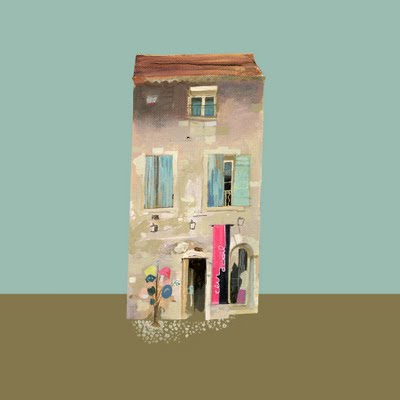
I used to be a lover of big department stores, you know, the ones full of racks upon racks of things to choose from– a little something for everyone. But that was the Suburban Florida girl in me. Since our move to the Northwest, I find myself more and more drawn to the small shops that make up most of the little towns we find ourselves living in and exploring. The shops themselves are often architectural gems, with brick walls, old hardwood floors and coffered ceilings, every time I see an empty storefront, I dream of the what a pretty little gallery or shop it might make. So I couldn’t help but be enchanted by this series by UK artist Johnny Bull, as he turns his brush to the lovely little shops to be found in the land of Degas and Monet.
Of course it goes without saying that French buildings and boutiques would be full of charm and joie de vivre, but the style of Bull’s work makes them even more delightful. In isolating the buildings against a muted pastel background, we are allowed to gaze upon them one by one, each with a personality and charm of its own.
Bull’s palette reminds me of what it might be like to see each shop in different lights of day– the blue grey of early morning, the warm glow of sunset. So lovely I can’t stand it. I immediately want to go into each shop and smell the cafe au lait and meet the quirky artists and writers sure to live above stairs.
To see more of Johnny Bull’s work, please visit his blog. Now I must go and plan a trip to France. Oh, it’s gonna happen.
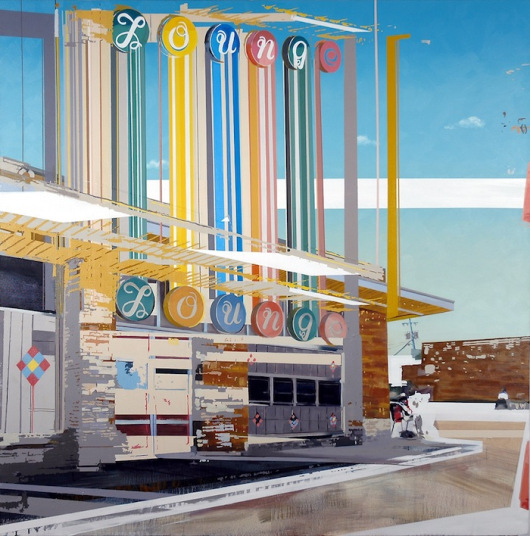
During our time here in Joshua Tree, Mr. Forager & I often find ourselves talking about what makes this place so different compared to everywhere else we’ve lived. Apart from the obvious, there is such an openness to the landscape here that creates incredible beauty, and yet, there is no place to hide abandoned buildings, rusted out cars and windblown trash. The paintings of Dallas artist Kim Cadmus Owens featured familiar lonely landscapes, infused with color and fractured lines inspired by technological irregularities.
Lounge, oil on canvas, 48×48Smoke and Mirrors: Coming and Going, acrylic and oil on canvas, 156×48
Just as the forsaken buildings once loved and cared may now be hazardous eye sores, our relationship with technology and electronic communication also shifts and evolves. We long for the immediate connection it allows, yet find ourselves frustrated and often unable to cope when the lines of communication go awry.
Pawn, carbon and acrylic on beveled wood panel, 24×30Grand, carbon and acrylic on beveled wood panel, 24×30Leader, carbon and acrylic on beveled wood panel, 24×30
We love how easy it is to connect and yet balk at how those systems of connection invade our privacy. We often find ourselves forsaking the people sitting right next to us for those on the tiny screen in our hands, just as we abandon old buildings full of character and history for shiny new strip malls. Owens use of fragmented lines and color in her work remind us that those connections have broken.
Cheap, acrylic and oil on canvas, 48×48
To see more of the work of Kim Cadmus Owens, please visit her website. How have you seen your relationships and landscape change with the changes in technology? What do you do to combat against a reliance on electronic communication & gadgets galore?
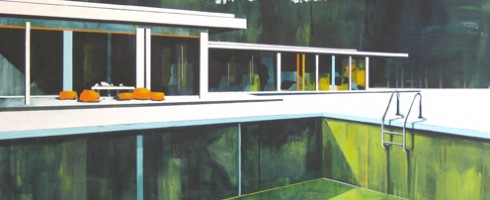
This traveling thing can be tough in many ways, but perhaps the most wearying is always living in someone else’s home. As hard as I work to make each place feel like ours, we always end up feeling a bit like house crashers. But then again, in some cases, we find ourselves caring for an otherwise empty, lonely house. Like the dwellings in Australian artist Paul Davies’ work, we are sometimes greeted by a sad shell. It is only when a house is occupied and filled with love that it truly becomes a home.
Seidler House, Sunset, acrylic on canvas, 122x153cmModern Home, Empty Pool, acrylic on canvas, 153×122 cm
Many of the houses Paul chooses to paint seem devoid of life. There are furnishings, but no people to be seen, pools with no water in which to swim.
Night Pool Copy, acrylic on canvas, 76x76cm
Like Davies’ abodes, a few of the homes we’ve occupied were crying out to be cared for. The one we rented in Coeur d’Alene was a particularly sweet little cottage that seemed so neglected due to its rental status. Any improvements were done on the cheap. What a lovely home it could have made for the right family, if only it were given the chance!
Seidler, Tree & Pool, acrylic on canvas, 122x153cmPeach Sky + Modern Home + Pool, acrylic on canvas, 122x153cm
Does anyone else see an empty house and think of how much happier it would be if it were cared for and loved as a home? Just me? What does your own home say about you?
To see more of Paul Davies’ work, please visit his website.
Featured image is Empty Pool + Modern Home + Palms, acrylic on canvas, 122×122 cm. All images are via the artist’s website.
Recently I’ve been hesitating to feature certain artists’ work because though I’ve had them in my queue for quite sometime, I suddenly starting seeing their work popping up all over other blog sites. And the last thing I want to do is seem like a copycat. But then I said to myself, Artsy Forager, why should you let that stop you from featuring talent that inspires you? I answered, I shouldn’t. Simple as that. Case in point, Berlin photographer Matthias Heiderich.
Spektrum Eins series
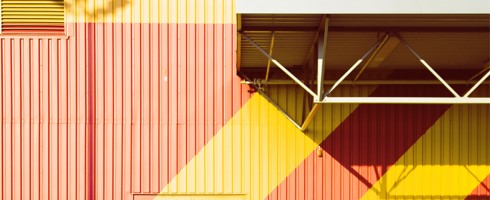
Heiderich has over ten series of images showcased on his website and any one of them are beautiful enough to be featured. But I’m currently in love with his most recent series, Spektrum Eins, so this post is full of his signature architectural loveliness.
Spektrum Eins Series
He is a master at finding the most interesting buildings and composing their intersecting angles and colors into striking, graphic compositions.
Spektrum Eins Series
His compositions are so simple yet so crisp, his colors so bright and bold. The architectural forms take a backseat to line, color and shape. Each photo is a celebration of simplicity.
Spektrum Eins SeriesSpektrum Eins Series
To see more of Matthias Heiderich’s work please visit his website ( and I highly recommend you do! ).
Do you see it? Love how these very different works compliment each other! Read more about Karen Schepf’s work here and Tom Fruin’s workhereand on Design Boom.
Featured images is Light & Shadow Play, Kolonihavehus, photographed by Nuno Neto. Images are via the artists’ websites unless otherwise noted.
We are headed to Seattle this weekend, one of my favorite cities in the world, the city where George and I fell in love. And while I was falling in love with G ( I was probably a little in love with him when we were friends in FL, but that’s a story for another time ), I was also falling in love with Seattle. I adore visiting cool cities– the urban landscape and architecture fascinates me. So it carries over that I would adore the art of the cityscape.
For this Friday Fave round-up, I’d like to share some of urbanist artists whose work I’m crushing on lately:
Hill Houses 2 by Brin LevinsonPassing 1 by Jason WebbSolitary I by John DuckworthLoew’s Hotel, 33rd Floor, Philadelphia by Sara YeomanMiyami by Darra CrosbyGreat Tortoise Hostel, Seattle by Robin WeissBoulevard Windows by Sharon Dowell
Looking forward to bringing you more from these artists soon! In the meantime, take a gander at their websites..
In my daily reading of Artinfo.com this morning I came across two articles, seemingly unrelated, until the Facebook comments regarding one of the articles tied them together for me. The first article, found here, poses the question, “Should Gaudi’s Sagrada Familia Remain Unfinished?” The Barcelona basilica, begun in 1882 by renown artist-architect Antonio Gaudi is still under construction eighty-five years following the architect’s death.
Though Gaudi left plaster models and drawings, many of his notes were destroyed during the Spanish Civil War, leaving his vision open to interpretation by current sculptors, architects and designers. While some critics feel the current direction doesn’t jive with Gaudi’s original vision, even during his lifetime, there were many sculptors working on the basilica. Like any monumental undertaking, “it takes a village” to bring Gaudi’s creation to life.
Should Gaudi’s original design be so open to interpretation? He gave artistic license to those working under him while alive, would he so object to modern interpretations now being imposed? Unlike other types of sculpture, cathedrals are often the product of centuries worth of work by multiple architects, artists and craftsman.
As Gaudi was aware he would not be alive to see it to completion, wouldn’t he have known his original design would be open to interpretation by those who came after him? Does the fact that Gaudi is not here to personally oversee the work negate the additions?
Artists using apprentices and assistants is nothing new. The art world of the Renaissance era, which produced such celebrated masters as Michelangelo and DaVinci was built upon the concept of apprenticeship. But what about now? The second article I read this morning was regarding the approval of a Dale Chihuly museum at the site of a former amusement park in downtown Seattle ( now the Seattle Center ).
The museum in itself is the subject of controversy, but that isn’t what I’d like to address here. Instead, I’d like direct attention to another Chihuly controversy– his use of others to craft his designs. One Facebook poster thought it necessary to point out that since losing the use of his left eye due to a car accident, he is no longer the person actually blowing the art glass he is so famous for. ( In reality, Chihuly continued to blow glass for three years following the accident, until a body surfing incident dislocated his shoulder, so he was no longer able to manually manipulate the glass ). The poster’s statement that “His employees make everything. Just sayin’.” seems to somehow fault Chihuly for continuing to create in the only way he physically could, by having others help him. The artist himself has said that his role, more of a director, allows him better perspective on the work.
As stated above regarding Gaudi, the practice of using assistants and apprentices to create monumental works of art has been done for centuries ( and yes, many of Chihuly’s creations are monumental in scope ). So as long as the artist himself continues to design the creations with his name on them, what’s the big deal?
And what about so-called “production originals”? You might be thinking of the ones advertised as “hand painted original works of art”, usually being sold out of a hotel ballroom. But what I’m talking about are the production art studios– where perhaps one “lead artist” is creating original works of art, which are then being recreated & reproduced by the hand of “assistant artists”. There are more of these studios around than people realize and the work can be found in galleries, corporate and private collections all over the world. While the savvy gallerist, art consultant, designer and art afficionado knows production art when they see it, what about the collector who thinks they are buying a true original work of art, only to spot an almost exact replica when in their hotel while on vacation in Hawaii? Do we lump Chihuly in with these?
These are three examples of artwork being completed and accomplished without the direct hand of the creator. What are your thoughts? Is it ever OK to put your name on something you didn’t actually physically create? This is definitely a gray area.. would love to hear your thoughts!