I have a soft spot for vintage pressed glass. My grandmother had tons and in a few boxes in storage somewhere, I have my own collection of milk glass. So when I spotted the work of Philadelphia artist Amber Cowan, I was immediately in love.
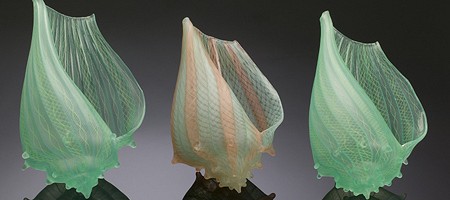
Cowan creates her magical sculptures from a process of flameworking, blowing, and hot-sculpting thrifted American pressed glass. The most amazing form of creative upcycling! With its tightly bunched flora and peek-a-boo fauna, Cowan’s work takes on a wonderfully gothic, fairy tail-like effect, like intricate illustrations come to life.
So much is made of the clothing we place on our bodies. I maintain my belief that the clothes we choose make a statement about who we are. But lately, the concept has been taken further to encompass not just the style of the fashions we wear, but what they are made of, where, and how. In her sculptural work, glass artist Cassandra Straubing addresses domestic and industrial labor, two of the major producers of clothing through the centuries.
With His Wife Now Gone, His Clothes Never Seemed to Make it Back in the Drawer, cast glass with found objects, 33.5x17x19With His Wife Now Gone ( detail )
Last Monday, as I was driving home, ironically from a day of shopping for a few clothing basics at Target, TJ Maxx, etc., I listened to this story on NPR regarding the trend of “fast fashion” begun in the 1980s and gaining relentless momentum since. Clothing is being produced, consumed, and disposed of at alarming rates, all the while using up valuable finite resources. And although the impetus behind Straubing’s work, according to her artist statment, is linked more to clothing as a representation of who we are and who we become, I see in it a throwback to the simplicity of the way clothing was once viewed– it’s first purpose was practical, perhaps overalls or an apron for every day, a suit and “Sunday dress” for special occasions.
The Beekeeper’s Wife, cast glass with found objects, 18x32x3Mrs. Evans, kiln cast glass and found objects, 22.5x30x3.25
But today, we fill closet after closet with “disposable” clothing, literally buying into what the fashion industry, media and manufacturers tell us we need. As Straubing’s glass articles of clothing suggest, we are all becoming naked emperors.
She Waited for Him on Pins and Needles ( detail )
How do we combat against falling prey to trendy fashion? Perhaps if we imagined each new fashion was sculpted of glass, might we be so quick to want it? Says the woman who travels with 5 large plastic bins of clothes, 1 giant suitcase, and several smaller suitcases. But I’m working on it and have two garbage bags full of Goodwill destined clothes to prove it.
Did you have a favorite animal growing up? One that you loved, identified with, family members bought you t-shirts & stuffed animals in their likeness? Isn’t it interesting how we, as young children, identify with our fellow members of the animal kingdom, then as with most of the magic of childhood, we outgrow our connection to our spirit creatures. The work of Tuscon artist Katja Fritzsche reminds us that those connections we once felt are not gone forever, only buried for a time.
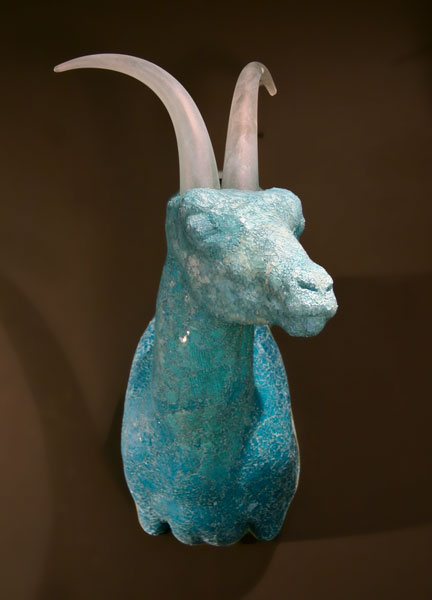
Blue Sky Ram, reverse painted mosaic and hand cast glass, 30x20x22
By casting her creatures in the glass with perceived rigidity and coldness, Fritzsche’s work serves to recall to us that though we overlook our fellow animals, destroying their habitats as we build our own glass and steel monuments, they are still among us. We catch glimpses of them in unexpected places, a lost deer wandering a suburban neighborhood, a hawk perched high atop a skyscraper.
Edge, blown glass and hand worked bronzeMigration, cast glass and hand forged bronze, 18x10x10Mapplethorpe, mosaic glass and hand worked glass, 30x21x10
As we amble clumsily through life, the animals live each day with instinct, grace, and purpose. Each born to his own calling and knowing it from birth. How have we strayed so far from our own guiding spirits?
Violet, blown glass, mosaic glass and pressed flowers, 24x15x22
To see more of Katja Fritzsche’s work, please visit her website. I went through a pretty serious manatee phase when I was young– such gentle, unassuming animals, while Mr. Forager has always had a fascination with wolves. What creature did/do you identify with? Has it changed over the years?
With the increasing sophistication of technology, we have become more and more aware of the realities of what was once mysterious. We know what the inside of our bodies look like, it’s even possible to see an unborn baby in 3-dimensional form. We can know what our children will look like before they ever take their first breath. Yet, what remains to be revealed is their personality. How they will evolve spiritually and emotionally remains a mystery. Sculptor Christina Bothwell‘s figures illustrate for us the metamorphosis of our beings, our deliverance into who we are become.
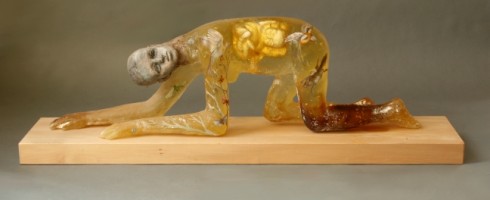
In her cast glass sculptures, Bothwell incorporates figures within figures. We see smaller figures nestled into the glass, most often in the shape of a newborn.
Octopus, cast glass, raku clay and oil paint, 48x23x23
From the artist: “I think of these pieces as souls, each being pregnant with their own potential, giving birth to new, improved versions of themselves.”
Hair, cast glass, raku clay and oil paints, 10x31x8
As long as we are breathing, we are constantly evolving, hopefully into a better version of ourselves. Wouldn’t it be fantastic to know that at the end of your life, you had become your most strong, your most loving, your most compassionate, the very best version of you?
Centaur, cast glass, raku clay, oil and found objects, 21x21x11Phoenix, cast glass, raku fired clay, oil paints and wood, 33x60x21
Bothwell’s work shows us, not the end result, but the transformation. We see the adaptation and evolution of the spirit as translated into the material. To see more of Christina Bothwell’s work, please visit her website.
Featured image is Dawn, cast glass, ceramic, wood and oil paint, 38x10x7. All images are via the artist’s website.
Happy Friday, Artsies! If you’ve been reading the blog for a while, you have probably noticed that it’s a little painting heavy. Painting as a medium is my first love, ooey-gooey globs of paint on a canvas will always be the first thing to catch my eye. I hate that it seems like sculpture is the red-headed step child of the art world. I do love beautifully rendered sculpture and have vowed to feature it more here. So as I work on some sculptors to feature soon, here’s a round-up of some three dimensional work that I am especially drawn to.
Vanilla Driftwood by Treg Silkwood and Candace Martin, AKA Silkwood GlassSeedpod, Nested by Eric MossPod, burnished earthenware and soluble metal saltsNest by Michael Roco, mixed media
Do you have a favorite 3-d artist? Do tell! Have a fantastic weekend, Artsies! To see more of any of the above sculptors’ work, please visit their websites:
PDX is slang for Portland, apparently. I kept seeing it everywhere in Portland this weekend and being from Florida, of course had no idea what it meant. Was it some sort of secret code? Some inside joke only super-hip Portlandians knew about? Nope, just Portland’s airport code, which has become short for Portland, just like JAX is short for my hometown of Jacksonville. I must admit, I was a bit disappointed that there wasn’t some sort of subversive meaning to PDX, at least not one I could find on Google.
After a month in the Northwest, George & I finally made the 2 1/2 hour drive from Aberdeen, WA to Portland last Saturday. We’ve already hit a couple of smaller artsy destinations nearby ( Olympia, WA & Astoria, OR ), but finally worked our way up to the mac-daddy of them all, Portland. The home of hip. We were only in Portland for the day, so decided it would be best to limit ourselves to one section of the city. So we chose The Pearl District, for its galleries for me and its proximity to Powell’s Books, Stumptown Coffee & Rogue Brewery for George. I try to make sure that when I drag him gallery-hopping, there is always the promise of beer. This makes for a much happier husband.
Work by David Slader at Gallery 903
Gallery 903 was filled with contemporary painting, sculpture and mixed-media work. I can usually tell the minute I walk into a gallery whether or not I’m going to enjoy my visit and find artists to blog about. As soon as I saw wonderfully textured abstracts and thoughtfully placed sculpture, I knew Gallery 903 was a good stop. The work of the artist above, David Slader, got George’s attention before than mine. Slader is a former high-powered attorney turned artist and after reading his tongue-in-cheek artist statement, I had a better appreciation for him. His work has deep texture , a powerful palette and expression. Here’s an even better shot of “You Want to Dance”, that gallerist Herschel was nice enough to email me..
You Want to Dance, Oil on canvas, 24×24
This was just the first of the delights to be found at 903. While George continued to admire the Sladers, I rounded the corner and happily came across a little niche and what was to be found there? Some thrilling little Salvador Dali prints!
Salvador Dali prints at Gallery 903
Complimenting the Dalis in the same little space were two epoxy-resing pieces by Alan Fulle. One of my favorite things about working in a gallery was designing & creating tableaus of artwork that coordinate together in unexpected ways. Virtual congrats to whomever hung the work in this gallery.
I absolutely loved this bronze geese sculpture! George wasn’t quite as enamored. What’s not to love about lovey-dovey, fat bronze geese? I mean, really, how could you not love them?! Oh well, moving on..
Augen Gallery had two interesting exhibitions showing, the first, work by Wendy Franklund Miller– I am a sucker for encaustics. There is just something about that waxy texture that I adore.
Artist: Wendy Franklund Miller, Augen Gallery
The kind-of cosmic feel to Franklund Miller’s work was a great complement to their other exhibition, Light Drawings by James Minden.
Artist: James Minden, Augen Gallery
These “light drawings” are scratched/etched PETG ( plastic ) reflecting light. They are totally trippy in the best sense. We had so much fun looking at these from all different angles. Check out this slide show to see better photos than I could have taken: James Minden on Vimeo.
Continuing the equestrian kick I seem to be on lately, Froelick Gallery happened to be showing Equine, a juried group exhibition showcasing the horse. A diverse showing of work centered around our four-legged friends, it was fun to see the variety of interpretations, including a plate from the famous MuybridgeAnimal Locomotion series. George was drawn to the work of Miles Cleveland Goodwin, which while beautifully rendered, was a bit on the dark side for my tastes. I love how the differences in our tastes spark lively discussion!
Artist: Miles Cleveland Goodwin, Froelick Gallery
I, on the other hand, fell in love with the giant below. White Shadow by Rick Barstow is pastel on paper, 74″ long and it is fabulous. I’m not sure what I love more, the lovely layering of the pastel, the unfinished, sketchy-quality or the scribbled “HORSES” at the bottom. It’s all workin’ for me. Or maybe it is that the straight-on gaze of the horse reminds me of an illustration of a story my grandmother used to read me as a little girl, The Goose Girl.
Artist: Rick Barstow, Froelick Gallery
Our next stop, Bullseye Gallery has a kick-a$$ space. Two levels, full of exposed brick and metal work, rustic wood and these amazing little installation rooms. I got so caught up in admiring my surroundings that I failed to take many pictures. I know, bad little blogger. The gallery is part of Bullseye Glass Company, maker of colored glass for art & architecture. Oh, that explains why there was so much incredible art glass!
Our final destination was Butters Gallery. Are ya’ll tired yet? Because I sure was by this point in the day. ( We’d also hit the Saturday Market, Stumptown Coffee, Powell’s Books and Rogue, in addition to all the galleries. ) Butters reminded me of some of the Chelsea galleries in NYC, as it was kind of hidden away, on the 2nd floor of a walk-up building.
Artist: Susan Hall, Butters Gallery
Butters had some really interesting work on display, I hope to bring you more on those artists very soon, especially the one whose work is pictured above, Susan Hall. I fell head over heads for her work– my crappy picture doesn’t even begin to do it justice. I’ll feature her more in depth in a separate post in the next few weeks.
So ends our little jaunt through Portland’s Pearl District galleries. I can’t wait to go back to PDX and explore the other art districts. This weekend we’re headed North!
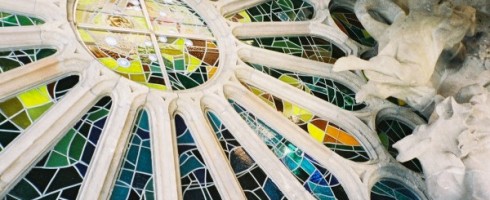
In my daily reading of Artinfo.com this morning I came across two articles, seemingly unrelated, until the Facebook comments regarding one of the articles tied them together for me. The first article, found here, poses the question, “Should Gaudi’s Sagrada Familia Remain Unfinished?” The Barcelona basilica, begun in 1882 by renown artist-architect Antonio Gaudi is still under construction eighty-five years following the architect’s death.
Though Gaudi left plaster models and drawings, many of his notes were destroyed during the Spanish Civil War, leaving his vision open to interpretation by current sculptors, architects and designers. While some critics feel the current direction doesn’t jive with Gaudi’s original vision, even during his lifetime, there were many sculptors working on the basilica. Like any monumental undertaking, “it takes a village” to bring Gaudi’s creation to life.
Should Gaudi’s original design be so open to interpretation? He gave artistic license to those working under him while alive, would he so object to modern interpretations now being imposed? Unlike other types of sculpture, cathedrals are often the product of centuries worth of work by multiple architects, artists and craftsman.
As Gaudi was aware he would not be alive to see it to completion, wouldn’t he have known his original design would be open to interpretation by those who came after him? Does the fact that Gaudi is not here to personally oversee the work negate the additions?
Artists using apprentices and assistants is nothing new. The art world of the Renaissance era, which produced such celebrated masters as Michelangelo and DaVinci was built upon the concept of apprenticeship. But what about now? The second article I read this morning was regarding the approval of a Dale Chihuly museum at the site of a former amusement park in downtown Seattle ( now the Seattle Center ).
The museum in itself is the subject of controversy, but that isn’t what I’d like to address here. Instead, I’d like direct attention to another Chihuly controversy– his use of others to craft his designs. One Facebook poster thought it necessary to point out that since losing the use of his left eye due to a car accident, he is no longer the person actually blowing the art glass he is so famous for. ( In reality, Chihuly continued to blow glass for three years following the accident, until a body surfing incident dislocated his shoulder, so he was no longer able to manually manipulate the glass ). The poster’s statement that “His employees make everything. Just sayin’.” seems to somehow fault Chihuly for continuing to create in the only way he physically could, by having others help him. The artist himself has said that his role, more of a director, allows him better perspective on the work.
As stated above regarding Gaudi, the practice of using assistants and apprentices to create monumental works of art has been done for centuries ( and yes, many of Chihuly’s creations are monumental in scope ). So as long as the artist himself continues to design the creations with his name on them, what’s the big deal?
And what about so-called “production originals”? You might be thinking of the ones advertised as “hand painted original works of art”, usually being sold out of a hotel ballroom. But what I’m talking about are the production art studios– where perhaps one “lead artist” is creating original works of art, which are then being recreated & reproduced by the hand of “assistant artists”. There are more of these studios around than people realize and the work can be found in galleries, corporate and private collections all over the world. While the savvy gallerist, art consultant, designer and art afficionado knows production art when they see it, what about the collector who thinks they are buying a true original work of art, only to spot an almost exact replica when in their hotel while on vacation in Hawaii? Do we lump Chihuly in with these?
These are three examples of artwork being completed and accomplished without the direct hand of the creator. What are your thoughts? Is it ever OK to put your name on something you didn’t actually physically create? This is definitely a gray area.. would love to hear your thoughts!