Every artist has their own style, not just in the work itself, but in the way they work. What we wear in the studio has as much to do with our personal style as it does with our working style. Messy painters and sculptors probably don’t wear precious clothing or jewelry in the studio!
My own personal studio style is an extension of what I like to wear every day. I don’t like changing clothes throughout the day and since I work freelance from home, I can pretty much wear whatever I like. I do, however, like to feel “ready” to work– I never roll out of bed in my pjs and get to work. Putting on my studio clothes is as much a signal to get down to painting as putting on my favorite music.
So what do I wear in the studio? Comfy clothes and shoes for a start.
My favorites are a t-shirt or tank under an oversized flannel or chambray with stretchy leggings.
I layer up because mornings here in the PNW are usually chilly but if I’m working hard, I’ll soon need to strip off that top layer. Fashion faux pas or not, leggings let me move easily and comfortably and they are my fave. I buy the cheapies from Target so I don’t feel guilty when they end up with paint on them.
Since living in the PNW, I can wear my most comfy old boots in the studio for most of the year.
In the warmer summer months, I opt for cheap flip flops I don’t mind getting paint and medium all over. Although, this year I’ve noticed a difference in the way my legs feel after wearing the flip flops in the studio all day so think I need to find a more orthopedically friendly choice.. ugh. Getting old is for the birds, ya’ll.
I always wear an apron in the studio– since we’re traveling light, my clothes need to be able to do double duty, so I can’t really have a set of clothes just for the studio. A sturdier apron works best for me, since I tend to use a lot of glazing medium, which has a heavy, glue like consistency and will go right through thinner aprons (which I discovered the hard way).
I rarely remember to remove my rings and watch before I start working, but find that acrylics clean up off them easily enough if I get super messy.
How about you? What’s your best get down to work wear?
Side note: All those artists I see on Instagram painting in bikinis or cute dresses and heels? No way you’re actually painting in that. Let’s be real with ourselves and each other.
What our eventual home space will look like is a major topic of conversation for Mr. F and I. We’re on our 15th(!) living space in 6 years of traveling and with each new home we discover what works for us and what doesn’t.
Since amping up my studio practice in the last several years, having space to paint has become more and more important for my happiness as an artist and well, the Mr. knows that happy wife=happy life. For our permanent living situation, we’ve talked about an in-home studio, backyard studio, and off-site studio. But lately, we’ve been seriously thinking about a live/work studio home.
Even when I have a little studio area, my painting paraphernalia always seems to find its way out into the other living areas. We don’t want a huge house with wasted space, so why not combine our living space with my work space?
Mr. F isn’t picky and he’s super low maintenance, not minding the thought of basically living in a big artist’s studio. All that he requires is a comfortable bed, sofa, and well-functioning kitchen. We both prefer spaces that aren’t precious– none of that “furniture you can’t sit on” for us. So I think we’d be OK with knowing there may be random paint splatters happening.
With that said, I’m a pretty neat painter– I always wash my brushes and keep my studio pretty clean and organized. So I think we wouldn’t have to worry too much about living in a disaster zone.
We’re still a few years away from settling down, so we have lots of time to ruminate on this option. Any of my artist readers work/live in the same space? I would love to hear your experiences!
When I’m in the studio, I’m always listening to something– just what depends on my mood and what I’m working on. Sometimes it’s music, sometimes podcasts. I have a few “go-to” podcasts that I really enjoy and thought you might like a listen if you haven’t tried them out already!
We all know Danielle Krysa as a champion of artists, but it turns out she is also a fantastic interviewer! Danielle spends time chatting with artists over coffee or an adult beverage, getting the low down on their backgrounds, artistic inspirations and aspirations, and fun tidbits like whether they prefer potato chips or chocolate. I’ll take chocolate covered chips!
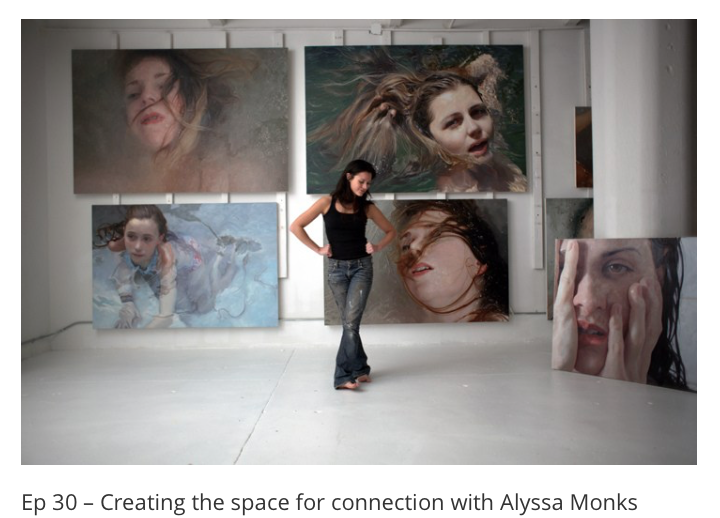
A painter with a sincere appreciation for the ins and outs of the studio work of other painters, John Dalton’s podcast Gently Does It, is a joy to listen to, especially for gaining insight into the minds of some of the best painters working today. I have a few favorites that I’ve listened to multiple times including Ep. 30 pictured above featuring Alyssa Monks and Ep. 26 and 27 with Ali Cavanaugh.
I have a soft spot for Joshua Tree, California. If you’ve been a longtime reader of AF, you may remember, Mr. F & I spent six months living in JT a few years ago. Joshua Tree has a distinctly creative vibe, which attracts all sorts of artsy folks to the high desert. Emily Silver interviews local JT area artists in their studios, which adds a layer of familiarity to her interviews that isn’t there among the podcasts in which interviewer/interviewee are separated by miles. The artists and Emily both continue to remind me of what an inspiring and magical place Joshua Tree can be.
Gale Straub’s She Explores podcast centers around the experiences of women in the outdoors. Artists, entrepreneurs, and thru-hikers are among her interviewees. Each bringing their own unique experience to the podcast. Listening to the SE podcast makes me want to get outside and if you take your inspiration from nature, like I do, I promise you’ll be inspired!
I’ve been a reader of Young House Love longer than any other blog I’ve followed. Even from before they were YHL (I remember This Young House!). Anyone who reads their DIY blog knows these two are super fun and super cute. Listening to them is like hanging out in your best friend’s kitchen.
Wild author Cheryl Strayed joins Steve Almond in dispensing advice to Dear Sugar listeners on this weekly podcast. Smart and insightful, this one is a favorite when I’m gessoing!
hover over the photo above and click through for a peek into the artist’s studio
As artists, once in a while, we come across someone who inspires us, who thinks the way we do, who spurs us to greater heights– artistic kindred spirits, if you will. I’ve featured Bay Area artist Jeffrey Beauchampbefore just recently, but the invitation for a visit to his studio before we left Marin County was too good to pass up and his work too good and inspiring not to share again!
I had so much going on personally while we were in Marin, that it was a challenge just to find the time to go to Jeff’s studio. Something always seemed to be getting in the way and we ended up putting it off until my next to last week in the Bay Area. I gave myself two hours to meet with Jeff before another appointment that day. But soon after we began talking, I found myself wishing we had met up sooner and that I had been able to give him more time that day.
The way Jeff works is almost antithetical to my process– he often takes years to finish a painting, while I rarely take more than an afternoon. Immediately, I felt like there was a lesson in that for me. That I need to have a willingness to take my time, to be able to let go and let something be for a while so that I know for sure where I need to take it.
Jeff lets his work sit, he is able to wait with it, to let it speak to him. To continue to work and rework until it reaches its conclusion. In doing so, there is a layered depth to his work that creates stunning visual texture.
the view from the ark, oil on canvas, 96×72
walrus suffrage gains ground, oil on paper, 28×20
There is also a willingness to be constantly experimenting and evolving his process. For instance, Jeff has recently begun a series of works on paper, reinforcing and validating my own decision to work on paper. We reveled in the distinct pleasure to be found in ripping the tape borders off upon completion! If you work on paper, you know that feeling well! Jeff has found, as have I, that in theory works on paper seem like they would come more fast and loose, but the work is the work and often creating a finished painting on paper takes as much time as painting on canvas or panel.
Another constant in Jeff’s practice is continually looking to and learning from the masters who have come before. For instance, he began a painting based on a Claude Lorrain drawing, taken from one of the many books strewn about his studio. Beginning with a sketch, he worked into the painting below and completely made it his own.
lorrain inspired sketch
proper & common- some of my best friends are nouns, oil on canvas, 60×72
Another lesson I took away from meeting with Jeff was the importance of pursuing what excites you and moves you, despite what may be trendy or popular. Though his landscape work is popular and sells well, Jeff loves to paint monumental figures and quirky narratives. It may take longer for these paintings to find their collectors, but once they do, he knows that they are collecting the work out of a passion for the visual story he is telling, a connection that doesn’t always exist with even the most beautiful landscape.
You can see more of Jeff’s work by visiting his website and following him on Facebook and Instagram.
Thank you, Jeffrey Beauchamp, for opening up your work and your studio.
Studio images by Artsy Forager. Art images via the artist.
hover over the photo above then click through for a peek into the artist’s studio
We live our lives in and within structures. From the house we call home, to the universe itself, to our very bodies, structure has a crucial role to play in every aspect of our lives.
San Francisco artist Howard Hersh is exploring the dualities of structure simultaneously in his two series, Dispositions of Structure ( encaustics on panel ) and Skin Deep ( acrylic on birch and basswood ).
His series of encaustics on panel, Dispositions of Structure are paintings about structure— physical, social, intellectual structures as well as the natural architecture of the universe. Skin Deep, on the other hand, are structures about painting— explorations into the idea that of the existence of the painting not just as a depiction of an object but as an object itself.
The connections and fluctuations in his shapes, the way they seem to move in and out, backward and forward make me think of how dependent we are on those structures in our lives. Societal structures such as laws and mores keep us safe and our base instincts in check while we rely on the health of our bodily structures to keep us alive. One type of structure doesn’t do much good without the other.
To see more of Howard Hersh‘s work, please visit his website. Howard was kind enough to invite Mr. F and I to tour his studio. Be sure to click through the studio tour at the top of the page!
Over the past five months, Artsy Forager has been nice enough to welcome my guest posts about my arts residency in Bali. During this time, I have shared some of my favorite experiences, artists, studio visits, and reflections.
To end this series on a high note, I saved the best for last. One of the nicest and most welcoming artists and people I met during my residency is woman named Ni Nyoman Sani. She welcomed me to her home, to Mother Art Space (then called Seniwati Art Space), and to her family’s shared creative workshop and gallery Muja Art Studio. Sani also helped to arrange multiple interviews with talented female artists ranging from internationally known painters like Mangku Muriati to younger emerging artists like Emy Triani and Ni Ketut Ratnasih.
Ni Nyoman Sani’s studio at Muja Art Studio, Sukawati, Bali. Photo courtesy of Ellen C. Caldwell and the artist.
Part of Sani’s charm and charisma is that she seems to always put others first in such a generous and heartfelt way. She shied away when I focused questions on her, instead always insisting on highlighting the work of her fellow artists and family members.
With this in mind, I am going to take a few moments introduce her work with Mother Art Space and her multi-generational family studio, and then I will share my interview with Sani about her own work and art practice, in order to turn the tables and reflect some of her light back onto her art, work, and passion.
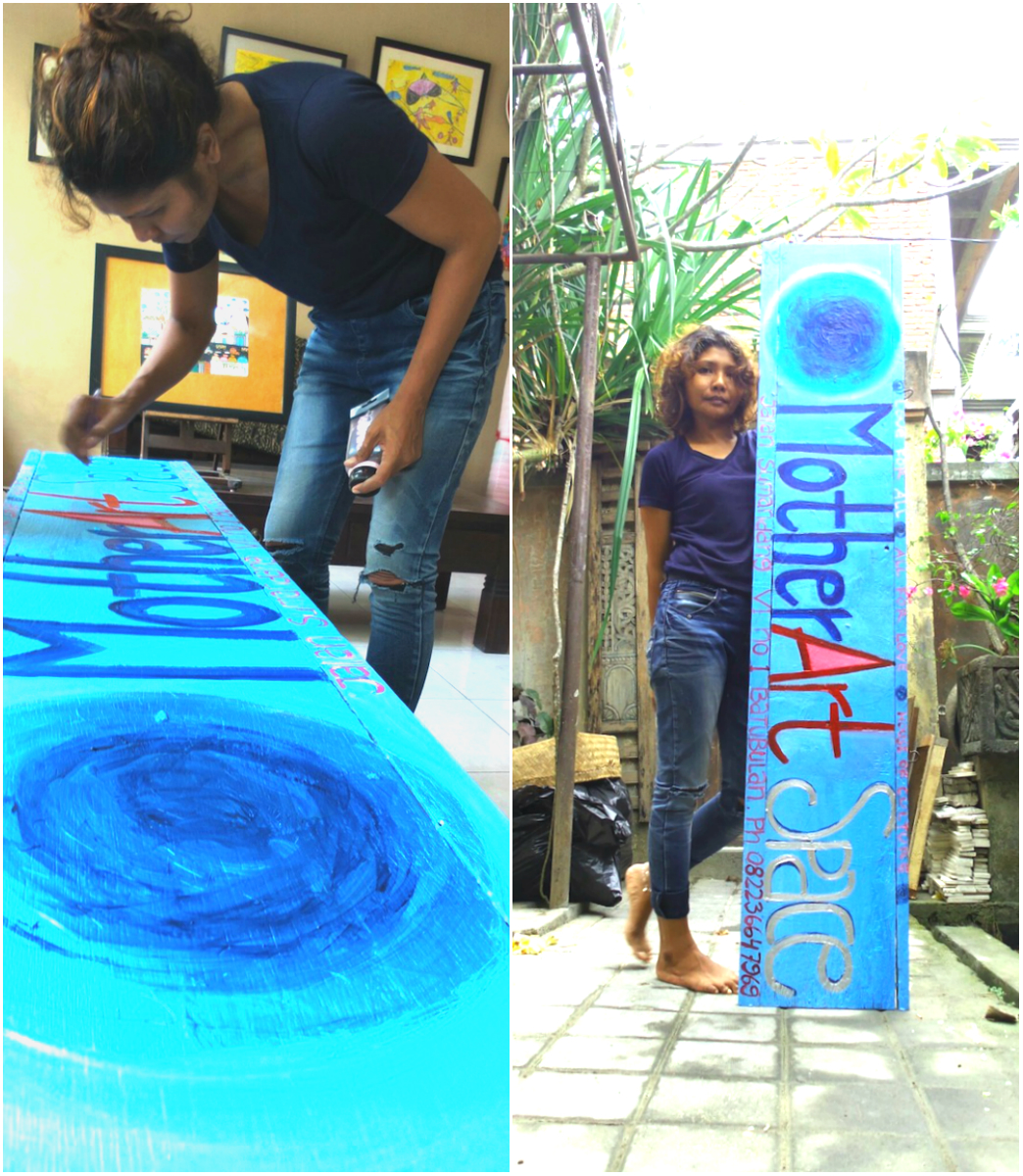
Ni Nyoman Sani with new sign Mother Art Space, Batubulan, Bali. Photo courtesy of the artist.
Mother Art Studio originally started as Seniwati Gallery in Ubud, and then later transitioned into Seniwati Art Space under Sani’s guidance and direction. There, she created a nurturing creative space that encourages collaborative workshops, exhibitions, and studio gatherings with women—both locally and internationally. In this sense, it is not just a gallery space, but a center for collaboration and shared support between women. Since there are not as many female artists practicing art in Bali (particularly in the more contemporary scene), this is really special and important.
However, Sani has recently cultivated some new changes in the space, changing its name to Mother Art Space and casting a wider net of participants to include male and female artists of all generations. Sani felt that there was a wider group of artists she could reach if they expanded their scope in this way and they are now planning exhibits, collaborations, and international residencies there.
left | Façade of Muja Art Studio, Sukawati, Bali. Photo courtesy of the artist.
right | Made Supena, Balinese stone, 2004. Muja Art Studio, Sukawati, Bali. Photo courtesy of Ellen C. Caldwell and the artist.
Another endeavor Sani helps to manage is her multi-generational family art space called Muja Art Studio. Muja features the work of six family members from three different generations – including sculpture, painting, carving, performance art, and more.
top right | Ketut Muja, Bhima, carved wood. Muja Art Studio, Sukawati, Bali. Photo courtesy of Ellen C. Caldwell and the artist.
top left | Ketut Muja, The story of knowledge, carved wood. Muja Art Studio, Sukawati, Bali. Photo courtesy of Ellen C. Caldwell and the artist.
bottom right I Ketut Muja, The story of knowledge – detail.
bottom left | Sculptural works by I Wayan Jana. Muja Art Studio, Sukawati, Bali. Photo courtesy of Ellen C. Caldwell and the artist.
Here, there is a range of working studios and gallery spaces so that one can visit this creative center and see art in process in addition to the finished work on display. The studio is a delightful and inspirational place to visit, featuring the work of:
I Ketut Muja, sculptor, age 71
I Wayan Jana, sculptor, age 46
I Made Supena, painter and sculptor, age 42
I Ketut Sugantika Le Kung, painter, performer, and sculptor, age 38
Ni Nyoman Sani, painter, poet, clothing designer, and photographer, age 38
Together, they are a family of artists showing their works internationally in exhibits ranging from locally in Bali and Jakarta, and going to Singapore, Australia, Spain, Holland, Belgium, and Germany.
left | Made Supena, The Mountain Series. Muja Art Studio, Sukawati, Bali. Photo courtesy of Ellen C. Caldwell and the artist.
right |Made Supena, Embryo Series 2, Muja Art Studio, Sukawati, Bali. Photo courtesy of Ellen C. Caldwell and the artist.
And last but not least, I would like to end by sharing my interview with Sani, as we discussed her work and process. Her paintings satisfy and explore a cosmopolitan sense – focusing on smart fashion, both international and Balinese. There is a clear strength in the women she depicts and after meeting Sani and learning about her work, this all makes perfect sense. She is all about supporting artists – both young and old, male and female, local and abroad. And it is a privilege to know her.
Ellen Caldwell | When did you start painting/practicing your art?
Ni Nyoman Sani | I started painting on canvas in 1990. I loved to paint from when I was a little girl. And I became a member of Seniwati Gallery in 1994, when it was in Ubud. I continued my education at the Art Institute in Denpasar from 1995 – 2000. Until now still acting with my art creatively and I also lead the Seniwati Art Space [now Mother Art Space, as of July 2014] and in the future, Muja Art Management.
EC | Have you always painted or did family teach you?
NNS | Art is my second soul, and none of my family is doing the same. I feel blessed with my art life and love to continue it, for giving and sharing some changes with other women.
EC | Please tell me a little bit about your process. What is unique about it?
NNS | I love to look at in every moment of life, and focus my eyes on people and what they do to grow up. Their life, especially the specifics…not too far from daily life. And all becomes unique and accumulates in my mind. At this time, then a new idea will follow in my art process.
left | Ni Nyoman Sani’s studio at Muja Art Studio, Sukawati, Bali. Photo courtesy of Ellen C. Caldwell and the artist.
right | Ni Nyoman Sani’, painting detail. Photo courtesy of Ellen C. Caldwell and the artist.
EC | Do you have a signature style or look that is unique to you?
NNS | I paint with my own style…fashion and women. And it’s become unique with the head cropping I do.
EC | What are you currently working on?
NNS | I usually work with my ideas, and I love to combine poetry, art, photograph, fashion, and also video art…My husband always supports me, our children give us time, and our family mostly support it. My friends, we are always sharing about what we are doing to increase Balinese art.
EC | How do you think that living in Bali has impacted your own artistic practice?
NNS | Bali for me is a good place and all my life has been here. I am a totally Balinese woman. But part of myself belongs to the art world. I mean, I feel free to become who I am. But it is also hard, because I am a Balinese—with full social and traditional life.
I enjoy my life; I have a kind husband, two children who understand my life, family who always back up me, and a lot of friends who really care about and love me.
***
Many thanks to Sani for her creative inspiration and for all of the work she does to encourage and cultivate the arts in Bali. Contact Sani to find out more about visiting her studios or applying for art residencies, workshops, and collaborations.
To learn more about my time researching and writing about art in Bali and to see more of Sani and Muja Art Studio, please view the video below.
Ellen C. Caldwell is an LA-based art historian, writer, and editor. For links to all of her Bali-related writing (and future writings), please visit the Bali portion of her website. Many thanks to Lesley for featuring my posts and welcoming my writing and creativity to find a home here these past five months.
byEllen C. Caldwell In my series of guest posts for The Artsy Forager, I have been writing about my time in Bali during an arts residency earlier this year. I was introduced to painter Federico Tomasi by another artist Giovanni Lovisetto on a trip to Bali in 2012 and upon my return, I was lucky to revisit Tomasi’s studio and discuss his current works.
As many of us in creative fields know, artistic inspiration is always something of a process. As artists, we are constantly pursuing new creative styles, mediums, subjects, narratives, and voices. Through this process of searching for ourselves, we get used to the circle of finding our grounding, losing our footing, and continuously rebuilding our foundations.
This process can feel painful, isolating, and challenging, but it can also offer creative redemption, freedom, and inspiration. As I discussed in an earlier essay The Writer’s Ledge, these moments on the creative “ledge” are simultaneously terrifying, jarring, and exciting, ultimately yielding the most creative and unique results. It was a joy to visit with Tomasi and discuss the pitfalls and roadblocks we all endure during the creative process—while also seeing the moving and dynamic results coming from this beautiful struggle.
In discussing the beauties and beasts of the unknown, the cycle of returning back to our roots and formal training, and the bounty of this very endeavor, Tomasi and I explored the ongoing challenges that come with living the creative process. Ellen Caldwell | Please tell me about the large-scale, monumental portraits you are working on in your studio now.
Federico Tomasi | The large, vertical-scaled portraits are simply the desire to make them have a monumental aspect even if they are paintings—more as sculptures, huge and oversized for a different perspective. The chromatic choice of colors goes from that marbled, transparent feeling to the copper and bronze. And of course the unusual dimension (3 meters tall and 1 meter wide) helped me to reach what I had in my mind. I actually like them leaned on the wall rather than hung so they look more three dimensional, as sculptures are. It’s still an open chapter for me so let’s see how it will end.
EC | How do they differ from your previous bodies of work?
FT | I don’t think those particular ones are very different from my previous paintings in terms of technique and apart from what I mentioned before, of course. There is a step forward or a research of something different, chromatically speaking, and there are more visible parts of the body instead of the close up facial portraits I used to focus on. There are so many elements that occur to me in this process so it’s a bit difficult to give a harmonic answer… EC | Who are you painting in your portraits now? Could you tell me a little bit about how you have chosen your current subjects or is it still too soon to discuss?
FT | I really don’t know where I’m going right now! I’m trying different things at the same time and the subjects just come either from pictures or movies or my own sketches. I’m still waiting for that sparkle to arrive and a bit of anxiety made me just paint without thinking too much! I have been working on two large portraits of my grandmother who passed away last year. She was incredible, so that brought me to another level. I remember working day and night on those pieces as they where so personal to me. I painted them with oils, which also made it very intense.
EC | We talked a lot about artistic background and training – how often an artist will learn to paint by copying and mimicking the masters. And you were saying that in some ways you felt like you had to return to this time and go back to more of your original training. What inspired you to move in this direction?
FT | Well each artist has his masters and backgrounds to actually admire and learn from—it depends on your goal—for sure not by copying, but what I was saying was that there are skills when it comes to figurative art that have to be there and it’s important to feed those skills to be able to move on. I believe you have to know how to do things in a traditional way to be able to do something very different in the future. I guess it’s the technique that matters in my case… When I feel it’s time to move forward, I always start from some basic skills (traditional) and from there find my own direction
EC | Where do you see yourself moving, having circled back to this original training? Do you see it taking you in an entirely new direction now?
FT | I see myself in moment of transition—a bit frustrating when things are not always coming out how I thought. But that’s part of the game; persistence will take me to a new direction. EC | Yes, that’s part of the beauty and agony of the process, right? How has living and practicing your art in Bali impacted your work—or has it?
FT | Unconsciously probably, it’s more the lifestyle—the freedom and the beauty everywhere that makes the difference but not more than that. Bali is not the same as when I arrived; the tourism and the development of businesses became very chaotic in the last years so it’s not really inspiring me anymore. And I’ve been here for 14 years almost so maybe it’s time to move again!
EC | When did you first start painting and how did you learn or train?
FT | My father was studying at the Academy of Arts in Stockholm when I was around eight years old and I was always surrounded by creative people, so that was my first introduction to that world. After I decided to study five years of art school in Rimini, Italy, and that’s where I started to take my first steps… I’m still learning and hopefully I will learn more in the future. EC | Regarding plastic in Bali, we discussed the over-packaging of products and how there is such a vast amount of plastic debris all over – in the rice paddies, on the streets, and filling the ocean and beaches after big rains… Could you discuss this a bit?
FT |This is a global problem not only about Bali, and it’s very sad. It’s about a lack of education and personal responsibility towards mother nature. For sure there are solutions, but there are too many businesses involved to change unfortunately. It’s incredible, sometimes I manage to see such a perfection and beauty in nature compared to what we humans have been able to do …we are terrible! Sometimes I feel ashamed to be a human being.
EC | Do you feel like you address this plastic problem as an artist or activist – or more simply just on an individual level?
FT | It’s difficult as an individual to change the world but you can always be aware of things in your little microcosm. I collect stuff on the beach, just walking with my dog, for example. I do it even if I know it will not solve the problem, hoping someone sees and gets the message. I said before it’s all about education so let’s start ASAP. It will take a generation to change if we are lucky… Born in Stockholm, Sweden, Federico Tomasi began showing his work in 1997 after moving to Asia. Since then, he has shown internationally in Italy, Indonesia, Malaysia, Singapore, Lebanon, and the U.S.
Oh Artsies, have I got a treat for you! Can you imagine traveling to a tropical locale solely for the purpose of meeting and discovering artists? Sounds like an exhilarating heaven to me! That’s exactly what arts writer Ellen Caldwell did and she will be guest foraging in a new Artsy Abroad column and sharing her discoveries with us! You can read more about Ellen here. Now let’s see some of the fruits of her Balinese artsy foraging!
The Lush Yayasan Bali Purnati grounds hosting the writer’s arts residency. Photo by Ellen C. Caldwell.
In February of 2014, I departed for Bali on a month-long arts writing residency, sponsored by the Los Angeles Department of Cultural Affairs. This residency included a month’s stay at the beautiful, lush grounds of Yayasan Bali Purnati – and when I arrived I could tell it would be magical.
My grant proposal laid out my goals of scouting local artists in the contemporary scene, interviewing them, and writing about them. I proposed to use my writing to make a small bridge between the art of LA (my hometown-with-my-heart) and Bali. When I found out I had won the grant, I was ecstatic until it dawned on me that I did not have a any real plan for finding artists there – at all.
Knowing from my experience with arts writing, whether here in LA or abroad on previous trips to Australia and Bali, though, I rest assured that I would find the artists, or that the artists would come to me. And as it happened, something right in the middle of those two potential outcomes occurred…
My first week there, I spent my days rising early to write – first just opening thoughts about traveling and leaving home and then the more arduous task of scouting artists to meet in my coming weeks. I decided to use a three-prong approach: email gallerists I found online, reach out to artists I liked individually via social media outlets like Instagram and Facebook, and ask friends of friends to put me in touch with people. Sounded like a great plan, right?
Flash to two weeks later, though, and I had one interview on the books. An emotion that lay somewhere between fear and frustration was starting to sneak up on me.
Thankfully, I met a couple of artists and one gallerist who ended up acting as artistic hubs for me, putting me in touch with other artists, and serving as the key (saviors) to my success in artsy foraging abroad.
Made Budhiana’s beautiful and airy studio in Denpasar. Photo by Ellen C. Caldwell.
First, I was introduced to artist Ketut Jaya Kaprus. He then introduced me to the famed Made Budhiana and talented Wayan Sunadi. I spent a day at Kaprus’ studio and then at Budhiana’s ethereal, light-filled barn-like studio, listening to classic rock, playing with puppies, and talking about art.
Ni Nyoman Sani’s studio space at her family’s Muja Art Studio. Photo by Ellen C. Caldwell.
Next I met the talented, gracious, and contagiously happy Ni Nyoman Sani of Seniwati Art Space. She introduced me to three more wonderful female artists including Komang Emy Agustriani, Ni Ketut Ratnasih, and the eminent Kamasan-style painter Mangku Muriati. Sani also showed me around her family’s art collective, Muja Art Studio. Here, three generations of family members work in their studio and gallery spaces to showcase their work, ranging from paintings to sculpture to carving.
Paintings by Ketut Teja Astawa and I Made Wiradana showcased at Tonyraka Art Gallery in Mas, Ubud. Photo by Ellen C. Caldwell.
And finally I met Tony Hartawan, owner of Tonyraka Art Gallery, who helped me to line up interviews with six artists represented in his gallery, including Ketut Teja Astawa, I Made Wiradana, and Wayan Suja. I also reconnected with painter Federico Tomasi whom I had met on my first trip to Bali, about 16 months prior.
Through this international foraging foray, I was able to explore artworks I would have never otherwise seen and get to know artists I would have never otherwise met. In a nutshell, it was an aesthetic experience of a lifetime.
Ketut Jaya Kaprus painting Caldwell’s portrait in his studio in Batubulan. Photo by Ellen C. Caldwell.
Federico Tomasi’s studio space and current projects. Photo by Ellen C. Caldwell
My next guest posts will more fully explore the art and studios of Ketut Jaya Kaprus and Made Budhiana, Ni Nyoman Sani and her family’s Muja Art Studio, and Federico Tomasi’s current projects – and I look forward to having all of you fellow artsy foragers along for the ride!
Touring artist studios at last weekend’s ArtsAlive got me day dreaming about my own future work space. As we travel, I paint either at our dining/kitchen table or on a collapsible easel Mr. F bought me a few years ago. I can’t wait for the weather to get warmer so I work out on our pretty little deck! Where do you like to set up your artistic command center?
If you work small like I do currently, or on paper, maybe a table works for you. A big flat surface where you can spread out and everything you need is within reach. And bonus– you get to sit down!
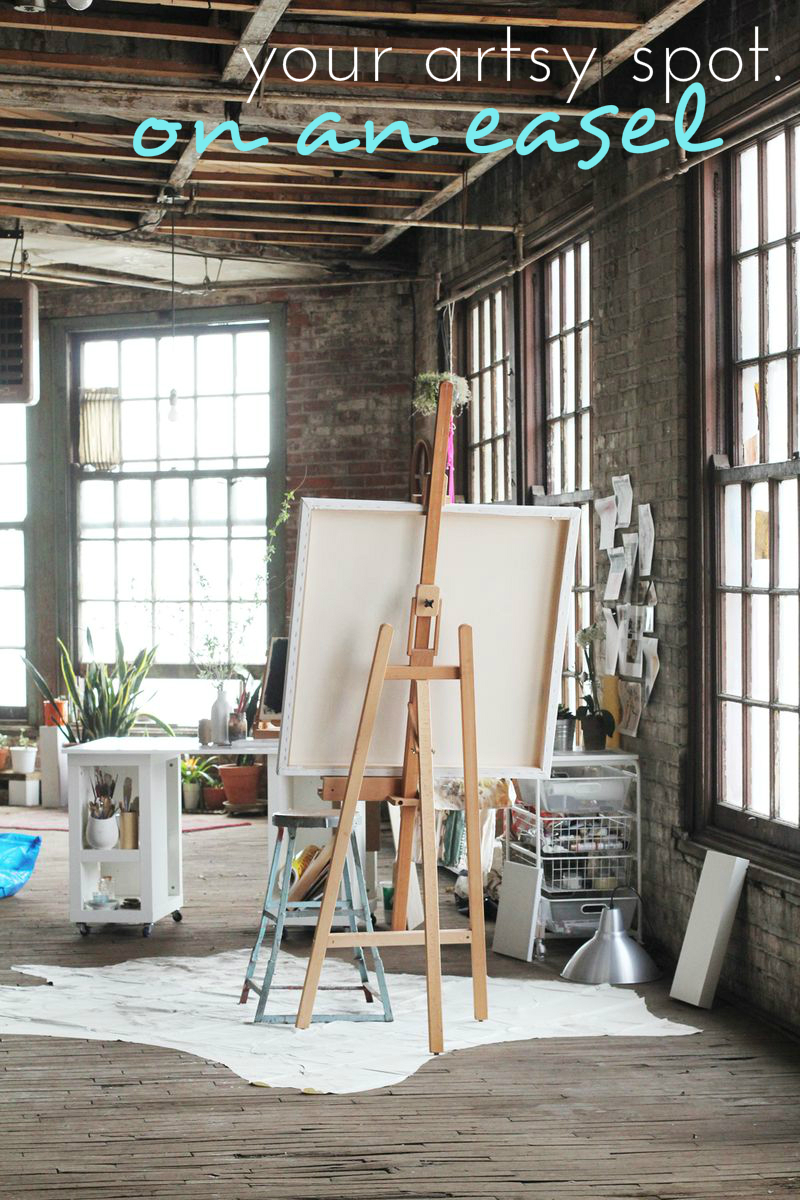
Or maybe you’re a traditionalist and working from an easel is your thing. A good sturdy, adjustable easel is a thing of beauty. There is one in the window of the local art supply store that I am totally coveting.
Perhaps you like working a la Jackson Pollock? It might be hard on the back, but working on the floor is great for large canvases or getting a different perspective on your work. And I’m pretty sure it’s a great workout.
A lot of artists like to mount their canvases on the wall and if we ever have the extra space, I would love to give this way of working a try. Would be especially fun in a studio in which you were free to make as big a mess as you wanted!
A lot of artists don’t have the luxury of a dedicated studio space, so we just find a place to land our artsiness wherever we can! Maybe it’s the kitchen island or a corner in the attic. If you’re an artist, wherever you happen to be, that’s your artsy spot.