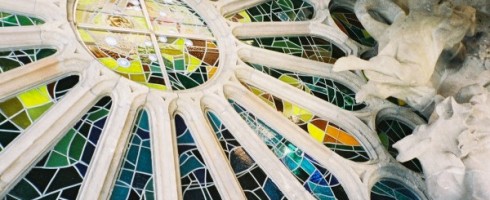
Last week, an interior designer friend from Florida was visiting Seattle, so we seized the opportunity to catch up over lunch. I racked my brain trying to come up with a lunch spot I thought would be inspiring to her design senses and then it hit me– the cafe at the Chihuly Garden & Glass museum! I’d been meaning to visit the museum since arriving in Seattle, but it just hadn’t happened yet, so here was the perfect excuse.
The museum centers around the work of renown Seattle glass artist Dale Chihuly. Chihuly is a bit of a polarizing figure in Seattle– his work, having saturated the Seattle glass market for quite sometime, he’s like the Starbucks of art in Seattle. He’s everywhere, as are copy cats and artists who’ve worked for him so it can be understandably tiresome to see yet more Chihuly. But with that said, the museum is a feast for the eyes and definitely worth a visit!
From an art lover’s standpoint, the mere spectacle of color and texture is unforgettable. The museum is relatively small, only about 1/2 dozen “rooms”, Chihuly’s work really shines in the atriums and outdoor garden spaces. The design of each space is done thoughtfully and with much regard to the characteristics of the works themselves, how the light behaves in and around them, color, etc.
Though the price of admission seemed a bit steep at $19 for an adult ticket, the museum staff was friendly & helpful, which goes a long way in my book! Overall, the Chihuly Garden & Glass is the perfect cultural diversion amongst the touristy offerings at Seattle Center. Oh and lunch at the Collections Cafe was delicious! For more information on visiting the Chihuly Garden & Glass, please visit their website.
If you’d like to see more photos from my visit, check out the Artsy Instagram feed!
In my daily reading of Artinfo.com this morning I came across two articles, seemingly unrelated, until the Facebook comments regarding one of the articles tied them together for me. The first article, found here, poses the question, “Should Gaudi’s Sagrada Familia Remain Unfinished?” The Barcelona basilica, begun in 1882 by renown artist-architect Antonio Gaudi is still under construction eighty-five years following the architect’s death.
Though Gaudi left plaster models and drawings, many of his notes were destroyed during the Spanish Civil War, leaving his vision open to interpretation by current sculptors, architects and designers. While some critics feel the current direction doesn’t jive with Gaudi’s original vision, even during his lifetime, there were many sculptors working on the basilica. Like any monumental undertaking, “it takes a village” to bring Gaudi’s creation to life.
Should Gaudi’s original design be so open to interpretation? He gave artistic license to those working under him while alive, would he so object to modern interpretations now being imposed? Unlike other types of sculpture, cathedrals are often the product of centuries worth of work by multiple architects, artists and craftsman.
As Gaudi was aware he would not be alive to see it to completion, wouldn’t he have known his original design would be open to interpretation by those who came after him? Does the fact that Gaudi is not here to personally oversee the work negate the additions?
Artists using apprentices and assistants is nothing new. The art world of the Renaissance era, which produced such celebrated masters as Michelangelo and DaVinci was built upon the concept of apprenticeship. But what about now? The second article I read this morning was regarding the approval of a Dale Chihuly museum at the site of a former amusement park in downtown Seattle ( now the Seattle Center ).
The museum in itself is the subject of controversy, but that isn’t what I’d like to address here. Instead, I’d like direct attention to another Chihuly controversy– his use of others to craft his designs. One Facebook poster thought it necessary to point out that since losing the use of his left eye due to a car accident, he is no longer the person actually blowing the art glass he is so famous for. ( In reality, Chihuly continued to blow glass for three years following the accident, until a body surfing incident dislocated his shoulder, so he was no longer able to manually manipulate the glass ). The poster’s statement that “His employees make everything. Just sayin’.” seems to somehow fault Chihuly for continuing to create in the only way he physically could, by having others help him. The artist himself has said that his role, more of a director, allows him better perspective on the work.
As stated above regarding Gaudi, the practice of using assistants and apprentices to create monumental works of art has been done for centuries ( and yes, many of Chihuly’s creations are monumental in scope ). So as long as the artist himself continues to design the creations with his name on them, what’s the big deal?
And what about so-called “production originals”? You might be thinking of the ones advertised as “hand painted original works of art”, usually being sold out of a hotel ballroom. But what I’m talking about are the production art studios– where perhaps one “lead artist” is creating original works of art, which are then being recreated & reproduced by the hand of “assistant artists”. There are more of these studios around than people realize and the work can be found in galleries, corporate and private collections all over the world. While the savvy gallerist, art consultant, designer and art afficionado knows production art when they see it, what about the collector who thinks they are buying a true original work of art, only to spot an almost exact replica when in their hotel while on vacation in Hawaii? Do we lump Chihuly in with these?
These are three examples of artwork being completed and accomplished without the direct hand of the creator. What are your thoughts? Is it ever OK to put your name on something you didn’t actually physically create? This is definitely a gray area.. would love to hear your thoughts!


 From an art lover’s standpoint, the mere spectacle of color and texture is unforgettable. The museum is relatively small, only about 1/2 dozen “rooms”, Chihuly’s work really shines in the atriums and outdoor garden spaces. The design of each space is done thoughtfully and with much regard to the characteristics of the works themselves, how the light behaves in and around them, color, etc.