Tag: Jackson Pollock

  • Artsy Reads: Lessons Learned from Lee Krasner

    Artsy Reads: Lessons Learned from Lee Krasner

    It seems a long while since I shared thoughts on my latest artsy read!  As a woman, it does follow that I’ve always been interested in the female artists who’ve made their marks on art history.  But lately, I’d been especially intrigued by a female artist who hated being gender labeled, but whose career trajectory veered a bit off course, thanks to becoming a wife.  Mrs. Jackson Pollock aka abstract expressionist artist Lee Krasner.

    In her biography of Krasner, Gail Levin  introduces us to a fiercely independent, sensual, and opinionated young woman who would become one of the founding members of the Abstract Expressionist movement.  She would be eclipsed for much of her career not just by the talent, personality and notorious nature of her husband, but by the sexist leanings of the modern mid-century art world, eventually winning for herself the respect and recognition she so deserved.

    What struck me most, when reading Levin’s account and Krasner’s own words, were her formidable strength when opposed, yet tenderness, graciousness, and respect reserved for the man she willingly sacrificed for.  I found myself dog-earing pages so that I could go back and take in her words again.  This artist who was always studying, taught me some valuable lessons.

    1 | buck tradition.

    Krasner collage1

     found here and here

    This young girl, raised in a traditional Russian Orthodox Jewish home, early on saw the inequities in her familial religion, soon relinquishing its hold.  She fought against tradition when expected to marry her widowed brother-in-law after her older sister died.  But she remained true to her fiercely independent self and her desire to become an artist.  She spoke out against inequalities and injustices whenever she recognized them.  At a time not long following women finally gaining the right to vote, Krasner was a leader among early abstract painters.

    2 | recognize and nurture greatness in others. 

    Krasner collage2

     found here and here

    I think few who knew her would describe Krasner as humble.  Yet, she recognized, supported and nurtured the talent in her husband.  She was his biggest fan and champion, and after his death, the manager of his estate.  She describes being “blown away” by first seeing his work.  She had a great deal of respect for her husband’s artistic mind and sensibilities, bolstering his career while still working away on her own.  When it was speculated that Krasner may have acted differently had she & Pollock gotten together in the age of feminism, she maintained, “I think I would do the same, identical thing all over again in the presence of talent like that..

    3 | don’t be afraid to share the spotlight or even give it up for a while.

    Krasner collage3

    found here here and here

    In Levin’s biography, it is intimated often that Krasner believed Pollock to be the greater artist.  She was confident in her own talent and work, and yet she recognized and respected his genius.  “Painting is revelation, an act of love.  There is no competitiveness in it.  As a painter, I can’t experience it any other way.”, Krasner said when asked about the prejudice she’d experienced as Pollock’s wife.  She worked away on her own, building her own portfolio and figuring out her own visual language, while allowing Pollock to shine.  Her time would eventually come.

    4 | fight for what is rightfully yours.

    Krasner collage4

    found here and here

    Krasner wasn’t afraid to fight for the recognition she deserved as an artist and member of the Abstract Expressionist movement.  She knew her place in art history wasn’t merely being the wife of an important painter.  She rightly believed she was a noteworthy artist in her own stead and, with the advent of the feminist movement and the increased interest in female artists, she was finally given the respect and recognition she deserved.  She never once wavered in her steadfast belief that she was an good an artist as any of the male artists of her time which were so widely adored.

    5 | never stop learning. 

    Krasner collage5

    found here and here

    Before Krasner’s retrospective show opened at the Museum of Fine Arts in Houston, the artist chose to keep one finished painting so that she could have it at home to study.  “I wanted to keep the one I just finished because I need to have my work to look at.  Even when I’m just looking; I am working.” 

    Here was a modern female painter, who though overshadowed by the enormous talent of her husband, quietly produced a body of work that holds its own alongside any of her contemporaries.  She was no shrinking violet, to be sure and her place in art history as someone other than the wife of Jackson Pollock was hard won.  Yet never saw herself in competition with him.  He was an artist.  So was she.  That was enough.

    You can find Gail Levin’s Lee Krasner, A Biography on amazon.com or in many libraries and bookstores.  I finished this book enlightened and inspired.  I think you will be, too.

    All image sources linked above.
  • Artsy Reads: Tom and Jack by Henry Adams

    Artsy Reads: Tom and Jack by Henry Adams

    I have always been a voracious reader, nerd that I am.  Summers were often spent with my nose in a book and summer reading contests were usually won handedly.  These days, with so much time spent reading blogs and articles online, I don’t pick up a book nearly as often as I’d like.  When I do, sometimes it’s an artist biography or other art/art history related tome, with the occasional fun & easy fiction read thrown in.  Since some of my artsy reads might be of interest to you, I thought I’d begin posting my thoughts on my latest conquests.

    Best reading spot ever

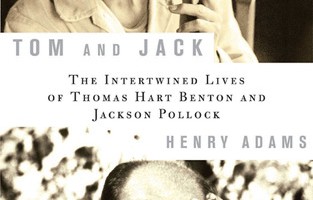
    My most recent artsy read has been Tom and Jack: The Intertwined Lives of Thomas Hart Benton and Jackson Pollock by Henry Adams.  Many of us know that Pollock was a student of Benton, but this book really delves into both their lives and careers, their complicated relationship and the influence of each on the development of modern art.

    Tom and Jack: The Intertwined Lives of Thomas Hart Benton and Jackson Pollock by Henry Adams

    While I’ve always admired Thomas Hart Benton’s work for its sweeping nature and subtly satirical voice ( though it is still widely criticized by many as too provincial ), I’ll admit my main draw to the book was Pollock.

    Arts of the West ( 1932 ) by Thomas Hart Benton

    Remembering back to my earliest forays into art history, I wasn’t especially intrigued by Pollock.  At the time, I was drawn to the more feminine abstractions of Georgia O’Keeffe and Helen Frankenthaler.  It wasn’t until I came face to face with a Pollock canvas during an Abstract Expressionism show at The Cummer Museum of Art in Jacksonville.   I was completely blown away.

    Convergence by Jackson Pollock ( 1952 ), oil on canvas, 155×93.5

    The texture, the seemingly randomness that once you really stare at it, is not so random, the thick build-up of paint.. I was now officially hooked.  The book details the rise of Thomas Hart Benton, paying special attention to his influences, as these would trickle down to ultimately influence Pollock.  Benton’s theory of “the hollow and the bump” becomes especially important to Pollock’s artistic growth.  Once studied side by side, it’s interesting to map how Pollock went from devoted student of Benton’s to the development of his own unique, groundbreaking style while still utilizing theories taught to him by this mentor and father figure.

    I confess, this one took me several library renewals to get through..  The first half of the book, which focuses heavily on Benton and his contemporaries is a bit of a challenge, perhaps because I was more interested in Pollock.  But once you begin to see it all culminating in the explosion of Pollock’s career, the transition from the Modern movement to Abstract Expressionism and the shifting of the center of the art world from Paris to New York, the book is impossible to put down.  Yes, there’s plenty of speculation regarding Pollock’s alcoholism, mental and emotional battles, but the focus comes back to how he dealt with those demons through his work.  A fantastic read if you are at all interested in modern art, abstract expressionism, Benton or Pollock.  I just wish I’d bought it instead of checking it out of the library!

    Anyone else out there read this book?  What were your thoughts?

    PS– If you have any recommendations for artsy reads, please share!  Right now, I’m really enjoying Steve Martin’s An Object of Beauty.  Thoughts on that one to come soon!  You can see more of my reading list on my Artsy Book Club Pinterest board. 😉

  • Masterworks Monday:  Jack the Dripper

    Masterworks Monday: Jack the Dripper

    A polarizing persona in the art world, Jackson Pollock, called “Jack the Dripper” by some, figured largely in the Abstract Expressionist movement in America.  His work  is such of the “love it” or “hate it” variety and it can often strike a chord with those who least expect it.

    Untitled, No. 3 by Jackson Pollock

    I remember taking a basic Art Appreciation class early on in college, with a good friend from high school.  Said friend was very conservative in most aspects and usually preferred the more realistic artwork we studied– but she loved Pollock’s work.  There was just something about it that she responded to.

    Untitled, No. 8 by Jackson Pollock

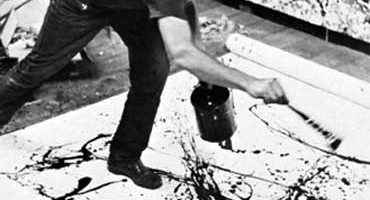
    Pollock’s process, referred to as “action painting”, involved several aspects that were innovative at the time– Pollock laid his canvases unstretched out on the floor, instead of stretched on an easel, utilizing household paints instead of more traditional oils and instead of brushing the paint on, dipped whatever was on hand into the paint and then slashed  & dripped it onto the canvas.

    Green Silver by Jackson Pollock

    I remember being intrigued by Pollock and his work, but it wasn’t until I saw one of his pieces up close & personal, in an Abstract Expressionist exhibition at the Cummer Museum in Jacksonville, that I truly became a fan.  Seeing the monumental scale of the work, the depth of the paint and being able to recognize that yes, there truly was a method to his madness in all those drips and splatters, sealed the deal for me.