Do you have a certain outfit you wear when you need a pick-me-up? Or maybe there is a particular piece of music that always gets your blood pumpin’ and instantly uplifts your mood? The work of Henri Matisse does the same for me.
Sorrows of the King
From his beginnings as a Fauvist, Matisse was never afraid of exploring expression through color.
Open Window
And like his friend and rival, Pablo Picasso, Matisse loved painting figures and still lifes, but it is the way he paints interiors that get me. Maybe it is my love of interior design or the fact that I too, went through a “let’s paint pictures of fun & pretty rooms” phase. Whatever the cause, Matisse gets the joy of painting rooms full of life and color and I dig it in a big way.
Dance(I) by Matisse, 1909
It is that brilliance of color and exuberance of design that draws me to his work. As the artist himself said, “With color, one obtains an energy that seems to stem from witchcraft”.
Les Codomas for Jazz, 1944
If that be the case, I am under the spell of Matisse’s color and hope to never be awakened.
Check out more of Matisse’s work at the MOMA website.
Thanks to our next door neighbor, who creates “sculptures” out of found objects and has a rotating display in his front & side yard, I’ve been thinking a lot about sculpture lately. Which has led me to discover an egregious error here at Artsy Forager and that is the incredible, unforgiveable lack of sculptural work on this blog! I am here to rectify the situation, beginning with one of my favorite contemporary masters, Constantin Brancusi.
Sleeping MuseBird in Space
In his work, Brancusi breaks down the forms of his subject into simple, geomtric shapes, so that the end result is less a representation of the actual subject, but rather the essence of the feeling that subject’s form evokes.
Mademoiselle Pogany, 1912The Newborn, 1920
The elegance of Brancusi’s lines and the restfulness and peace his forms suggest, even when depicting a screaming baby ( see The Newborn, above ), help to quiet my spirit. What about you? Any artists whose work “quiets your spirit”? Or maybe you’re not in to Brancusi ( and that’s OK ).. Whose sculptures do you love?
Though our time in the cities we visited on our cross-country tour was short, we managed to hit a couple of wonderful, yet very different museums along the way. In Tulsa, we spent a few hours exploring the Philbrook Museum of Art.
Front facade of the Philbrook Museum of Art
My Jacksonville readers will be familiar with the Cummer Museum of Art in Jax. The Philbrook is, to me, like the Cummer on steroids. Like the Cummer, the Philbrook was once a private residence, which was donated to the city of Tulsa by its owners, oilman Waite Phillips and his wife Genevieve. Once we entered the museum doors, we found ourselves in a gorgeous, domed center hall, light streaming through the oculus in the center of the dome.
Center hall at the PhilbrookPhilbrook oculus
Just walking the halls of this Renaissance style villa, built in 1927 and designed by architect Edward Buehler Delk for the Phillips as “a place where there two children could entertain friends” ( Imagine the sleepovers you could have! ), is a pleasure in itself.
Corridor at the Philbrook
The museum houses a varied and extensive permanent collection of art, ranging from African & Asian collections, Native American art to Italian Renaissance and a surprising and delightful modern collection.
Bougereau at the Philbrook, a favorite artist of the Frenz’sLovely little Picasso at the PhilbrookFabulous modern design collection at the Philbrook
While the museum collections are enjoyable, it is the museum grounds that really steal the show. Though we visited on a gray and rainy day, it didn’t stop us from exploring the extensive gardens behind the museum. The original formal gardens extend from the rear colonnade of the museum down to the tempietto. Let’s take a little walking tour..
Rear collonade at the PhilbrookView from the colonnade down to the tempiettoWonderful stepped fountainBeautiful, naturalistic water featureNo formal garden is complete without a koi pond!View from the tempietto back toward the museumYours truly in the tempietto ( wouldn’t this be a romantic spot to pop the question? )Contemporary sculpture walk beyond the formal gardens
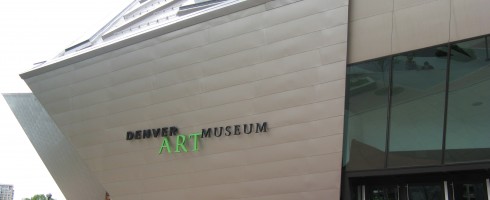
Let’s switch gears now, fast-forward through another 12 hour day on the road and pay a little visit to Denver. While in the mile-high city, we spent some time downtown including a tour through the Denver Art Museum. While the Philbrook is classically ornate, the DAM’s Hamilton Building, where we spent our time, is splendidly contemporary. Designed by Daniel Lubeskind, the structure represents the Rocky Mountain peaks surrounding Denver.
Denver Art Museum
We started at the top and worked our way down, discovering lots of fun & interesting contemporary work along the way.
Noguchi sculpture and Motherwell painting **Sidenote: Motherwell was born in Aberdeen, WA, the town where we are living for the summer.Ceramics at DAM
Did you notice in the pictures above how the walls are slanted? The angled walls created a very interesting visual space, especially in the 4th floor gallery where they were prominent. They were a bit disconcerting when walking down the main stairs, though!
Artist: Mark Tansey
We were all fascinated by the piece above, by Mark Tansey. Another highlight was the Fox Games installation by Sandy Skoglund. I first saw Skoglund’s work in Jacksonville and am always fascinated by the environments she creates.
Fox Games by Sandy Skoglund
And there was just something about “Minotaur with Brushstrokes” that appealed to us. What can I say, we like work that makes us smile.
Minotaur With Brushstrokes by Richard Patterson
Speaking of making us smile, George & I also loved the piece below, although I’m sad to report that I don’t recall the name of the artist. But it reminded me of spring in the Northwest.
Kicking myself for not writing down the title & artist for this piece! Anyone have any clues?
The museum also boasts an impressive Western American Art Collection, as well as African, American Indian, Oceanic, Pre-Columbian and Spanish Colonial Collections. We toured through the current special exhibition, Cities of Splendor: A Journey Through Renaissance Italy, but alas, no photography allowed in the exhibit, so you’ll have to check out the DAM website for a taste. As you can see, our art experiences on this trip were widely varied and we are looking forward to more such experiences here in the Northwest.
Hello Artsies!!! After being out of the blogosphere for the past three weeks or so, I am finally back behind the computer, as it were and it feels great. I have so much to share that I hardly know where to begin.. As many of you know, my hubby George and I recently moved from Florida to Washington. We were incredibly blessed to be able to make a vacation out of our cross-country trek, with stops to see friends, new places and old favorites along the way.
Our first stop ( OK, first fun stop.. we spent the first night in a motel outside Little Rock, AR, not super exciting ) was Tulsa, Oklahoma. George lived in Tulsa for several years and we hadn’t been back since we got married, so decided to take a couple of days to introduce me around to Tulsa friends and places. It just so happened that the friends we were staying with in Tulsa had a friend who owned a gallery, Exhibit by Abersons at Center 1 Tulsa. Said friend of friends happened to be having an opening the night of our arrival in Tulsa, so even though there was a whole gang of people expected for dinner, we popped over to the gallery to have a peeksy.
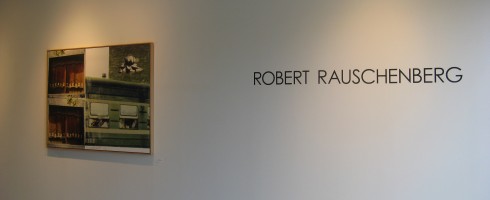
The exhibit, which opened on May 19th was curated by Master Printer Bill Goldston of Universal Limited Art Editions and follows the progression of Rauschenberg’s print work through the years. Like any good Art History Major, I recognized Rauschenberg’s work and his importance as a painter & print maker, but beyond that, I admit I didn’t know much. Rauschenberg came to the forefront toward the end of the Abstract Expressionist movement and toward the beginning of the Pop Art movement. The prints included in the exhibition lean more toward the Pop end of the spectrum, showing examples of his collaging of photographic images through silk-screen processing showcasing pop culture imagery of the 1950s and 60s, such as Guardian ( 1968 ).
Guardian is compromised of transfer images from Life Magazine, the transfers being done by brushing the images with solvent, placing them on the lithograph stone, then passing the stone through the printing press. These are works that demand a closer look, there is so much going on, even little details are significant. George enjoyed scrutinizing the work ( see photo below! ), which are so accessible that they seem just as relevant today as they must have 50 years ago.
The work George is pondering is Bazaar, an intagilio print and lithograph on paper created in 1984. Other highlights for me included, Aquafix ( below ), a haunting image created by Rauschenberg in 1981. As the years progressed, his work evolved into cleaner, more simplified compositions as exemplified in Aquafix and Lotus VII, both favorites of mine from the exhibit.
Lotus VII ( above ) is part of Rauschenberg’s final series of prints, completed only a month prior to his death. The Lotus images were created for an exhibition of Rauschenberg’s work in Beijing and are compilations of photographs taken by the artist on two trips to China. The photographs were transferred to panels, then an intagilio process, photogravure, was used to tie the images together visually. The results are stunning images, which surely pleased Rauschenberg as his final legacy.
If you are in the Tulsa area, be sure to check out the show at Exhibit by Abersons. If you can’t get to Tulsa, Rauschenberg’s work can be found in many major museum collections with images, biography and other info available online, check out the websites of MOMA, The Tate, the Guggenheim and many more.
A polarizing persona in the art world, Jackson Pollock, called “Jack the Dripper” by some, figured largely in the Abstract Expressionist movement in America. His work is such of the “love it” or “hate it” variety and it can often strike a chord with those who least expect it.
Untitled, No. 3 by Jackson Pollock
I remember taking a basic Art Appreciation class early on in college, with a good friend from high school. Said friend was very conservative in most aspects and usually preferred the more realistic artwork we studied– but she loved Pollock’s work. There was just something about it that she responded to.
Untitled, No. 8 by Jackson Pollock
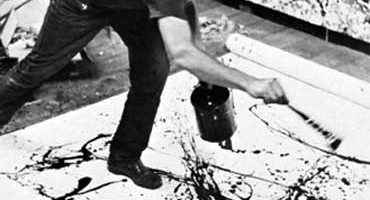
Pollock’s process, referred to as “action painting”, involved several aspects that were innovative at the time– Pollock laid his canvases unstretched out on the floor, instead of stretched on an easel, utilizing household paints instead of more traditional oils and instead of brushing the paint on, dipped whatever was on hand into the paint and then slashed & dripped it onto the canvas.
Green Silver by Jackson Pollock
I remember being intrigued by Pollock and his work, but it wasn’t until I saw one of his pieces up close & personal, in an Abstract Expressionist exhibition at the Cummer Museum in Jacksonville, that I truly became a fan. Seeing the monumental scale of the work, the depth of the paint and being able to recognize that yes, there truly was a method to his madness in all those drips and splatters, sealed the deal for me.
In my daily reading of Artinfo.com this morning I came across two articles, seemingly unrelated, until the Facebook comments regarding one of the articles tied them together for me. The first article, found here, poses the question, “Should Gaudi’s Sagrada Familia Remain Unfinished?” The Barcelona basilica, begun in 1882 by renown artist-architect Antonio Gaudi is still under construction eighty-five years following the architect’s death.
Though Gaudi left plaster models and drawings, many of his notes were destroyed during the Spanish Civil War, leaving his vision open to interpretation by current sculptors, architects and designers. While some critics feel the current direction doesn’t jive with Gaudi’s original vision, even during his lifetime, there were many sculptors working on the basilica. Like any monumental undertaking, “it takes a village” to bring Gaudi’s creation to life.
Should Gaudi’s original design be so open to interpretation? He gave artistic license to those working under him while alive, would he so object to modern interpretations now being imposed? Unlike other types of sculpture, cathedrals are often the product of centuries worth of work by multiple architects, artists and craftsman.
As Gaudi was aware he would not be alive to see it to completion, wouldn’t he have known his original design would be open to interpretation by those who came after him? Does the fact that Gaudi is not here to personally oversee the work negate the additions?
Artists using apprentices and assistants is nothing new. The art world of the Renaissance era, which produced such celebrated masters as Michelangelo and DaVinci was built upon the concept of apprenticeship. But what about now? The second article I read this morning was regarding the approval of a Dale Chihuly museum at the site of a former amusement park in downtown Seattle ( now the Seattle Center ).
The museum in itself is the subject of controversy, but that isn’t what I’d like to address here. Instead, I’d like direct attention to another Chihuly controversy– his use of others to craft his designs. One Facebook poster thought it necessary to point out that since losing the use of his left eye due to a car accident, he is no longer the person actually blowing the art glass he is so famous for. ( In reality, Chihuly continued to blow glass for three years following the accident, until a body surfing incident dislocated his shoulder, so he was no longer able to manually manipulate the glass ). The poster’s statement that “His employees make everything. Just sayin’.” seems to somehow fault Chihuly for continuing to create in the only way he physically could, by having others help him. The artist himself has said that his role, more of a director, allows him better perspective on the work.
As stated above regarding Gaudi, the practice of using assistants and apprentices to create monumental works of art has been done for centuries ( and yes, many of Chihuly’s creations are monumental in scope ). So as long as the artist himself continues to design the creations with his name on them, what’s the big deal?
And what about so-called “production originals”? You might be thinking of the ones advertised as “hand painted original works of art”, usually being sold out of a hotel ballroom. But what I’m talking about are the production art studios– where perhaps one “lead artist” is creating original works of art, which are then being recreated & reproduced by the hand of “assistant artists”. There are more of these studios around than people realize and the work can be found in galleries, corporate and private collections all over the world. While the savvy gallerist, art consultant, designer and art afficionado knows production art when they see it, what about the collector who thinks they are buying a true original work of art, only to spot an almost exact replica when in their hotel while on vacation in Hawaii? Do we lump Chihuly in with these?
These are three examples of artwork being completed and accomplished without the direct hand of the creator. What are your thoughts? Is it ever OK to put your name on something you didn’t actually physically create? This is definitely a gray area.. would love to hear your thoughts!
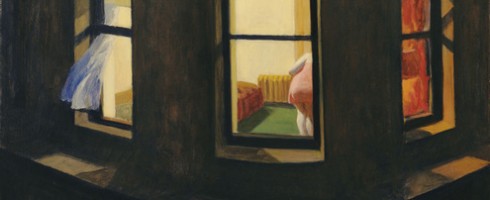
Happy Monday, Artsies! Hope everyone had a wonderful holiday weekend. This week’s Masterworks Monday artist is one of my all-time faves, American Realist painter Edward Hopper. A feeling of melancholy tends to pervade most of Hopper’s work, but maybe that is why they appeal to me. His scenes seem so very real, not just in their sense of time and of place, but in the capturing of a moment. Early mornings in small towns DO feel desolate, being an attendant at a gas station on a far off country road WOULD be lonely.
Despite the lone figures or desolate landscapes, Hopper’s images are filled with light and in that, create a sense of hope within the isolation. Early morning means it is a new day.. light coming in a window means that there is an escape from the darkness. Whether this is what Hopper intended or not, it is what I personally take from his work.
OK, the fashion loving girl in me is coming out! Check out this amazing show opening at the Legion of Honor in San Francisco. “Pulp Fashion: The Art of Isabel de Borchgrave” is a study in fashion and sculpture, meticulously recreating garments from the annals of art history out of paper. Wonder if George will let me take me a detour through San Fran on our trip to the NW?
OK, I know it’s something of a cliche to be a woman who loves the work of Georgia O’Keeffe. But I don’t care. I have unabashedly loved her work for what seems like forever. And I’m proud to say that my ten year-old niece, Samantha is a fan, as well and with no initial prodding from her aunt. ( Though I do admit to unabashedly encouraging her whenever I can! )
I was drawn to her work on first sight, but it wasn’t until I began taking studio courses in drawing and painting that my love truly blossomed. Maybe it was that her palette seemed to be similar to the colors I was repeating in my own work.
Or maybe it was how shocking some of her abstract work, thought to recall certain parts of a woman’s body, were in her day. Perhaps that sense of rebellion against the “boys club” appealed to the feminist in me.
It could have been how she was celebrating quiet and peace of the natural world, while technology was being ushered in at a rapid pace.
Maybe it is the softness of her brushwork– seriously, can you even see any brushstrokes? Or how delicate her lines were drawn.
Perhaps it is a combination of all these things. Whatever it is, I find her work magical.
I have a weakness for Abstract Expressionism. I’m not sure what it is about the paintings of that time and the artists who created them, but there is just something about these works that move me. Maybe it is the experimentation, or the emotionality behind them or the rebellion against a post-WWII saccharine society.
The last of the original group of the Abstract Expressionists, Hedda Sterne has passed on. Perhaps a lesser known member, her work was still widely collected and is held in the collections of several prominent museums.

















 I have a weakness for Abstract Expressionism. I’m not sure what it is about the paintings of that time and the artists who created them, but there is just something about these works that move me. Maybe it is the experimentation, or the emotionality behind them or the rebellion against a post-WWII saccharine society.