I am especially jealous of anyone who gets to see the Joan Mitchell show. So very very jealous! If you go, tag me on Instagram with the hashtag #dontmissartsiness!
Sometimes it feels as if we are simply tumbling through life, being swayed to and fro like a pinball or a tumbleweed. In these incredible large scale drawings, Brooklyn artist Leah Yerpe multiplies her figures as they spill through the air.
Placing her figures on a blank background, we lose any sense of situation, leaving them to float through the air as if caught in a tornado, hurtling down toward the ground. There’s a sense of a loss of control, yet the faces are calm and peaceful– though the winds blow, they simple let themselves be carried.
byEllen C. Caldwell In my series of guest posts for The Artsy Forager, I have been writing about my time in Bali during an arts residency earlier this year. I was introduced to painter Federico Tomasi by another artist Giovanni Lovisetto on a trip to Bali in 2012 and upon my return, I was lucky to revisit Tomasi’s studio and discuss his current works.
As many of us in creative fields know, artistic inspiration is always something of a process. As artists, we are constantly pursuing new creative styles, mediums, subjects, narratives, and voices. Through this process of searching for ourselves, we get used to the circle of finding our grounding, losing our footing, and continuously rebuilding our foundations.
This process can feel painful, isolating, and challenging, but it can also offer creative redemption, freedom, and inspiration. As I discussed in an earlier essay The Writer’s Ledge, these moments on the creative “ledge” are simultaneously terrifying, jarring, and exciting, ultimately yielding the most creative and unique results. It was a joy to visit with Tomasi and discuss the pitfalls and roadblocks we all endure during the creative process—while also seeing the moving and dynamic results coming from this beautiful struggle.
In discussing the beauties and beasts of the unknown, the cycle of returning back to our roots and formal training, and the bounty of this very endeavor, Tomasi and I explored the ongoing challenges that come with living the creative process. Ellen Caldwell | Please tell me about the large-scale, monumental portraits you are working on in your studio now.
Federico Tomasi | The large, vertical-scaled portraits are simply the desire to make them have a monumental aspect even if they are paintings—more as sculptures, huge and oversized for a different perspective. The chromatic choice of colors goes from that marbled, transparent feeling to the copper and bronze. And of course the unusual dimension (3 meters tall and 1 meter wide) helped me to reach what I had in my mind. I actually like them leaned on the wall rather than hung so they look more three dimensional, as sculptures are. It’s still an open chapter for me so let’s see how it will end.
EC | How do they differ from your previous bodies of work?
FT | I don’t think those particular ones are very different from my previous paintings in terms of technique and apart from what I mentioned before, of course. There is a step forward or a research of something different, chromatically speaking, and there are more visible parts of the body instead of the close up facial portraits I used to focus on. There are so many elements that occur to me in this process so it’s a bit difficult to give a harmonic answer… EC | Who are you painting in your portraits now? Could you tell me a little bit about how you have chosen your current subjects or is it still too soon to discuss?
FT | I really don’t know where I’m going right now! I’m trying different things at the same time and the subjects just come either from pictures or movies or my own sketches. I’m still waiting for that sparkle to arrive and a bit of anxiety made me just paint without thinking too much! I have been working on two large portraits of my grandmother who passed away last year. She was incredible, so that brought me to another level. I remember working day and night on those pieces as they where so personal to me. I painted them with oils, which also made it very intense.
EC | We talked a lot about artistic background and training – how often an artist will learn to paint by copying and mimicking the masters. And you were saying that in some ways you felt like you had to return to this time and go back to more of your original training. What inspired you to move in this direction?
FT | Well each artist has his masters and backgrounds to actually admire and learn from—it depends on your goal—for sure not by copying, but what I was saying was that there are skills when it comes to figurative art that have to be there and it’s important to feed those skills to be able to move on. I believe you have to know how to do things in a traditional way to be able to do something very different in the future. I guess it’s the technique that matters in my case… When I feel it’s time to move forward, I always start from some basic skills (traditional) and from there find my own direction
EC | Where do you see yourself moving, having circled back to this original training? Do you see it taking you in an entirely new direction now?
FT | I see myself in moment of transition—a bit frustrating when things are not always coming out how I thought. But that’s part of the game; persistence will take me to a new direction. EC | Yes, that’s part of the beauty and agony of the process, right? How has living and practicing your art in Bali impacted your work—or has it?
FT | Unconsciously probably, it’s more the lifestyle—the freedom and the beauty everywhere that makes the difference but not more than that. Bali is not the same as when I arrived; the tourism and the development of businesses became very chaotic in the last years so it’s not really inspiring me anymore. And I’ve been here for 14 years almost so maybe it’s time to move again!
EC | When did you first start painting and how did you learn or train?
FT | My father was studying at the Academy of Arts in Stockholm when I was around eight years old and I was always surrounded by creative people, so that was my first introduction to that world. After I decided to study five years of art school in Rimini, Italy, and that’s where I started to take my first steps… I’m still learning and hopefully I will learn more in the future. EC | Regarding plastic in Bali, we discussed the over-packaging of products and how there is such a vast amount of plastic debris all over – in the rice paddies, on the streets, and filling the ocean and beaches after big rains… Could you discuss this a bit?
FT |This is a global problem not only about Bali, and it’s very sad. It’s about a lack of education and personal responsibility towards mother nature. For sure there are solutions, but there are too many businesses involved to change unfortunately. It’s incredible, sometimes I manage to see such a perfection and beauty in nature compared to what we humans have been able to do …we are terrible! Sometimes I feel ashamed to be a human being.
EC | Do you feel like you address this plastic problem as an artist or activist – or more simply just on an individual level?
FT | It’s difficult as an individual to change the world but you can always be aware of things in your little microcosm. I collect stuff on the beach, just walking with my dog, for example. I do it even if I know it will not solve the problem, hoping someone sees and gets the message. I said before it’s all about education so let’s start ASAP. It will take a generation to change if we are lucky… Born in Stockholm, Sweden, Federico Tomasi began showing his work in 1997 after moving to Asia. Since then, he has shown internationally in Italy, Indonesia, Malaysia, Singapore, Lebanon, and the U.S.
We are down to seven more weeks left in Eureka. That is, if Mr. F’s contract doesn’t get extended, which we think it will. Mr. F always knows exactly how many weeks we have left in one spot. He is such a wanderer, too long in one place and he begins to feel a bit hemmed in. And I admit, it’s rubbed off a bit on me. Living in someone else’s home, with their stuff, a view that I didn’t choose, will often leave me a bit unsatisfied, too and ready to move on in our adventures. In her work, Brooklyn artist Louise Belcourt explores her own views in the shapes and forms she sees and the one’s that block her vision.
Belcourt takes her inspiration from the views she sees, using color and form to play with their spatiality and physicality. Forms seem to recede and advance at the same time, just as our time in one place seems both long and short-lived.
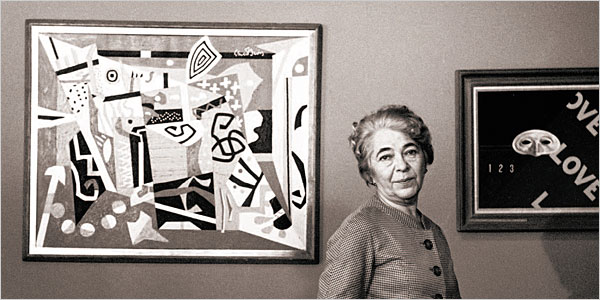
Hello my fellow Artsy bookworms! This is going to be a quick Artsy Reads as I’m busy with freelance work this week ( yay! ). The Girl With The Gallery by Lyndsay Pollock, is a biography of early twentieth century New York gallerist Edith Gregor Halpert, who at just twenty-six years old founded the successful Downtown Gallery where she cultivated the careers of American modern artists like Arthur Dove, Stuart Davis, and Jacob Lawrence.
Reading almost like a novel, the biography follows Halpert’s life from her childhood in Russia to become wife and muse to artist Sam Halpert, to the founding of one of Greenwich Village’s first galleries, her art world rise and dogged devotion to the artists she represented.
What I found most intriguing about Halpert’s story was the many modern day gallery practices that she innovated in the late 1920s and 30s. Methods like creating a home-like gallery environment, selling furnishings alongside artwork, and creating a community atmosphere within the gallery walls, as well as diversifying her gallery offerings during the Depression by building a market for American Folk Art, just as many galleries now sell items such as fine crafts alongside paintings and sculpture.
If you’re intrigued by the early American modern art movement, the New York gallery world or just the running of a gallery in general, this will be a fascinating read for you. Though Ms. Halpert’s life took a tragic turn, her story is nonetheless riveting and proof that women were brokering power in the art world long before the Feminist Movement.
Top image by Artsy Forager, all other image sources linked above.
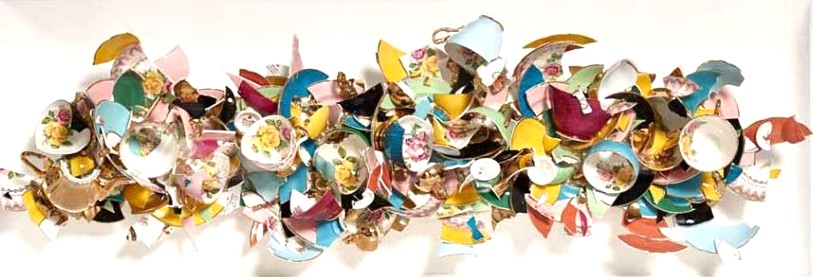
I’ve always been drawn to the imperfect.. the broken shell on the beach, the scratched and worn kitchen table. There is something poetic in the brokenness. In her sculptural series Broken, London artist Sandra Shashou intentionally breaks beautiful pieces of fine china, the broken pieces becoming a part of a new whole.
It must be at once heartbreaking and cathartic to smash these lovely things to pieces! But perfection isn’t always what it’s cracked up to be ( pun intended, ha! ). Instead of collecting dust in a china cabinet or waiting for a buyer in an antique shop, these pieces are given not just a second chance, but are transformed into a completely new object. May we all be so lucky!
It hardly feels like summer. Here on the Northern Cali coast, the temps have barely ever gotten out of the sixties– I’m still wearing scarves and boots on occasion! In addition to the cooler weather, Mr. F and I both seem to be having trouble getting into a relaxed summer vibe these days. There always seems to be something on the agenda, something to be done, something to plan, somewhere to go. I feel like we’re missing out a bit on the carefree feeling that summer brings, but these paintings by Massachusetts artist Carol O’Malia bring me that much closer.
Any time we’re able to get to the beach, a river or waterfall, any body of water, really, and I see the ripples sparkling in the sun, my mind instantly relaxes and calms. O’Malia really captures the radiance of summer light, not just sunlight, but the way we feel more effervescent in summer. I’m still waiting for that weightless feeling, forgetting everything that’s happening in the world and just soak it all in. I hope it comes soon.
To see more of Carol O’Malia’s work, please visit her website.
There is such a magic and a mystery to the natural world surrounding us. The way trees grow, skies shift, often seem to be inherently artful and purposeful. The work of Canadian artist Troy Moth gives expression to those dreamful moments.
When Mr. Forager and I are out hiking, sometimes we stop talking and just listen to the forest– trees creaking, the rustle of birds in a bush, a breeze gently rattling branches. Occasionally we come across a particularly lovely tree, stroke its bark and imagine it breathing and taking in the enormity of its long and vast life. I wonder how these beings know how to find the food, how to find the light. We make it such a struggle, they make it seem so effortless.
Hey you fellow Foragers! There are some incredible shows going on right now. Here are just a few of my recommendations for must-see museum and gallery shows this week!
Last week, as I was finishing up a painting a little gift for my niece, I got to thinking about what we tend to listen to while creating. For me, my studio soundtrack depends on what I’m working on– for instance, when I work on one of my Feminine Wiles pieces, I tend to prefer classic female voices like Billie Holiday or Edith Piaf. But if I want to just let loose and experiment, I like to listen to maybe something a little energetic and soulful like Florence + The Machine or Motown.
So tell me, Artsies– what’s your studio soundtrack?
pump up the jams | Are you a high energy creator? Maybe you like to blast the beats or turn it up to 11? Rockin’ it old school with some classic rock, 80’s rap or modern girl power totally gets my energy pumping!
slow ride, take it easy | Maybe you like a more peaceful soundtrack for your studio? I know I’ve occasionally asked Mr. F to change the tunes when they’re just a bit too raucous for the mood of what I’m painting. Classical, slow blues, maybe even just something soft and acoustic help keep the mellow flowing.
voices carry | So maybe music isn’t your thing. Some artists fancy a spoken word soundtrack like audio books or talk radio. If I choose to nix the music, This American Life or artist interviews on YouTube inspire and keep my interest without being too distracting.
sounds of silence | Some artists prefer a more quiet creative space, preferring to work with no sound at all. Especially if you’re working on something highly intensive, sound can be a little distracting. So maybe your soundtrack is simple silence.
Which type of studio soundtrack do you prefer? Any specific musical artists, types of music or non-music you always have on your studio playlist? Let’s all share in the comments!
Thanks to Jessica Brilli for providing the beautiful artwork for this post! My first radio may or may not have been similar to one of these.. See more of Jessica’s work on her website!

 north | Kinetic Sculptures, Prints, and Carved Wood Panels by John Buck at Greg Kucera Gallery