Ya’ll it has been a whirlwind few months. Followed by a whirlwind five days in Greenville, SC for the opening of my LATITUDE show at Art & Light Gallery! Greenville welcomed me with warmth and sunshine and made this Northwestern girl feel right at home.
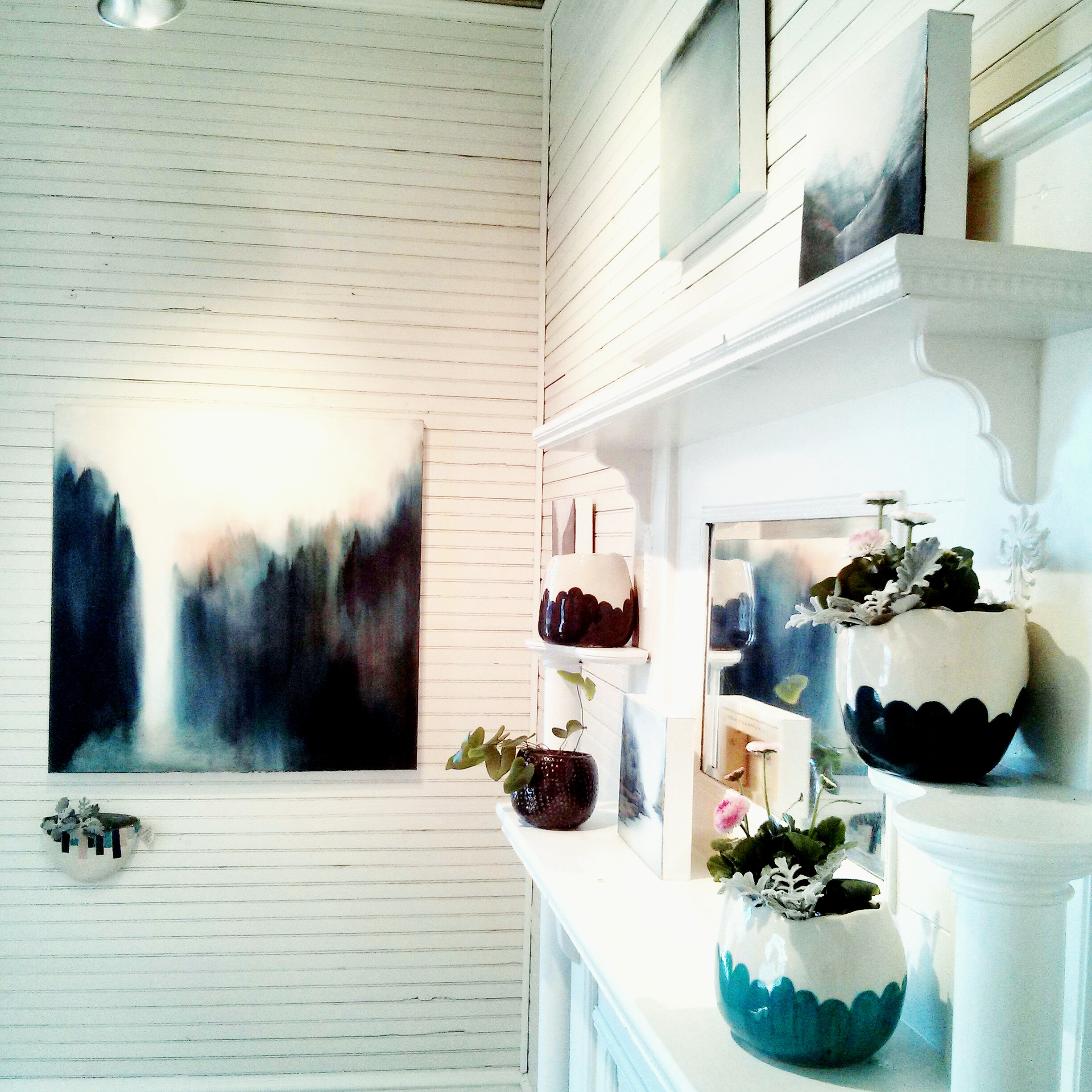
Teresa Roche, the owner and curator of Art & Light has created such a beautiful space! From the moment you step on the front porch and open the screen door ( so Southern, ya’ll! ), the space feels like stepping into sunshine. The house turned gallery/ art studios exudes old Southern charm, yet its clean white walls and sparse rustic furnishings feel completely modern. The mix of contemporary and organic is perfect for my work! Want to take a peek inside? Come on in!
This slideshow requires JavaScript.
Because A&L is housed in an old Greenville home, the galleries are small rooms perfect for wandering. Candidly, I was a bit worried that my work was too Northwestern in feel to fit in with Greenville’s historic, Old South vibe.
I was so surprised not only with how beautifully it fit, but with how many Gville folks either had NW connections or found their own LATITUDE moments in mine.
This slideshow requires JavaScript.
Ceramic artist Dee Sullivan created custom pottery pieces to go with the LATITUDE paintings, such a treat and they were just perfect! If I had a home to put them in I would have gladly purchased several, one wall pocket especially caught my eye ( and everyone else’s I might add! ).
My family came in from Florida and North Carolina to be with me and see the show but I also have a new Greenville family! Thank you to Teresa, Kiah, Everett and all the Greenville folks who have made this show such a success! There’s still time to see LATITUDE, the work will be up at Art & Light through the end of March. And if you’re not in Greenville, you can peruse all the paintings on my website.
Most images by me. Family group photo and panoramic gallery photo by my sister-in-law. Greenville family photo by Everett Waldrep.
G-Five, Plastic Attack, 2013 (rice fields installation view); plastic bottles and metal frames; 2 meters high. Courtesy of the Artists. Photo: G-Five Art Management.
Something is in the air in Bali. As I was interviewing a long string of artists during my writing residency there, one topic that kept coming up was plastic and the environment. Several of the artists I met and interviewed brought it up specifically, while many others merely danced around the subject and spoke of the environment more vaguely.
As time went on during my month’s stay, common themes and unifying strings clearly started to emerge between various artists and their work. But plastic and its place in our environment and culture was a big theme that I truthfully didn’t see coming. I consider myself an environmentalist (beginning with my dad’s teaching the Boy Scout rule to always leave your campsite [or hiking trail] cleaner than you found it, and leading all the way to my co-founding a residence hall recycling program at my university), so it wasn’t something I was unaware of or blind to, but I simply wasn’t expecting it.
Many of the artists I met in Bali brought up the problems of plastic degradation in a plethora of ways – from painter Federico Tomasi’s aside about the rainwater run-off flooding the ocean with plastic from one-time-use packaging to Made Aswino Aji’s laments about the changing landscape of Bali with its tourist growth. Or, in Ketut Jaya Kaprus’ plans to feature an entire gallery exhibit about the dangers of plastic, while showcasing its redemptive and transformative power as art.
left | Ketut Jaya Kaprus, photo of Kaprus painting pillars made from found plastic bottles, 2014; paint on plastic bottles. Courtesy of the Artist. right | Ketut Jaya Kaprus, installation view of plastic bottle pillars, 2014; paint on plastic bottles. Courtesy of the Artist.
I couldn’t ignore this recurring theme, but what intrigued me most was that the majority of the artists I spoke with were quick to un-identify with an environmental movement. Many artists informed me quite specifically that they were “not activists,” or god forbid, “environmentalists.”
I wasn’t sure exactly where this fear of labeling was coming from, but what I did know was that all of this art spoke loudly with its impact and aesthetics (though at times ambivalently with its message), much like its creators. I think part of the fear for these painters must be that they would lose their title as “artist” if they were simply seen as an activists – a fear I can sympathize with. For years, I have had business cards that vary between self-identifying as a “writer” or “art historian” because I don’t want one label chosen over another. But, with these artists, it seemed there was something more brewing below the surface.
So I decided to investigate some of the bigger, (non)environmental art projects I encountered in Bali.
top | G-Five, Plastic Attack, 2013 (beach installation view); plastic bottles and metal frames; 2 meters high. Courtesy of the Artists. Photo: G-Five Art Management. bottom | G-Five, Plastic Attack, 2013 (gallery installation view); plastic bottles and metal frames; 2 meters high. Courtesy of the Artists and Tonyraka Art Gallery. Photo: G-Five Art Management.
G-Five, a group of five younger artists on the contemporary art scene in Bali, has come together to produce a number of successful group exhibitions. Individually, they are artists in their own rights with unique styles and distinctive techniques, but together they aim to tackle broad and fluid subject matter and experimental work. All from Gianyar, a region known as the artistic capital of Bali, I Wayan Upadana, Wiguna Valasara, Made Gede Putra, Kadek A. Ardika, and I Wayan Legianta formed this talented group in 2009.
In their 2013 show “Plastic Attack” at Tonyraka Art Gallery, G-Five focused on plastic as their medium, and in some respect, message. This followed a trend of their prior exhibitions wherein they had focused on using and featuring a specific medium, be it rubber, thread, wood, or resin.1 Here, they created and joined five large walls of plastic bottles. First they filmed and photographed these walls out in nature on the iconic shores of Bali and in the equally picturesque and emblematic Balinese rice fields. Then they moved this large wall structure and installed it in the front of the gallery, with backlights that made it feel more paranormal and artistic than a foreboding environmental message. Inside the space, one hallway was completely blocked off with an enormous inflatable bulbous plastic ball, made up of taped plastic and powered by a fan, timed to inflate and deflate as if it was a living, breathing creature. They also showcased installations of found dirt, layered with plastic debris and refuse from the rice paddies in Ubud. These cutout segments were made into spectacles and “ready-mades,” as they were displayed in pristine glass boxes that would more typically be reserved for a rare and valuable artifact.
Bali Not For Sale, Bali Not for Sale, 2011; bamboo and acrylic signage. Courtesy of the Artists. Photo: Bali Not For Sale.
Another art collective entitled Bali Not For Sale is comprised of three young artists from Ubud: Gede Suanda Sayur, I Wayan Sudarna Putra, Pande Putu Setiawan. In 2010, they used bamboo and acrylic paints to form large three-dimensional letters that spelled out “NOT FOR SALE” and installed these signs in the remaining rice paddies at Jl. Sriwedari, in the Junjungan rice fields of Ubud.
These installations (and digital photographs of the installations that now float around the web) call attention to the growing number of residents who have sold their families’ rice fields to developers. Many families have been doing so to accommodate a growing hospitality industry, succumbing to the demand of the ever-growing tourist population, who would like to stay overnight and retreat amongst the picturesque rice fields in Ubud. Over time, these sales and developments have damaged a long-standing farming tradition in Bali, leaving families with a massive sum of money up front from property sales, but one that does not last over time or reap a steady income, as tending to the rice fields once did. Bali Not For Sale’s message is clear and humble, carrying visible force through art installations, “Bali is better simpler. Paradise ‘soul and pride’ is not for sale!”2
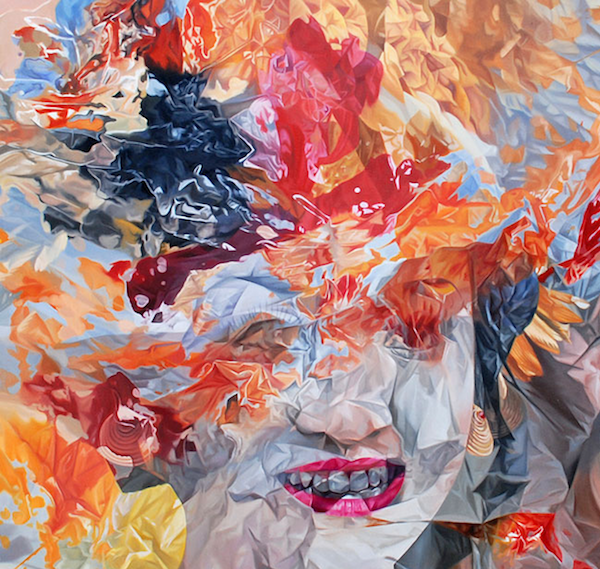
Wayan Suja, Plastic Rhetoric, 2011-2012; oil on canvas; 150 x 150 cm. Courtesy of the Artist and Tonyraka Art Gallery.
Wayan Suja paints intimate portraits of people, but he separates their faces from that of the viewer with obtrusive veils of wrinkled plastic. This creates an opposing dynamic wherein the detailed and naturalistic portraiture draws viewers in and creates an intimate feeling and setting, while the plastic intercedes between the depicted sitter and the viewer, thus superseding the very subject of the painting. In many of Suja’s series such as “Plastic Rhetoric,” are the paintings about portraits or are they in fact about plastic as the titles would suggest? It seems that plastic is both the subject and non-subject of his work, as the viewer’s eye oscillates between focusing only on the plastic veil while also shifting only to the veiled face behind it.
When I asked him about why he would use plastic in this way, Suja said he is not an activist. It is not about being for or against plastic, but about saying that plastic is here and using it quite literally as a lens through which to view the world. The figure wears traditional Balinese dress and is veiled in plastic so that she challenges what it means to be 100% Balinese. Suja compared it to the same way that he painted a Coca-Cola can in Untitled 2005. It is here; plastic is here; a Western influence is here in Bali and Suja is not saying that things need to remain traditional, but he is commenting and observing an ever-changing and adaptive culture.
And perhaps this fluidity of culture is the real heart of the subject matter I had been dancing around all along. In an essay on G-Five’s show “Plastic Attack,” Wayan Seriyoga Parta writes that their dirt and trash installation shows “packaging repackaged.”3And in my interview with Legianta and Valasara, they were quick to tell me that this show was about “art for art’s sake” and not about the environment. But to me (admittedly an American abroad bringing my own ingrained ideas in tow), it was hard to consider the exhibit without reading an environmental message. They explained that they were exploring “plastic as new media,” so that it is both a medium and experience.
In light of Suja, Bali Not For Sale, and G-Five’s art and aims, perhaps these works are actually less environmental and more about influence. Truly a message and medium repackaged. And perhaps some of this work is less of a protest and more of a proclamation of prevalence. An “I see you,” kind of acknowledgement towards the impact, union, and delicate merger of Balinese and Western culture.
Wayan Suja, Being a Colorful Balinese #3, 2012; oil on canvas; 160 x 150 cm. Courtesy of the Artist and Tonyraka Art Gallery.
As artists, often what we want to express can’t be contained between the four straight lines of a canvas. So artists like Australian artist Kate Tucker push the boundaries of surface and form, leading to paintings that seem to break free from their molds, even as those same structures hold them in place.
Even paintings framed in a traditional way seem liberated when incorporated into an installation of shards of compositions. Each painting reflects the installation, which reflects the painting. It’s like a wonderful tale of deliberate chaos.
There’s a school of thought that white walls = boring. But white walls + wooden textures + pops of colorful artwork? Anything but!! And this Artsy is here to prove it to ya. Let’s take a beautiful, airy space like the one below. The white surfaces have already been warmed a bit by pops of cozy wood textures. The way the light bounces off those walls make this the perfect place for some color. And that beautifully curved staircase wall? It’s just crying out for a fabulous wall sculpture or installation. Don’t believe me? Let us count the ways..
There are lots of different ways you could take the artwork in this space– those white walls are the perfect blank canvas!
1 | happy texture Smooth surfaces abound in this space, which leaves ample room for adding pattern and texture. A Liz Tran sculptural installation is like a party on a wall, providing an instant shot of joyful movement. Or how about gettin’ a little groovy with a retro-ish weaving? Tanya Aguiniga‘s Multi Knot Wall Hanging is a bit more minimalistic, but still adds just the right amount of texture and color. Making a simple, bold statement is hardly ever the wrong choice and one of Jen Pack‘s fabric & wood wall sculptures packs just the right amount of punch.
2 | organic elegance Not only can a space like this handle something dynamic and full of color but a single elegant representational sculpture can add just the right amount of elegance to bring the slightly casual atmosphere up a notch.
3 | slick pop Interesting juxtapositions your game? Graphic, pop inspired pieces provide an intriguing touch of je ne sai quois when paired with these white walls and warm textures. Think of the neon signs, sand and palm trees of Miami– opposites never looked so good together.
Have I convinced you yet? Are you running out to buy gallons and gallons of white paint? 😉 See more of my favorite artsy interiors on my Artsy DwellingPinterest board. Oh and like what I put together here? I can do it for you, too!
This time last year, Mr. Forager and I were in a very different place. For six months, we traded our beloved Northwest for the California high desert. Joshua Tree, California, to be exact. And although we ultimately decided desert life wasn’t for us, we nonetheless felt the beauty and magic to be found there. In his Lucid Stead installation project, Indio, CA artist Phillip K Smith transforms a 70 year old desert homestead into a miraculous mirage.
The desert, with its vast expanses, can be a disorienting, isolating place, which always made me wonder– what was it that made first settlers decide to stop and try to make a life from such an unforgiving landscape? Perhaps it was the intense light and the shadows it creates or the endless sky with its countless stars?
In Lucid Stead ( sorry, now closed to the public ), Smith gilds this desert shack in mirrors, reflecting the sandy surrounds and creating an every changing spectral form on the landscape. At night, the mirrors give way to darkness, colored LED lights lending an alien air.
To see more of Phillip K Smith‘s work, please visit his website. If you’re in Southern California, you can see an exhibition of Smith’s latest works at Royale Projects in Palm Desert.
I’ve found that occasionally, where and how I see an artist’s work will influence how I feel about it. If I see something while relaxing on vacation, I might think more highly of it than I would have if it had just been hanging in my local coffee shop. A beautifully designed gallery or thoughtfully hung gallery can positively influence the way work is viewed. Context is everything! New York based artist Rudolf Stingel‘s installation of work at Palazzo Grassi in Venice turns the context of the gallery on end by blanketing expansive surfaces in an Ottoman-style carpet.
The carpet, a nod to the palazzo’s history ( it used to be a trading spot for rugs from the Middle East ), creates a dramatic backdrop for Stingel’s monochromatic paintings. The work ranges from small scale portraits of classical sculpture to large minimalist abstracts. In a white wall gallery, they would still grab attention, but somehow the carpeted space seems to create a more intimate experience with the artwork. And set against all that pattern– the work still calls out, perhaps the pattern serves to even enhance the work, drawing the viewer in and intensifying details that may have been overlooked.
It’s an interesting thought, isn’t it? The way in which the context of work might influence our opinions and feelings toward it. Have you ever experienced something similar? Seeing work in one context and feeling a certain way, then completely changing your mind when you see it differently?
If you’d like to see more of Rudolf Stingel‘s work, please visit his representing gallery, Gagosian.
I find myself continually fascinated by the work of artists who very literally paint outside the lines. Artists like Margie Livingston and Laura Moriarty use paint as a medium for sculpture, who see beyond paint applied to canvas to what else these aqueous pigments can be. German artist Katharina Grosse paints across spatial planes, creating psychedelic landscapes which push and ignore our perceptions of boundaries.
Untitled ( 2013 ) by Katharina Grosse, Nasher Sculpture CenterPigmentos Para Plantos y Globos, acrylic on balloons, soil, wall, floor
Our realities are really all about perceptions– each person’s reality is different depending on their perceptions. When we were in Friday Harbor last weekend, we received wildly different answers to the question “What is it like to live on the island?” Because of their own unique experiences, each person we asked had a completely different answer. Their perceptions had shaped their reality.
Untitled, 2008, New Orleans, acrylic on wall and floor
Grosse’s work takes the process of “painting” off the canvas and onto any surface, often ignoring spatial boundaries. Her installations cause us to change how we perceive reality through her eyes and perhaps changes our perceptions permanently.
One Floor Up More Highly, 2010, styrofoam, acrylic on wall, floor, soil and reinforced plasticPicture Park, 2007, acrylic on wall, ceiling, soil, latex balloons and canvases
If you’d like to see more of Katharina Grosse’s work, please visit her website. Have you seen any interesting installations lately? Perhaps ones that pushed boundaries?
Sometimes the amount of garbage we accumulate in a week completely shocks us. We wonder how in the world two adults could create so much waste. We do try to be aware of our consumption and curtail it wherever we can. The work of French artists Hortense Le Calvez and Matthieu Goussin aka Forlane 6 Studio speaks to the human race’s over consumption and the consequences it will eventually bring.
Ordinary, mass produced objects, decorated with “seaweed” and “tentacles” are submerged. These objects, which weigh so heavily on many of our lives and the earth in general, gloat weightlessly.
This slowness of movement contradicts the rate at which so many of these objects are consumed and disposed of. The objects seem at once foreign and organic to the sea’s atmosphere. Perhaps in a nod to how we fool ourselves into thinking that buying that next thing we don’t really need doesn’t make a difference.
To see more of the work of Forlane 6 Studio, please visit their website and be sure to follow their Facebook page, where they’ve recently posted photos of a new installation!
After my grandmother died, there were a few pieces of her clothing that I kept just because they reminded me of her. Even a few years after she was gone, you could catch the faint scent of her perfume in the cloth. Clothing is so deeply personal, it lies close to our skin, keeps us warm and dry, carrying with it memories of moments, past lives and future hopes. Finnish installation artist Kaarin Kaikkonen embraces the influence clothing has over us in her site specific installations.
Kaikkonen’s installations began with the hanging of men’s jackets, a coping mechanism of sorts in dealing with the loss of her own father. She would eventually shift to women’s clothing in memory of her mother. Her most recent installation, though, turns her eye upon children and gender roles. Children’s clothing is strung in rows, subtly organized by color. The blues and pinks face off, yet as the lines recede, the colors fade. Perhaps a symbolic nod to how traditional gender roles have always been the “loudest voices”?
What we chose to clothe ourselves in does say something about who are. Whether we are designer label fiends or thrift store junkies, what we wear tells the world our story with one glance. Even Mr. Forager, who claims not to care about fashion, is still picky about his clothing choices! What story are your clothes telling?
You can find more of Kaarina Kaikkonen’s work on her website.
Artist found via This is Colossal. All images via their website.
After posting an image from our trip to Vegas on the Artsy Forager Facebook page yesterday, very insightful artist Gigi Mills wondered if perhaps all of Vegas could be considered one giant art installation? It is after all, full of manufactured manifestations. Which got me thinking about the environmental installation work of Lothar Gotz.
Lothar Gotz creates site specific abstract “wall paintings”. His work encompasses single walls, rooms, even entire floors and buildings, swathing vertical surfaces in planes of saturated color.
Winterreise 2010, acrylic and mineral paint on wall, Fundacio Joan Miro, BarcelonaDrawing Room 2008, vinyl on wall, National Gallery Prague
The colors and shapes move in and out of the vertical surface, giving the eyes freedom to wander beyond the walls to see an abstract landscape of the artist’s own making. The walls themselves recede and though the viewer may be boxed in by these partitions, Gotz’s paintings make them come alive, so that we hardly notice the facade.
What Makes Boys Dance 2012, Domo Baal
To see more of Lothar Gotz’s work, please visit Rahn Contemporary, his representing gallery in Zurich.
All images are via Rahn Contemporary, except where otherwise noted. Artist found via The Painter’s Table.