Tag: movies

  • Finding My Own Artsy: Feminine Wiles, Painting Four

    Finding My Own Artsy: Feminine Wiles, Painting Four

    Another week, another painting in my Feminine Wiles series to share with you!  Feminine Wiles is a series of small abstract color studies based on iconic female film characters.  My introduction to many of these films and characters came through my mom, with whom I share a love of sappy love stories, witty characters, and gorgeous design.  One of her favorite character turns ( and mine!! ) is Barbara Streisand as Fanny Brice in Funny Girl.

    FMO_Funny Girl collage

    images found here here here and here

    I’ve always loved the palette of this film– filled with warm earthy browns and oranges, highlighted with delicate pinks and passionate reds– but when thinking about this project, I was struck by the reoccurring use of lavender hues on and around Fanny.  Of course, this could have something to do with how the cool hues so beautifully compliment Streisand’s creamy complexion!  But I like to think that costume designer Irene Sharaff and the production team were delicately clueing the audience in to the fact that the character of this young girl from Henry Street was destined for greatness.

    Frenz_Barbra Streisand as Fanny Bryce

     Barbra Streisand as Fanny Brice in Funny Girl by Lesley Frenz

    acrylic on canvas panel, 6×6

    Purples hues are often associated with royalty, riches and power.  So it isn’t surprising that Fanny would often assume a lavender glow.  She was a star, but unlike Jo Stockton, one of her own making.  She was confident in her talent and passionate in her pursuit of fame and stardom, even at personal loss.

    FMO_Funny Girl collage with painting

    Funny Girl still found here

    In the end, despite setbacks and heartache, Fanny perseveres and shows that the strong will always survive.  I’ve always thought there were great lessons to be learnt from Funny Girl— of tenacity, talent, love, humility and perseverance.  Oh and let’s not forget that unbelievably beautiful voice!

    To see more from the Feminine Wiles series, check out the archives here.  Next week, a polarizing character and one of the most iconic!  Hint: drapery.

    Film image sources linked above, art images by Lesley Frenz.
  • Artsy on Film: Cutie and The Boxer

    Artsy on Film: Cutie and The Boxer

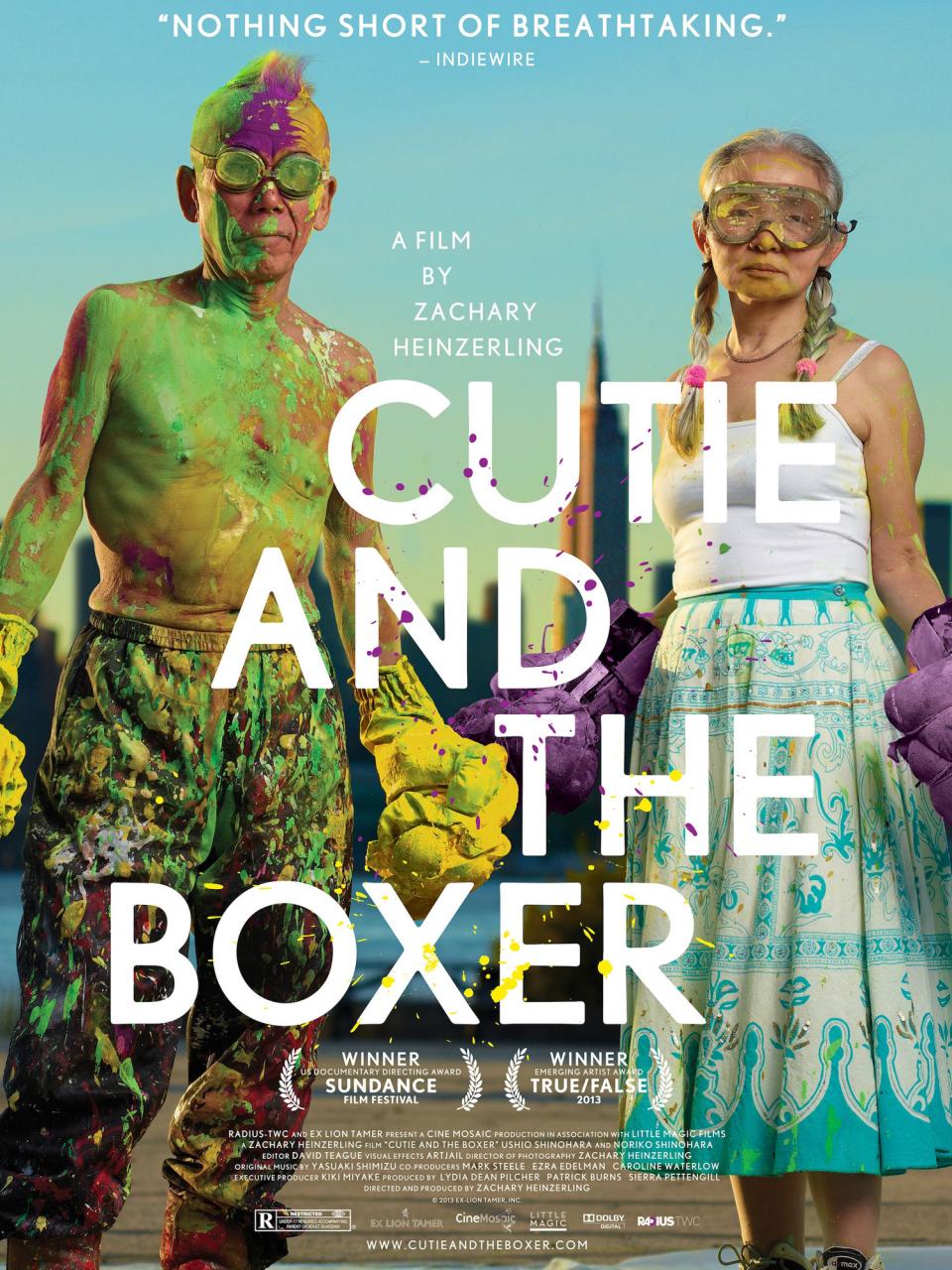
    Mr. F & I have recently established a democratic movie-night selection system.  It goes something like this, His, Hers, Ours.  We love a well done documentary and after the last two disturbing political picks by Mr. F ( Dirty Wars & The Act of Killing ), it was time for a joint movie night selection.  Documentary for Mr. F + art-related story for me, we settled on Cutie and the Boxer.  Win win.  The Sundance Film Festival winner follows the story of the 40 year marriage between famed “boxing” painter Ushio Shinohara and his artist wife Noriko.

    AoF_Cutie

     image found here

    Ushio Shinohara came to notoriety as an artist in Tokyo in the 60s, eventually leaving Japan for New York, where he was a relatively unknown working artist and met Noriko, then an art student around twenty years his junior.  Not long after meeting and falling in love, Noriko became pregnant with their son, Alex.  She would spend the next forty years raising Alex and taking care of Ushio, a temperamental alcoholic ( who is now sober ).

    AoF_Cutie_kitchen scene AoF_Ushiro and Noriko

    images found here and here

    There are obvious parallels between the relationship of Ushio & Noriko and that of Jackson Pollock and Lee Krasner— the boisterous, alcoholic artist husband overshadowing his artist wife and caretaker.  But in Ushio & Noriko’s story, the long-suffering wife regains her artistic identity not with the death of her husband, but by taking it back for herself.

    AoF_Cutie_Shionara painting AoF_Cutie painting

    images found here and here 

    I do wonder if, had Pollock lived and gotten the treatment he needed, whether that couple’s story would have had a similar ending– the tortured artist finding health and peace while his wife finally comes out from behind her husband’s shadow to find her own voice.  Krasner, of course, would eventually gain her own well deserved notoriety but only many years following Pollock’s death.

    We love documentaries for all the questions they bring forth, leading to great conversations between Mr. F & I, usually over coffee the next morning.  Cutie and The Boxer led to questions like Is there truth to the stereotype of the tortured artist?  Why do so many female artists end up putting their own work on hold while caring for husband and family?  Was that a generational thing or is it still happening today?  Is all art cathartic for the artist in some way?  What say you, Artsies?  Would love to hear your thoughts on these questions and the film, if you’ve seen it!

    All image sources linked above.

  • Artsy on Film: (Untitled)

    Artsy on Film: (Untitled)

    Mr. Forager and I take turns choosing the films we watch together.  So hopefully for every documentary about beer or politics, I get a turn at an artsy flick!  Last weekend, we gave (Untitled) a viewing and although as a movie I didn’t find it anything to shout about, I did find the portrayal of the art world and its archetypes, hierarchies, pretensions, and perceptions really interesting.

    AOF_Untitled movie poster


    Adam Goldberg, an actor I’ve always loved since his turn as the too-good-to-be-true-turned-crazy roommate to Chandler Bing on Friendsstars as a struggling avant garde composer who falls down the rabbit hole of the contemporary art world.  Goldberg is the archetypical brooding starving artist, while his brother, played by Eion Bailey, is a “commercial” artist whose work is selling to a certain type of buyer, yet he longs for critical validation.  Enter love interest/contemporary gallery owner Marley Shelton.

    Adam Goldberg as Adrian Jacobs, photo by Parker Film Company/Samuel Goldwyn Films
    Adam Goldberg as Adrian Jacobs, photo by Parker Film Company/Samuel Goldwyn Films

    Shelton’s Chelsea gallerist with her ubiquitous collection of trendy, non-prescription glasses embodies the gallerists’ struggle between the work that sells and the work seen as innovative, evocative, and important.  While these two aren’t always mutually exclusive, there is often an art world snobbery that comes about when work is commercially successful or decorative rather than intellectual, isn’t there?

    Marley Shelton_Untitled_Parker Film Company:Samuel Goldwyn Films'
    Marley Shelton as gallery owner Madeleine Gray, photo by Parker Film Company/Samuel Goldwyn Films

    In addition to the main characters, the film also includes art world archetypes such as The Collector Who Will Buy Anything the Gallerist Tells Him To, The Maurizio Cattelan/Jeff Koonsish Artiste, The Artist Who Makes Art Out of Nothing ( but who are we to tell him it’s not? ), The Consultant With an Eye For Work People Actually Want to Buy and Live With, and of course, the Supportive Parents of Artists, who let’s face it, often don’t have a clue what exactly it is you do, they just want you to eat.

    Orth and Shelton_Untitled_Parker Film Company:Samuel Goldwyn Films
    Zak Orth and Marley Shelton as Collector & Gallerist, photo by Parker Film Company/Samuel Goldwyn Films

    Are the characters in the film stereotypical and a bit caricature-ish?  Absolutely.  Is there truth behind each one?  Most definitely.  Anyone who’s been around the business of art for any length of time has likely encountered some or all of these types.  But I think the film successfully gives us a glimpse into the humanity of these archetypes– how they struggle against who they are expected to be and as some accept who they actually are.  As there are millions of artists, so are there millions of opinions on what art is.  And there is room for all.

    All images by Parker Film Company/Samuel Goldwyn Films.