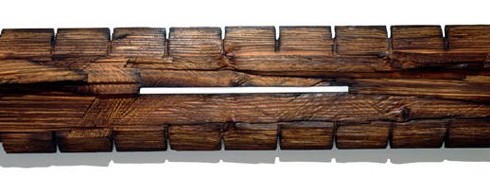
Here in the Northwest, the trees are so spectacular that they grab your attention and demand to be noticed and admired. St. Augustine, Florida artist Joe Segal’s work does the same. His sculptures are a celebration of these kings of the forest, their textures, patterns, their cycle of life.
Instead of a literal translation of branches and limbs, Joe instead chooses to focus on the core of what gives a tree its strength, character and economic value, the hard, fibrous wood.
By cutting, stacking, carving, painting, even burning the wood, Joe re-envisions the pattern of the tree’s life. He takes the normal processes for which and by which wood is harvested and calls our attention to the beauty of the materials in their simplest forms.
The steel used to cut the tree becomes instead, the connecting force that holds the wood together. Pieces of stacked wood, recalling a firewood pile, are juxtaposed with charred wood creating an interesting “before and after” effect.
Working with the nature of the materials, rather than against them, going with the grain, if you will, Joe is exploring the rhythms of the natural world and reinterpreting them into beautifully designed works of art.
To see more of Joe’s work, check out his Pick of the Crop page here at Artsy Forager, where you’ll find a link to his website. I hope you love it as much as I do.
Last night, as my hubby was catching up on my blog posts ( he reads them all, even if he has to sit and catch up on a week’s worth at a time, such a good hubby! ), over his shoulder I re-read my In Search Of post from last week and man, what a whiney little whiner! To save you all from more self-pity-filled posts from me, sweet George took me on a day trip to Astoria, OR on Saturday, in the hopes of helping me feel a bit more connected to the 3-dimensional art world. You know, the one that doesn’t live inside my laptop.
Astoria, Oregon
Despite the gray day, my spirits were sunny. Astoria’s main claim to fame is the movie, The Goonies, which was filmed here way back in 1985 ( yes, we made a children of the 80’s pilgrimage to The Goonies House ). But movie history isn’t the only draw to Astoria. Its downtown area is super charming, filled with a mix of restaurants, coffee houses, shops and YES, some very interesting and diverse galleries.
Our first stop was Lightbox Photographic, a wonderful little gallery dedicated to the photographic arts. Their current show, Plastic Fantastic II, features images created using plastic toy cameras. Absolutely beautiful, emotion-filled images. Be sure to check out their website to see images created their member photographers.
Inside Lightbox Photographic
Astoria was definitely starting out with a bang! We continued our walking tour of downtown, stopping for coffee and treats along the way. Right across from the Astoria Coffeehouse, was Lunar Boy Gallery, whose quirky-look caught my eye. And LunarBoy definitely brought the quirk. June 7th was Astoria’s Official Goonies Day, so Lunar Boy was exhibiting a special show of Goonies-related work. Fun!
This Is Our Time Now! Goonies Show at Lunar BoyLandscapes by Nicholas Knapton at Lunar Boy
After lots of cool art & laughs at Lunar Boy, we perused a few bookstores & other shops ( it can’t be ALL about me ) before finding RiverSea Gallery. This contemporary gallery features a wide variety of work by artists from the Northwest and beyond. I was thrilled to find that their current show, The Fabled Landscape, featured the work of Marla Baggetta.
Artist, Marla Baggetta
Since my days of specifying art for the corporate & healthcare industries, I’ve been a fan of Baggetta, her landscapes bring that perfect combination of happy color and peace, perfect especially for healthcare. Her work is even more lush and gorgeous in it’s original state than her reproductions even begin to show. I was in awe.
Artist, Marla BaggettaArtist, Marla Baggetta
Though seeing Baggetta’s original work was a highlight for me, RiverSea had many other artists whose work caught my eye. Like…
Maple wood sculpture by Michael HampelEncaustics by Paula BlackwellFigurative work by Shannon RichardsonWonderful urban landscapes by Brin Levinson
George had his favorites, too– like the work of abstract mixed-media artist, Charles Schweigert ( told you he was loving abstracts now! ) and kooky sculptures by Pamela Mummy.
Namikaze by Charles SchweigertA Lot on His Mind by Pamela Mummy
Our little day trip to Astoria was just what the art doctor ordered. I was able to peruse some lovely, unique galleries and found some really interesting artists to share with you. We even spotted a couple of empty storefronts that would make great galleries.. you know, just in case.
Though our time in the cities we visited on our cross-country tour was short, we managed to hit a couple of wonderful, yet very different museums along the way. In Tulsa, we spent a few hours exploring the Philbrook Museum of Art.
Front facade of the Philbrook Museum of Art
My Jacksonville readers will be familiar with the Cummer Museum of Art in Jax. The Philbrook is, to me, like the Cummer on steroids. Like the Cummer, the Philbrook was once a private residence, which was donated to the city of Tulsa by its owners, oilman Waite Phillips and his wife Genevieve. Once we entered the museum doors, we found ourselves in a gorgeous, domed center hall, light streaming through the oculus in the center of the dome.
Center hall at the PhilbrookPhilbrook oculus
Just walking the halls of this Renaissance style villa, built in 1927 and designed by architect Edward Buehler Delk for the Phillips as “a place where there two children could entertain friends” ( Imagine the sleepovers you could have! ), is a pleasure in itself.
Corridor at the Philbrook
The museum houses a varied and extensive permanent collection of art, ranging from African & Asian collections, Native American art to Italian Renaissance and a surprising and delightful modern collection.
Bougereau at the Philbrook, a favorite artist of the Frenz’sLovely little Picasso at the PhilbrookFabulous modern design collection at the Philbrook
While the museum collections are enjoyable, it is the museum grounds that really steal the show. Though we visited on a gray and rainy day, it didn’t stop us from exploring the extensive gardens behind the museum. The original formal gardens extend from the rear colonnade of the museum down to the tempietto. Let’s take a little walking tour..
Rear collonade at the PhilbrookView from the colonnade down to the tempiettoWonderful stepped fountainBeautiful, naturalistic water featureNo formal garden is complete without a koi pond!View from the tempietto back toward the museumYours truly in the tempietto ( wouldn’t this be a romantic spot to pop the question? )Contemporary sculpture walk beyond the formal gardens
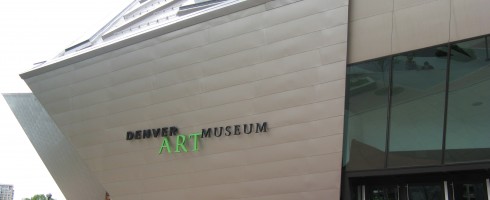
Let’s switch gears now, fast-forward through another 12 hour day on the road and pay a little visit to Denver. While in the mile-high city, we spent some time downtown including a tour through the Denver Art Museum. While the Philbrook is classically ornate, the DAM’s Hamilton Building, where we spent our time, is splendidly contemporary. Designed by Daniel Lubeskind, the structure represents the Rocky Mountain peaks surrounding Denver.
Denver Art Museum
We started at the top and worked our way down, discovering lots of fun & interesting contemporary work along the way.
Noguchi sculpture and Motherwell painting **Sidenote: Motherwell was born in Aberdeen, WA, the town where we are living for the summer.Ceramics at DAM
Did you notice in the pictures above how the walls are slanted? The angled walls created a very interesting visual space, especially in the 4th floor gallery where they were prominent. They were a bit disconcerting when walking down the main stairs, though!
Artist: Mark Tansey
We were all fascinated by the piece above, by Mark Tansey. Another highlight was the Fox Games installation by Sandy Skoglund. I first saw Skoglund’s work in Jacksonville and am always fascinated by the environments she creates.
Fox Games by Sandy Skoglund
And there was just something about “Minotaur with Brushstrokes” that appealed to us. What can I say, we like work that makes us smile.
Minotaur With Brushstrokes by Richard Patterson
Speaking of making us smile, George & I also loved the piece below, although I’m sad to report that I don’t recall the name of the artist. But it reminded me of spring in the Northwest.
Kicking myself for not writing down the title & artist for this piece! Anyone have any clues?
The museum also boasts an impressive Western American Art Collection, as well as African, American Indian, Oceanic, Pre-Columbian and Spanish Colonial Collections. We toured through the current special exhibition, Cities of Splendor: A Journey Through Renaissance Italy, but alas, no photography allowed in the exhibit, so you’ll have to check out the DAM website for a taste. As you can see, our art experiences on this trip were widely varied and we are looking forward to more such experiences here in the Northwest.
In my daily reading of Artinfo.com this morning I came across two articles, seemingly unrelated, until the Facebook comments regarding one of the articles tied them together for me. The first article, found here, poses the question, “Should Gaudi’s Sagrada Familia Remain Unfinished?” The Barcelona basilica, begun in 1882 by renown artist-architect Antonio Gaudi is still under construction eighty-five years following the architect’s death.
Though Gaudi left plaster models and drawings, many of his notes were destroyed during the Spanish Civil War, leaving his vision open to interpretation by current sculptors, architects and designers. While some critics feel the current direction doesn’t jive with Gaudi’s original vision, even during his lifetime, there were many sculptors working on the basilica. Like any monumental undertaking, “it takes a village” to bring Gaudi’s creation to life.
Should Gaudi’s original design be so open to interpretation? He gave artistic license to those working under him while alive, would he so object to modern interpretations now being imposed? Unlike other types of sculpture, cathedrals are often the product of centuries worth of work by multiple architects, artists and craftsman.
As Gaudi was aware he would not be alive to see it to completion, wouldn’t he have known his original design would be open to interpretation by those who came after him? Does the fact that Gaudi is not here to personally oversee the work negate the additions?
Artists using apprentices and assistants is nothing new. The art world of the Renaissance era, which produced such celebrated masters as Michelangelo and DaVinci was built upon the concept of apprenticeship. But what about now? The second article I read this morning was regarding the approval of a Dale Chihuly museum at the site of a former amusement park in downtown Seattle ( now the Seattle Center ).
The museum in itself is the subject of controversy, but that isn’t what I’d like to address here. Instead, I’d like direct attention to another Chihuly controversy– his use of others to craft his designs. One Facebook poster thought it necessary to point out that since losing the use of his left eye due to a car accident, he is no longer the person actually blowing the art glass he is so famous for. ( In reality, Chihuly continued to blow glass for three years following the accident, until a body surfing incident dislocated his shoulder, so he was no longer able to manually manipulate the glass ). The poster’s statement that “His employees make everything. Just sayin’.” seems to somehow fault Chihuly for continuing to create in the only way he physically could, by having others help him. The artist himself has said that his role, more of a director, allows him better perspective on the work.
As stated above regarding Gaudi, the practice of using assistants and apprentices to create monumental works of art has been done for centuries ( and yes, many of Chihuly’s creations are monumental in scope ). So as long as the artist himself continues to design the creations with his name on them, what’s the big deal?
And what about so-called “production originals”? You might be thinking of the ones advertised as “hand painted original works of art”, usually being sold out of a hotel ballroom. But what I’m talking about are the production art studios– where perhaps one “lead artist” is creating original works of art, which are then being recreated & reproduced by the hand of “assistant artists”. There are more of these studios around than people realize and the work can be found in galleries, corporate and private collections all over the world. While the savvy gallerist, art consultant, designer and art afficionado knows production art when they see it, what about the collector who thinks they are buying a true original work of art, only to spot an almost exact replica when in their hotel while on vacation in Hawaii? Do we lump Chihuly in with these?
These are three examples of artwork being completed and accomplished without the direct hand of the creator. What are your thoughts? Is it ever OK to put your name on something you didn’t actually physically create? This is definitely a gray area.. would love to hear your thoughts!
OK, the fashion loving girl in me is coming out! Check out this amazing show opening at the Legion of Honor in San Francisco. “Pulp Fashion: The Art of Isabel de Borchgrave” is a study in fashion and sculpture, meticulously recreating garments from the annals of art history out of paper. Wonder if George will let me take me a detour through San Fran on our trip to the NW?
Beauty was abounding in Jacksonville last night and I’m not just talking about the perfect weather. My sister-in-law and I attended the monthly Downtown Art Walk and were treated to not just the usual visual stimulation but mental and emotional engagement, as well. Now, I had a list about a mile long of the spots I wanted to hit, but we arrived late and spent quite a bit of time at each one, so.. yeah, we only made it to a few.
But we began the night with a bang at The VAULT Gallery, Willliams-Cornelius’ space in a former bank vault ( yes, you read that right! ) on Forsyth Street. Greeted by the Mr. Williams & Ms. Cornelius themselves, and intern Adam, we set off to see what artist Jeff Whipple had in store for us. Whipple has been working on this “Spasm” series for more than thirty years. What began as a painterly device to fill negative pace, the three-barred icon has grown from an element in the background to become the object of an entire series of work.
The three bars that comprise a “spasm” serve to symbolize life, lifetime or a lifestyle. The artwork is open to interpretation, based on the viewer’s own experience– how you see it may not be the way I see it and that’s OK. All of our lives are different and it is in this difference that we each find meaning in the spasms. This is work that truly that makes you stop and think– what does this mean? To the artist? To me?
In conjunction with the showing of Jeff Whipple’s work, Williams-Cornelius also presented a performance piece by self-proclaimed “deformance artist”, Liz Gibson. Gibson was born with a birth defect causing her to have only seven fingers– five on one hand and only two on the other. The performance last night was a character of Gibson’s own creation “Ben Wa Betty”. Betty appears as part archetypal Asian lady, but in a hip and provocative way. Gibson tells stories of how at times she felt lucky or unlucky to have been born with a deformity, all while pouring wax over her deformed hand, proving how you can take something that seems unlucky and make something beautiful out of it.
The overaching theme is one of contentment– be happy with who you are and how you were made. At times you may feel unlucky, but there will always be a reminder of just how lucky we all are.
Our next stop was Southlight Gallery, where there is always a display of exceptional art by some of the most well-known artists in Jacksonville, right along side with talented emerging artists. The featured artist last night was wood sculptor, Grant Ward.
I’m a sucker for any burl or wood sculpture and have been a fan of Ward’s pieces for a long time. There is something about an artist that looks at a log or a tree stump, sees the potential for creating something unique AND possesses the craftsmanship to create something polished and beautiful out of such rough raw materials.
I have always especially loved Ward’s pieces that combine burl wood with spun metal. These pieces take on, for me an other worldly space-like quality. It is as if the wood is a planetary surface and the metal pieces are alien pods making their home there.
After leaving Southlight, we made our way toward the river to the Suntrust Tower, new home of Town Editions, Thomas Hager’s new line of accessibly affordable limited editions– making this artist’s beautiful work available to even a young collector.
These hand-crafted, signed and numbered editions are created using vintage photographic processes, which give the simple subject matter an elegance and sophistication lacking in much of today’s photographic prints. Also on view are some of Hager’s paintings ( He paints, too! I know! ).
Filled with texture and a pastel & neutral palette, these pieces are reminiscent of sand or rock. They have an organic feeling to them that such completely non-representational work rarely possesses. I’m looking forward to seeing Tom’s paintings evolve just as his photography continues to do so.
I wish I could tell you more about all the places we visited and amazing art we saw, but alas, that was the end of our night. I can tell you that I will be back downtown soon to visit the exhibits and studios I missed. I’m not sure how anyone could see it all in ArtWalk’s four hours.. but what an awesome problem to have!
May’s Downtown ArtWalk will be May 4, 2011. More information available here. Hope to see you there!
WINTER TRANSITIONS; SPRING STORMS is R. Roberts Gallery’s celebration of the transition from the grey, dreary days of winter into the fresh bloom of spring. The show features the work of three very different artists, mixed media artist Madeline Peck-Wagner, sculptor James Oleson and encaustic painter Kathleen Wobie.
As you enter the gallery, you may almost miss James Oleson’s tiny bust sculpture. This diminutive piece, made of repurposed metal, will definitely make you stop and take the time to really check it out. I couldn’t believe I walked right by it when I first came in! Beyond the bust is one of Oleson’s horse sculptures. With its stilt-like legs and flowing tail, this equine could be right out of a Tim Burton movie. Oleson also has some much larger scale sculptures that are interesting in their own right.
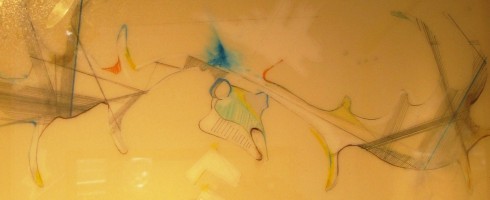
Speaking of equines, Madeline Peck-Wagner’s mixed media works were defnitely, for me, the star of this show. She takes subject matter that could be trite and cringe-worthy ( think cheesy Southwestern art ), but treats it in a unique, contemporary and elegant way.
These are delicate line drawings possessing an intense presence and power, much like the impressive animals depicted. The cross-hatching & precision of the lines are reminiscent of architectural drafting, giving the figures depicted a strutctural, landscaped quality. Conversely, blots and washes of brightly colored paints call to the spiritual significance such animals, both living and decayed possess.
Just as the delicate, bare branches of winter transition into the full, heady blooms of spring, so we move from Madeline Peck-Wagner’s graceful lines into Kathleen Wobie’s encaustics, thick with wax, paint & color. Kathleen’s pieces, in the context of this show, seem to depict spring at its height– full of pastel tones and sunshiney warmth.
For me personally, I found the larger, abstract piece below to be Wobie’s most successful of this show. This piece, rather than being the literal translation of winter to spring that the piece above is, instead represents more the feeling of spring– of rebirth, renewal and the joy of being alive.
As we in North Florida transition into spring ( though some days lately, it feels as if summer is already upon us! ), take the time to drop by R. Roberts to see how these artists make the switch and enjoy this last show in the gallery’s current space. R. Roberts is doing some transitioning of their own, can’t wait to see the bountiful blooming that is sure to be in store!
R. Roberts Gallery is located at 3606 St. Johns Ave in historic Avondale, in Jacksonville.
Winter Transitions; Spring Storms will be on display through April 23rd, the gallery is open Tuesday-Saturday 11am-6pm.