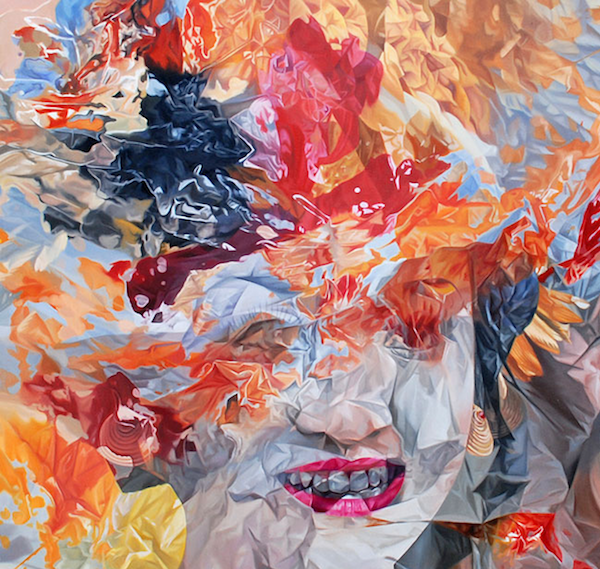
That little piece of thread. You know the one. You want to pull it, you want to cut it, but you know that if you do, that seam will be broken and everything will unravel.
Many times over the last year I’ve had that feeling, that longing to pull the thread, to let things unravel. Sitting by my mom’s bedside, especially in those last two weeks, alone with her at night in the hospice room, listening so closely to every breath, I had to stop myself from pulling on that thread. She needed me. I couldn’t let myself unravel.
We all felt it– she was so weak, we all had to be her strength. Then when she was gone, we were able to allow ourselves to unravel, to feel and express those emotions we’d dammed up for so long. Our cloaks were undone but we didn’t leave them in a discarded pile on the floor. We picked up the threads and began to weave a new story. One that included her memory, her spirit, her strength. It won’t look the same as before, not even close, we’re rebuilding into a completely different kind of beautiful.
The sculptural work of El Paso artist Adrian Esparza uses threads from Mexican sarapes and reconstructs them into architectural-like wall sculptures. To see more of his work, please visit the website of his representing gallery, Taubert Contemporary.
It doesn’t always take another person to imprison us. We can often bind ourselves up without any outside help– whether by our own thoughts, or actions, or expectations. It’s a challenge just to get out of our own way.
In this sculpture series, artist Pava Wulfert binds together painted canvas and wooden racks, illustrating in three dimensions a sense of captivity.
We don’t always recognize our own confinement– like Wulfert’s elements painted in bright, happy colors, we may be blissfully ignorant of our lack of liberty. It’s interesting that Wulfert uses typical artists’ materials like paint, canvas and rack pieces in these bound sculptures. Perhaps how we see ourselves as artists can be a prison of sorts? Certainly thinking of ourselves only in one artistic dimension limits our boundaries!
As humans, none of us are one dimensional. We are a mashed up conglomerate of peaks and valleys, opposing polarities that often don’t make sense. It is when we reach below the surface, into the crevices where the true self often hides, that we see ourselves and our fellow beings in reality, for better or worse.
In his wood sculptures, San Francisco artist Sean Newport begins with individual geometric shapes, building them up and arranging them into a finished whole.
Varied colored surfaces reinforce patterns and illusions created by the undulating geometrics. Our perception of the shapes changing with differing perspectives. Just as opening our eyes to a different view of another may alter the way we see them, or at the very least, help us to understand the crevices behind their own facade.
Momentum can be a tricky thing. If we’re moving in a positive direction, building and maintaing momentum is crucial. But if we’ve begun sliding into bad habits or toward danger, we need to do everything we can to stop the propulsion. In her Plank sculptures, New York artist Leslie Wayne takes her paint on a journey, pushing and piling like lava flowing down a hillside.
Sometimes we can temporarily stop the slide, but what if it just keeps coming, piling and piling until it overflows? Maybe the trick is to just let it slide. Sometimes we need to allow ourselves the freedom to shift so that we can position ourselves to move away from one thing and build toward another. The shifting can be tricky, though. Overcorrecting might delay or detour. But if just allow a tiny, scary bit of sliding, we move with greater purpose.
When my mom was diagnosed with ovarian cancer last year, I kept coming back to a photograph I had taken of a sand dollar that summer. You see, when we were growing up, my mom had a thing for seashells and sand dollars. She loved hunting for those little treasures on our Florida beaches and our house was filled with them. The sand dollar from my California beach was beautifully bleached and perfectly round, but with a gaping hole in its center. For me, the sand dollar was my mom– her beauty and grace was intact but her shell was broken.
When faced with the mortality of our parents, it drives home our own vulnerability. In my mom’s weakness and helplessness, I saw my own– how scared I was sometimes to be alone with her, fearful that something could happen and I wouldn’t know what to do for her. Next to losing her, it was my biggest fear. Not being enough. Not being able.
One particularly weak day, she wasn’t doing well and had taken herself into the bathroom. I didn’t hear any noises out of the ordinary, but when I came in a few minutes later to check on her, she was on the bathroom floor. Thankfully not hurt in any way, but so weak that she couldn’t lift herself up. And I wasn’t strong enough to lift her from the floor. We tried and tried, but even together we couldn’t do it. I was afraid of hurting her and she was afraid of me getting hurt trying to lift her. So we called my stepdad and we waited. For what seemed like an eternity.
We both shed a lot of tears that day. Most of mine came when I was back at my brother’s house, alone before the rest of the family came home. The weight of what could have happened came down on me, along with a tremendous feeling of relief and thankfulness that what could have happened– didn’t. But it had been there in that moment, more so than any other I spent with her, that I felt how vulnerable she was, how much this ugly disease had broken her beautiful shell.
She’s doing better these days. Still fighting this beast with all the strength her now tiny body can muster. When we talk she sounds more like herself than she has in months. I hear a hope in her voice and it gives me hope, a feeling that has sometimes eluded me through this process. As impossibly difficult as it has been, she has not let it break her. Her shell is different, but her spirit is still the same.
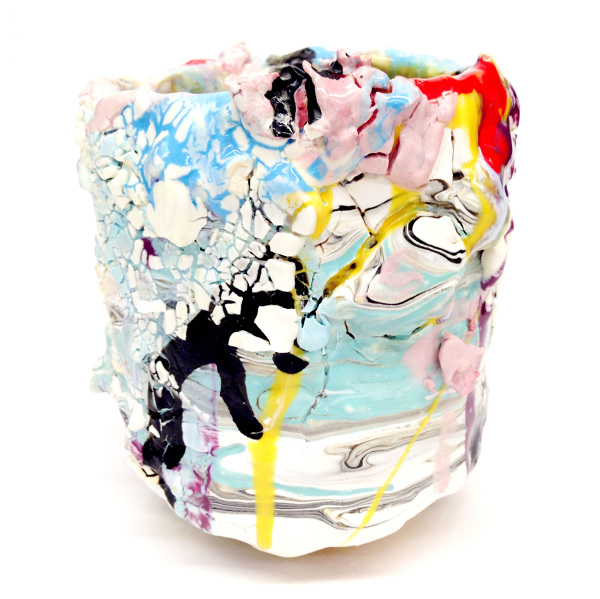
Ceramic cups featured today are by Los Angeles based artist Brian Rochefort. I found an incredible beauty in their cracked and broken shells. To see more of Brian’s work, please visit his website.
Who remembers the Rubik’s Cube sensation back in the 80s? I can distinctly remember spending hours twisting and turning, trying to line up all those little colored squares! I always thought the more random arrangement of colors much more interesting than the neatly lined up hues. These sculptures by London artist Sophie Smallhorn how much more interesting things can be when we allow for a bit of disarray.
A life where all is neat and orderly, all black and white, in which we can easily answer any question with this is wrong and this is right is one hardly worth talking about, is it? It is in the missing pieces, in the gaps between where we may not find answers, but will likely find understanding.
It can be easy to get stuck pigeon-holing people into the roles in which we know them best. Mother, father, sister, brother, doctor, lawyer, artist. But we aren’t flat and one-dimensional. We are made up of many sides, many layers– some complementary to each other, others contradictory. When we think of abstraction, for me at least, my mind automatically runs to painting. But, as the work of Hilary Harnishfeger shows, abstraction can move past the dimensional limits of a painting on canvas.
Harnischfeger’s work feels to me like what happens when we peel open the layers of a person we’ve never attempted to understand outside the box we’ve placed them in. All of sudden, we begin to see a world opened up– dreams and interests we could have never imagined because we never took the time to ask. It’s so easy to take that flatness for granted, to not bother to think beyond it. And on the other side, it can be difficult to let those dimensions be seen. It’s less risky to just settle into and reveal ourselves in only that one role. What if, when we turn ourselves around, we find it was all just a facade?
Some people find horizontal lines soothing. Maybe I’m weird, but I almost always prefer vertical lines. Perhaps a nod to the soaring peaks of the mountains I love so much? Textile artist Nike Schroeder takes full advantage of verticality in her string sculptures and I can’t get enough of them.
The tactile quality of the string and the way it hangs seems to give a nod in my eye to indigenous garments and weavings. There is also an intriguing sense of color field painting to each piece, as the individual string colors shift gradually, almost imperceptibly to create depth, line and shadow. The nature lover in me sees moss silently drooping in fog, a waterfall cascading over a cliffside. Silent representations of a world of life.
To see more of Nike Schroeder’s work, please visit her website.
As we get back into the swing of normal life following our week in the wild, I’ve been struck by the obvious artificiality that surrounds so much of our landscape. Plastic flowers where real should be, fountains instead of waterfalls. In their In Pieces series, photographer Dean West and Nathan Sawaya present highly stylized, manipulated representations of modern life.
Upon first glance, these may appear as simple photographs, just as that strip mall facade from a distance might appear to be a row of historic buildings. But on closer inspection, we see that these are carefully crafted tableaus combining West’s photography with Sawaya’s LEGO sculptures to create an unreal reality. ( click on each image to enlarge the photo and see the LEGO elements better ).
To see more from the In Pieces series, please visit the collection website. You can check out more work from Dean West here and Nathan Sawaya here.
G-Five, Plastic Attack, 2013 (rice fields installation view); plastic bottles and metal frames; 2 meters high. Courtesy of the Artists. Photo: G-Five Art Management.
Something is in the air in Bali. As I was interviewing a long string of artists during my writing residency there, one topic that kept coming up was plastic and the environment. Several of the artists I met and interviewed brought it up specifically, while many others merely danced around the subject and spoke of the environment more vaguely.
As time went on during my month’s stay, common themes and unifying strings clearly started to emerge between various artists and their work. But plastic and its place in our environment and culture was a big theme that I truthfully didn’t see coming. I consider myself an environmentalist (beginning with my dad’s teaching the Boy Scout rule to always leave your campsite [or hiking trail] cleaner than you found it, and leading all the way to my co-founding a residence hall recycling program at my university), so it wasn’t something I was unaware of or blind to, but I simply wasn’t expecting it.
Many of the artists I met in Bali brought up the problems of plastic degradation in a plethora of ways – from painter Federico Tomasi’s aside about the rainwater run-off flooding the ocean with plastic from one-time-use packaging to Made Aswino Aji’s laments about the changing landscape of Bali with its tourist growth. Or, in Ketut Jaya Kaprus’ plans to feature an entire gallery exhibit about the dangers of plastic, while showcasing its redemptive and transformative power as art.
left | Ketut Jaya Kaprus, photo of Kaprus painting pillars made from found plastic bottles, 2014; paint on plastic bottles. Courtesy of the Artist. right | Ketut Jaya Kaprus, installation view of plastic bottle pillars, 2014; paint on plastic bottles. Courtesy of the Artist.
I couldn’t ignore this recurring theme, but what intrigued me most was that the majority of the artists I spoke with were quick to un-identify with an environmental movement. Many artists informed me quite specifically that they were “not activists,” or god forbid, “environmentalists.”
I wasn’t sure exactly where this fear of labeling was coming from, but what I did know was that all of this art spoke loudly with its impact and aesthetics (though at times ambivalently with its message), much like its creators. I think part of the fear for these painters must be that they would lose their title as “artist” if they were simply seen as an activists – a fear I can sympathize with. For years, I have had business cards that vary between self-identifying as a “writer” or “art historian” because I don’t want one label chosen over another. But, with these artists, it seemed there was something more brewing below the surface.
So I decided to investigate some of the bigger, (non)environmental art projects I encountered in Bali.
top | G-Five, Plastic Attack, 2013 (beach installation view); plastic bottles and metal frames; 2 meters high. Courtesy of the Artists. Photo: G-Five Art Management. bottom | G-Five, Plastic Attack, 2013 (gallery installation view); plastic bottles and metal frames; 2 meters high. Courtesy of the Artists and Tonyraka Art Gallery. Photo: G-Five Art Management.
G-Five, a group of five younger artists on the contemporary art scene in Bali, has come together to produce a number of successful group exhibitions. Individually, they are artists in their own rights with unique styles and distinctive techniques, but together they aim to tackle broad and fluid subject matter and experimental work. All from Gianyar, a region known as the artistic capital of Bali, I Wayan Upadana, Wiguna Valasara, Made Gede Putra, Kadek A. Ardika, and I Wayan Legianta formed this talented group in 2009.
In their 2013 show “Plastic Attack” at Tonyraka Art Gallery, G-Five focused on plastic as their medium, and in some respect, message. This followed a trend of their prior exhibitions wherein they had focused on using and featuring a specific medium, be it rubber, thread, wood, or resin.1 Here, they created and joined five large walls of plastic bottles. First they filmed and photographed these walls out in nature on the iconic shores of Bali and in the equally picturesque and emblematic Balinese rice fields. Then they moved this large wall structure and installed it in the front of the gallery, with backlights that made it feel more paranormal and artistic than a foreboding environmental message. Inside the space, one hallway was completely blocked off with an enormous inflatable bulbous plastic ball, made up of taped plastic and powered by a fan, timed to inflate and deflate as if it was a living, breathing creature. They also showcased installations of found dirt, layered with plastic debris and refuse from the rice paddies in Ubud. These cutout segments were made into spectacles and “ready-mades,” as they were displayed in pristine glass boxes that would more typically be reserved for a rare and valuable artifact.
Bali Not For Sale, Bali Not for Sale, 2011; bamboo and acrylic signage. Courtesy of the Artists. Photo: Bali Not For Sale.
Another art collective entitled Bali Not For Sale is comprised of three young artists from Ubud: Gede Suanda Sayur, I Wayan Sudarna Putra, Pande Putu Setiawan. In 2010, they used bamboo and acrylic paints to form large three-dimensional letters that spelled out “NOT FOR SALE” and installed these signs in the remaining rice paddies at Jl. Sriwedari, in the Junjungan rice fields of Ubud.
These installations (and digital photographs of the installations that now float around the web) call attention to the growing number of residents who have sold their families’ rice fields to developers. Many families have been doing so to accommodate a growing hospitality industry, succumbing to the demand of the ever-growing tourist population, who would like to stay overnight and retreat amongst the picturesque rice fields in Ubud. Over time, these sales and developments have damaged a long-standing farming tradition in Bali, leaving families with a massive sum of money up front from property sales, but one that does not last over time or reap a steady income, as tending to the rice fields once did. Bali Not For Sale’s message is clear and humble, carrying visible force through art installations, “Bali is better simpler. Paradise ‘soul and pride’ is not for sale!”2
Wayan Suja, Plastic Rhetoric, 2011-2012; oil on canvas; 150 x 150 cm. Courtesy of the Artist and Tonyraka Art Gallery.
Wayan Suja paints intimate portraits of people, but he separates their faces from that of the viewer with obtrusive veils of wrinkled plastic. This creates an opposing dynamic wherein the detailed and naturalistic portraiture draws viewers in and creates an intimate feeling and setting, while the plastic intercedes between the depicted sitter and the viewer, thus superseding the very subject of the painting. In many of Suja’s series such as “Plastic Rhetoric,” are the paintings about portraits or are they in fact about plastic as the titles would suggest? It seems that plastic is both the subject and non-subject of his work, as the viewer’s eye oscillates between focusing only on the plastic veil while also shifting only to the veiled face behind it.
When I asked him about why he would use plastic in this way, Suja said he is not an activist. It is not about being for or against plastic, but about saying that plastic is here and using it quite literally as a lens through which to view the world. The figure wears traditional Balinese dress and is veiled in plastic so that she challenges what it means to be 100% Balinese. Suja compared it to the same way that he painted a Coca-Cola can in Untitled 2005. It is here; plastic is here; a Western influence is here in Bali and Suja is not saying that things need to remain traditional, but he is commenting and observing an ever-changing and adaptive culture.
And perhaps this fluidity of culture is the real heart of the subject matter I had been dancing around all along. In an essay on G-Five’s show “Plastic Attack,” Wayan Seriyoga Parta writes that their dirt and trash installation shows “packaging repackaged.”3And in my interview with Legianta and Valasara, they were quick to tell me that this show was about “art for art’s sake” and not about the environment. But to me (admittedly an American abroad bringing my own ingrained ideas in tow), it was hard to consider the exhibit without reading an environmental message. They explained that they were exploring “plastic as new media,” so that it is both a medium and experience.
In light of Suja, Bali Not For Sale, and G-Five’s art and aims, perhaps these works are actually less environmental and more about influence. Truly a message and medium repackaged. And perhaps some of this work is less of a protest and more of a proclamation of prevalence. An “I see you,” kind of acknowledgement towards the impact, union, and delicate merger of Balinese and Western culture.
Wayan Suja, Being a Colorful Balinese #3, 2012; oil on canvas; 160 x 150 cm. Courtesy of the Artist and Tonyraka Art Gallery.


 When faced with the mortality of our parents, it drives home our own vulnerability. In my mom’s weakness and helplessness, I saw my own– how scared I was sometimes to be alone with her, fearful that something could happen and I wouldn’t know what to do for her. Next to losing her, it was my biggest fear. Not being enough. Not being able.