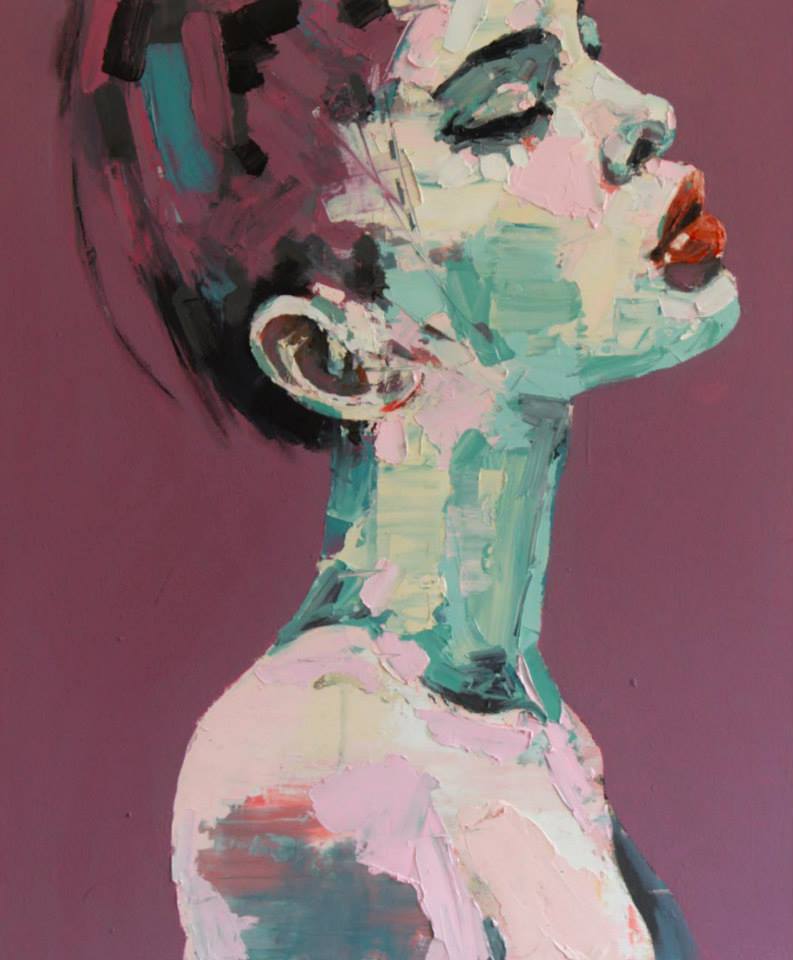
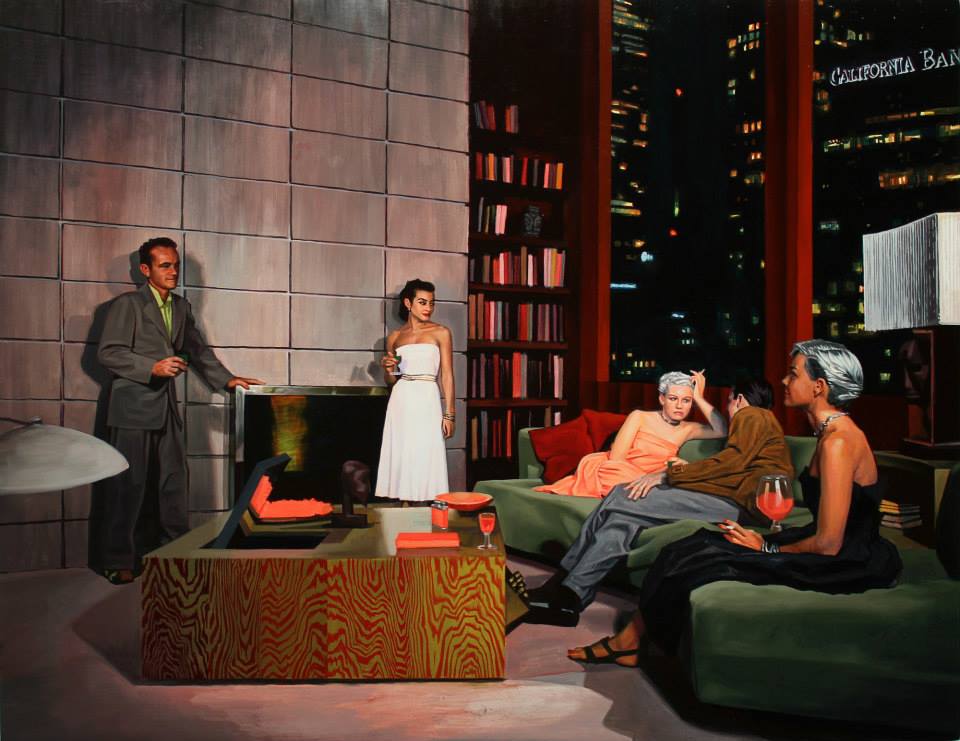
In our discussions regarding our final landing spot, Mr. F and I have an ongoing dilemma. He is drawn to the drama of being surrounded by super high mountain peaks, while I feel most at home among the trees.
These paintings by Australian artist Shannon Smiley bring to mind the lushness of the forest canopies I am so drawn to.
In my new little studio ( I do mean little, it’s about 50 square feet ), I have a lovely view of treetops and rooftops in our neighborhood. The sunsets from the west facing windows are often spectacular and I would love to capture them from my roost, but there’s a bit of a problem. Screens. The window screens allow for leaving the windows open without risking bugs coming in, but they get in the way of clear vision.
The abstract paintings of California artist Chris Trueman with their undulating layers bring to mind the view through veiled cover.
As a Florida girl, the warnings in California to “never turn your back on the ocean” took some getting used to. But as I soon learned, Pacific waves are much more unpredictable than their Atlantic cousins. A rogue wave could sneak up on shore and sweep you out to sea when you least expect it.
And so it goes with most everything else. It is easy to get swept away– by emotion, by anger, by busyness. Sometimes being swept up is a good thing, what is better than being caught up in the arms of someone you love? Or loosening your grip in order to be more free?
These paintings by New York based artist Angelina Nasso reminded me of that feeling of being swept up, of loosing our grip on control, for better or worse.
The art world, like so many others, has its own language. It’s spoken by curators, gallerists, and art writers everywhere. As artist Raul Cordero puts it in describing his Transient Poetry series, it is “A language taught in art schools, heard at intellectual theoretical events or commercial art fairs; which many learn how to speak as a matter of survival..”
When we begin our journey as artists, all we want is to create, to express ourselves. We often simply pour out what is inside without a thought of how to explain it. Then we need to write an artist statement for a gallery, a grant proposal or website text and we find ourselves searching for a way to describe intellectually what is an emotional journey. Words often fail.
One Christmas, a long time ago when my oldest nieces were still little, I painted an old suitcase and filled it with old prom dresses and costume jewelry, creating for them a Dress-Up Box. Looking back, I wish I had thrown in a doctor’s coat, a stethoscope, an artist’s palette.. options to dress up in more than just pretty dresses. But we love to fantasize about who we could be, to dress ourselves up in costumes that, at least visually, transform us.
There is that old adage, “dress for the job you want, not for the job you have“. The costumes we put on have a way of sometimes transforming us from the outside in. We feel fancy when we put on a fancy dress, we feel powerful and in control in a suit. There have been a few stereotypical artist ensembles like the dark, all black, beret-wearing brooder and the wild hair, layered boho hippie look. But my wardrobe, like most artists, lies somewhere in between. I sometimes think if I could start over, if I could overhaul my wardrobe to perfectly reflect how I want to be seen as an artist, will I then feel like the real deal? But I know it won’t work. It is still a costume. I feel like the real deal when I pour out my heart on a canvas, no matter what the outfit.
Paintings featured are by Pennsylvania artist Adrienne Stein. To see more of Adrienne’s work, please visit her website.
Between the highs of the mountaintop experiences like holidays, weddings, and vacations, we can forget to find the meaningfulness in the everyday. The paintings of Aubrey Levinthal celebrate the beauty to be found in the commonplace.
Throughout the day, I find myself being struck by the play of light coming through the window, the framed scene seen through an open window pane. Our albums are filled with captures of the important moments, but how often do we document talking over a leisurely Sunday breakfast or the loveliness of the evidence of lives well lived.
A while back, I posed a question on Instagram asking whether other artists prefer to tweeze out random brush hairs from their paintings or just allow them to exist as part of the painting process. Results were split between those that like a perfect surface and those that just live and let live.
UK artist Matthew Stone falls into the former category, his process involves photoshopping our imperfections of his paintings on glass, then printing the resulting digital images on wood panels, mirror, and acrylic.
Like my social media followers, I’m a bit split. I love a wonderfully perfect surface but at the same time I like the idea of allowing the entire process to show, even the imperfections. It’s a bit like the way we live our lives, isn’t it? Do we let others in on the little errors and missteps or do we present a perfectly rendered facade, only allowing those closest to us to see the blemishes?
Creating anything from scratch is a difficult endeavor. If the foundation of what you’re building isn’t secure, it will never be sound, it won’t be what you planned for, what you dreamed of.
These mixed media pieces by Barcelona artist A Ruiz Villar with their structural emphasis, remind me of what we build up for ourselves.
We lay ourselves open in more ways than just physical nakedness. Baring our souls often requires much more bravery. We aren’t just our bodies but our spirits. And it is in those deepest places that our true selves reside.
As artists, we lay ourselves bare every time we put brush to canvas. We make ourselves vulnerable as we pour ourselves out in color and form. It is a scary thing to be an artist, to embrace the emotional roller coaster of putting ourselves out there and opening up what is inside for the world to see.
While Mr. F and I were living outside San Francisco, we both had a feeling of being hemmed in. Even though we were living in a small town in the mountains, the number of people had us feeling a bit cagey. Now we’re in another small town, but here in Idaho Falls, there is hardly any traffic and life is just more laid back.
These paintings by Los Angeles artist Seth Armstrong reminded me of the cages that we find ourselves in, sometimes of circumstance, sometimes of our own making.