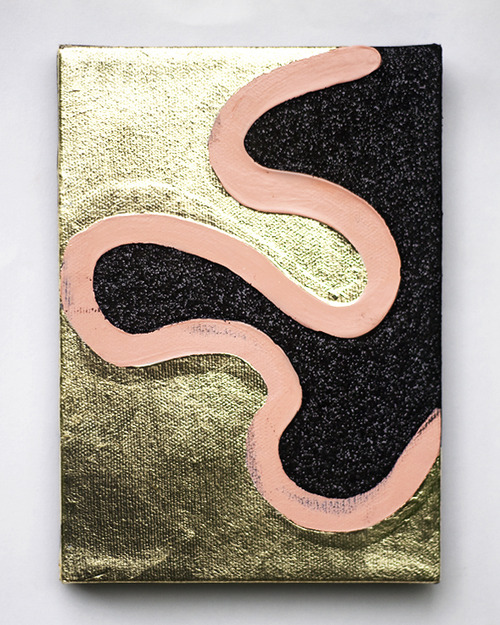
For some artists, the end product is the goal, but for others, the process of creating, pushing the limits of medium and where that journey takes them is more the target. In his work, Portland artist Justyn Hegreberg explores the reaction of paint against glitter, plastic against canvas.
Given their diminutive size, most being around 5×7 inches, there is a playfulness about these pieces that make them seem like small and lively test samples for a larger project. Which is a huge part of their charm. If they were to be enlarged, these pieces would lose some of their frivolity, gaining in return something labored. It’s that experimental aspect of each piece that is so pleasing– you can almost see him working out the juxtapositions.. so what if I extend the raw canvas here, how about some yellow there?
How about you, Artsies? Are you a final result type of artist or is the process where your joy is found? If you’d like to see more of Justyn Hegreberg‘s work, please check out his website.
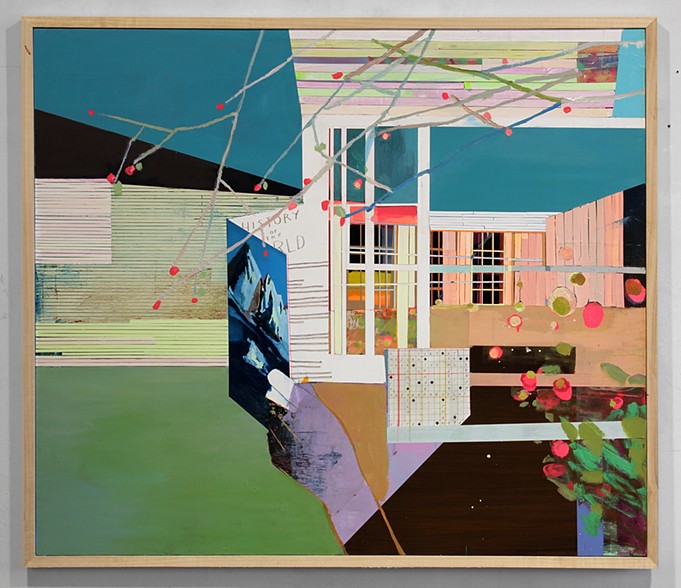
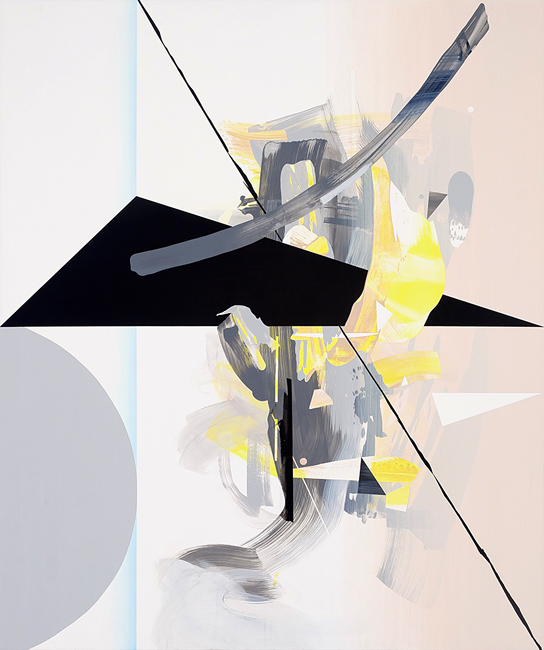
Occasionally, Mr. F will wake up and unknowingly be mad at me for something I did in one of his dreams. It’s only after being awake for a bit that he realizes that what he is remembering never actually took place. Just last night, I had a similar dream about him and had to stop myself from carrying those feeling on into our day. Funny how much what happens while we’re sleeping can affect us, isn’t it? These paintings by Kristen Schiele remind me of what my subconscious must be like– not orderly and sensible, but filled with hints and tokens of seemingly unrelated moments.
These pieces are dream-like in their mash-up of elements, jumping from here to there just as our subconscious does in slumber. I often awake wondering– where did that come from?? Sometimes it seems like we’re trying to work out our waking life in our dreams, or perhaps the past comes back more vividly when we aren’t consciously trying to resurrect it.
To see more of Kristen Schiele‘s work, please visit her website. Have a fabulous weekend, Artsies! I’m looking forward to lots of dream-time!
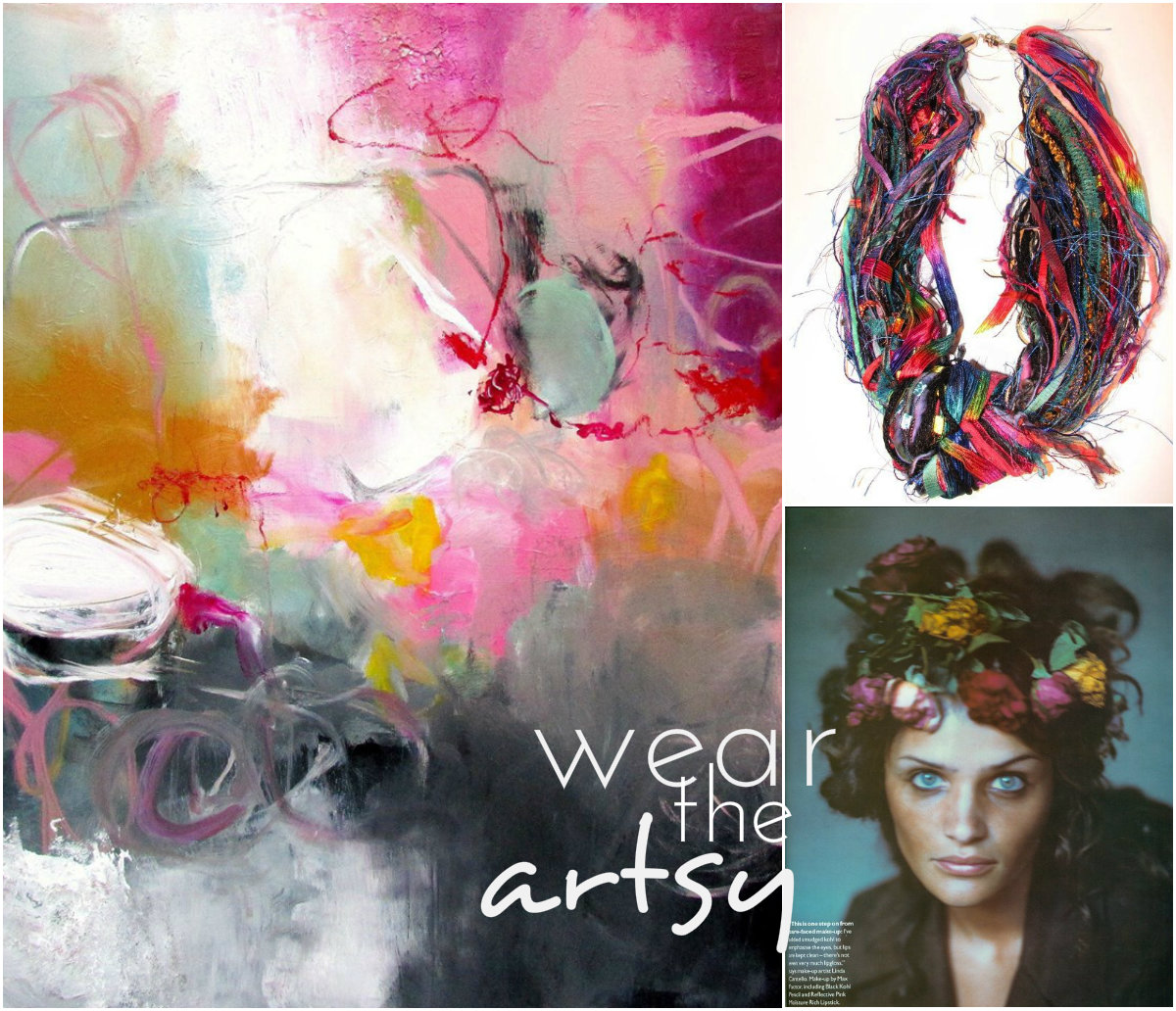
A while back I wrote about the work of Wendy McWilliams and how to me, much of her work illustrates the glimpses of light and color that give us hope in the dark. We are now well into winter and if you happen to be living in the Northeast, you may be wondering if you will ever see blue skies, flowers and unfrozen ground. February has always seemed to be winter’s last cold blow, preparing us for March and the beginning of our transition into spring. But maybe you can’t wait for March and need to put a little spring into your dark winter days! This painting by McWilliams reminded me that even in the midst of the coldest, darkest winter, we can still embrace the spring in our souls.
I love how the Tapestry Necklace brings together the dark and light of McWilliams’ painting, the colors echoing the painting and the inspiration, as well as mimicking the beautiful messiness of the brushstrokes. Perfect for a shot of color and would keep your neck warm while it’s still freezing outside!
To see more of Wendy McWilliams’ work, please visit her website and to see more fiber art necklaces like these ( I want one! So many gorgeous choices! ) check out the You Made That shop on Etsy.
Once upon a time, wood paneling was the epitome of dated and dreary. Think back to that 70s basement.. yikes! But wooden wall treatments are seeing a resurgence lately and they are coming back stronger and more artful than ever! You may love the look of these modern paneling interpretations, but not sure how to incorporate art on wood walls? There are as many ways to style a wood paneled room as their are trees in the forest. Since painting over wood gives you basically the same canvas as a painted wall and I like a challenge, we’re going to focus on art on wood walls with a more natural finish/stain.
Here are just a few ways you can go–
1 | beachy keen, jelly bean. Lightly stained or pickled wood lends the perfect bleached out style to a coastal setting. If your taste in art tends toward a pastel palette, keep the softness and natural calm going. Pieces like these by Leora Armstrong with a strong horizontal vibe recall that perfect spot where the sky meets the sea.
2 | mid-century glam it up. Love Mad Men? Live for Saturday afternoons spent combing vintage shops and thrift stores for Mid-Century treasures? Secretly want to wear a pencil skirt and heels while serving cocktails? Large cut wood panels in a uniform stain are the ideal backdrop for some MCM goodness. Abstract artwork in earthy tones complete a room Don Draper would be proud of.
3 | cozy up to modern warmth. Sometimes the elements we love about modern spaces, like concrete floors and soaring ceilings, can lead to a less than inviting atmosphere. But juxtapose warmly stained wood walls against those details and it’s like cozying up to a warm fire. Artwork with lots of texture as well as pops of color and pattern add to the warming effect.
4 | elevate to rustic elegance. Pickled wood walls can be taken in so many directions. Their greyed-out tone makes them ultra versatile. In Jackie Aster’s NYC apartment, as featured in Elle Decor, the wood walls add just a hint of neutral texture and ground the formal finishes with just the right amount of rusticity. A Damien Hirst etching adds a bit of playfulness turning what could have been an uptight room into space filled with snuggly joie de vivre.
Do you live with art on wood walls? How is it working for you? Or maybe this inspired you to embrace that wood paneling you used to hate! Work with the grain, not against it. 😉
All images are linked above. Want to see more in the Artsy Dwelling series? Check out the archives here.
Not that long ago, women were valued for not just their beauty, but their “accomplishments”. That term didn’t refer to earning a promotion or college degree at the time, but showing a capacity for a certain “womanly” skill set– things such as singing, playing music, dancing and embroidery– all thought to be the types of talents needed to be a successful hostess and therefore, appropriate for marriage. In her Samplers series, New York artist Clare Grill deconstructs these antiquated notions by reinterpreting and deconstructing embroidery samplers in paint.
Painting would have also been listed under the merits of “accomplishment”, a coincidence not lost on me or I’m sure on the artist. Samplers were originally just that– quick samples of stitches a needlewoman saw and admired. Then, as time went on, they became examples of proficiency and skill at needlework, a talent valued across the classes, though certainly more necessary for the lower.
Grill’s paintings retain some of the original sampler designs– the decorative borders, the notation of name, date and age. Yet I find it interesting in the way that these painted samplers are done in a much more abstract and naive style. Perhaps a nod to the exclusion of these girls and women from achieving more meaningful and intellectual pursuits.
You know one thing I miss about working in an office? Cake days. Birthdays, new babies, going aways, work anniversaries– any excuse to have an afternoon cake break in the lunch room. I was always amazed by how having a little treat in the middle of the day made the work day seem just a bit special. I can almost taste these painted treats by Kentucky artist Lori Larusso.
It’s interesting how important food is, the preparing of it, the gathering, the sharing and consuming, to so many cultures, including our own. How baking cookies for someone is a warm and welcome way to say thank you and how we wouldn’t dream of having a celebration without food! Why do you think that is? Perhaps because our need to eat is so universal? Because we all need and crave food, it’s the perfect ice breaker and status leveler. Maybe that cupcake isn’t on our diet, but the child we share it with will remember the moment always.
I love writing this blog so much. One of my favorite reasons? An excuse to follow the artistic journey of so many amazing artists. California artist Clare Elsaesser was among some of the first artists featured on Artsy Forager and her work just continues to evolve and grow. This latest body of work is so stunning, I couldn’t wait any longer to give you a peek.
Clare’s work is moving into a more complex, narrative direction with these, yet still retaining the simplicity and graphic style that is her artistic trademark. There is so much visual texture and depth and the emotionality that is always present in her work really takes center stage. It feels like we are being given short glimpses into not just a moment in physical existence, but a visceral, intimate look into the spirit of a moment.
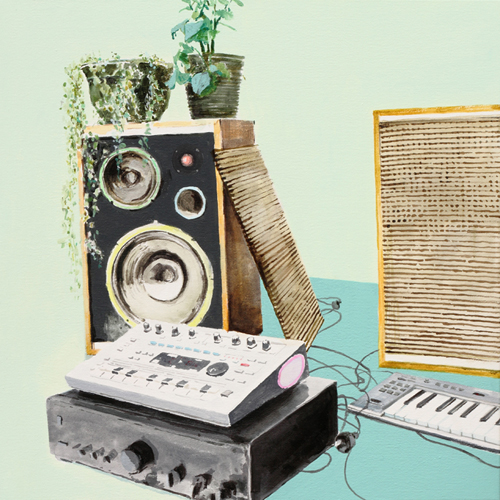
Music is an amazing connector. We can be at a concert with thousands of strangers and share one voice. We smile and wink at the fellow coffee shop patron secretly singing along to the ubiquitous Mumford and SonsPandora station. For those who love it, music has the power not just to connect us to people but to connect us to places and memories. These paintings by Melbourne artist Dane Lovett remind me of how the music we love becomes the soundtrack to our lives. ( Sorry, that was a pretty cheesy line. But music does that to me. Just go with it. )
From the lullabies our mothers sing, to the Alphabet Song, to the music-our-parents-hate, we can identify stages and cornerstones in our lives by the music we listened to at the time. When Mr. F and I hear “our song“, no matter where happen to be, we are instantly taken back to those first magical months of falling in love. Music can have the power to heal and to comfort. Musicians and their words have the capacity to communicate what perhaps we cannot. A few years ago, on our first trip together to Glacier National Park, this song came on the iPod as Mr. F and I were ascending up the Going to the Sun Road, surrounded by amazingly beautiful scenery, we were both overcome with emotion– overjoyed at being in such a place with each other and sharing in that moment, the beauty of the song matching the intensity of our feelings. It’s one of my favorite musical memories. Do you have any special musical moments? Share in the comments!
A blank canvas can be a scary, intimidating thing. Many artists have some kind of end product in mind when they make that first mark. But for me, it is the ones who embrace what is happening spontaneously and throughout the painting process that create the most interesting work. For Brooklyn artist Vince Contarino, the practice is one of careful balance between the plan and the process.
According to his artist statement, Contarino develops ideas for paintings through small graphite drawings. Once a painting begins, it is a “continual balancing act between embracing the intuitive nature of the painting process and making aesthetic choices through patient, considered moves.”
I’ve been learning this lesson in my own painting practice recently, perhaps starting with an idea, sketch or palette in mind, but allowing myself to follow the brush where it leads, even if that means something completely different from where I began. The times I’ve allowed myself to do that– still learning not to force myself to conform to a preconceived ideal– are the works I’ve been most proud of. I think Mr. Contarino is definitely on to something!
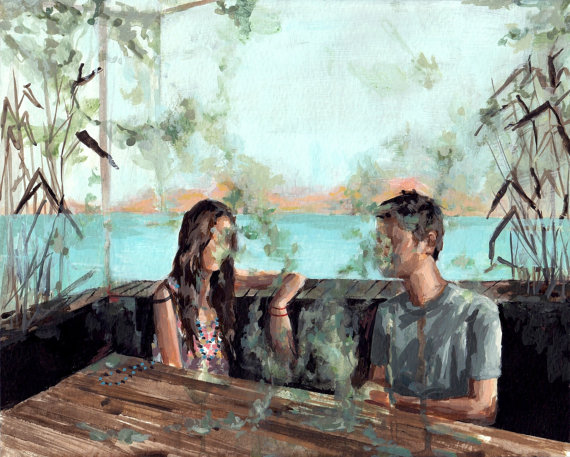
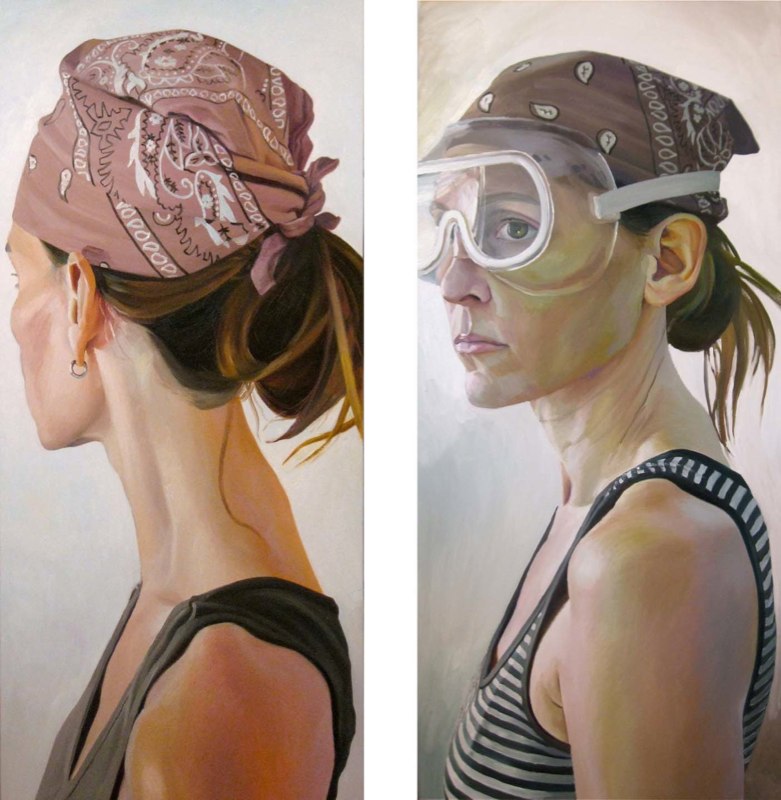
Our memories of the people we love aren’t full scale photos, but more the recollections of the details that made them special to us– the softness of a grandmother’s hand, the freckles on a child’s face, the little particulars that make us unique. In his work, New York painter Stephen Wright gently records the minutia of a face, a lock of hair, the turn of a neck.
Occasionally, when we sitting together, holding hands while watching Colbert or a movie, I am struck suddenly by the realization that when we’re old and perhaps Mr. F is no longer around, that my hands will remember what his felt like around mine. That those physical memories will be more precious than any photograph could be.
Stephen Wright zeroes in on the minor details of his subjects bodies, we get the sense that we can almost feel what that skin is like, soft, maybe cool to the touch, or we feel the sharpness of a clavicle, the roughness of hair gone grey. I love that his compositions often crop out the subject’s face, after all, we know the hands, feet, the shoulders of our loved ones just as well as their faces, but often fail to really think about how integral they are to our memories of them. What about you, Artsies? What details do you remember most about those you love? I can still smell my grandmother’s perfume and know every freckle on my niece’s cheeks!