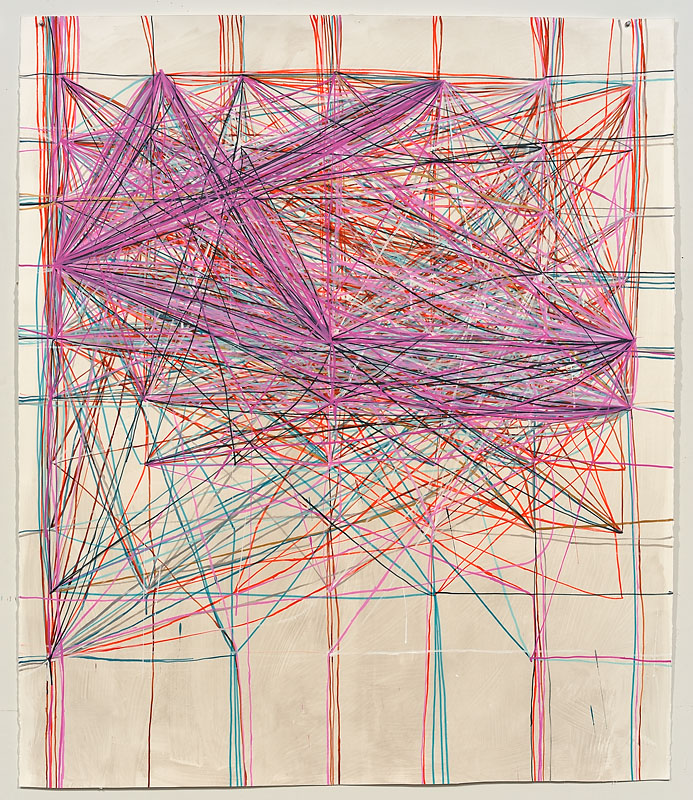
At the end of our traveling, I think it might be interesting for Mr. Forager & I to map out all of our journeys, connecting the places we’ve lived and visited. As we enter into our 3rd year of traveling together, I have a feeling our map might eventually look like one of these mixed media pieces. San Francisco artist Mel Prest uses an eccentric system to plot out grids of dots corresponding to Japanese metro routes, connecting the dots to reveal a complex system of connections.
Grid points are based on spelling out map relationships as Japanese characters. The artist connects the grid points, including mistaken lines ( in gold ) so that the mistake, instead of detracting from the beauty, adds to it.
I am especially intrigued by this aspect of Prest’s work. Although the path we take or the place where we find ourselves wasn’t necessarily what we wanted or intended, it can still add meaning and beauty to our life’s journey.
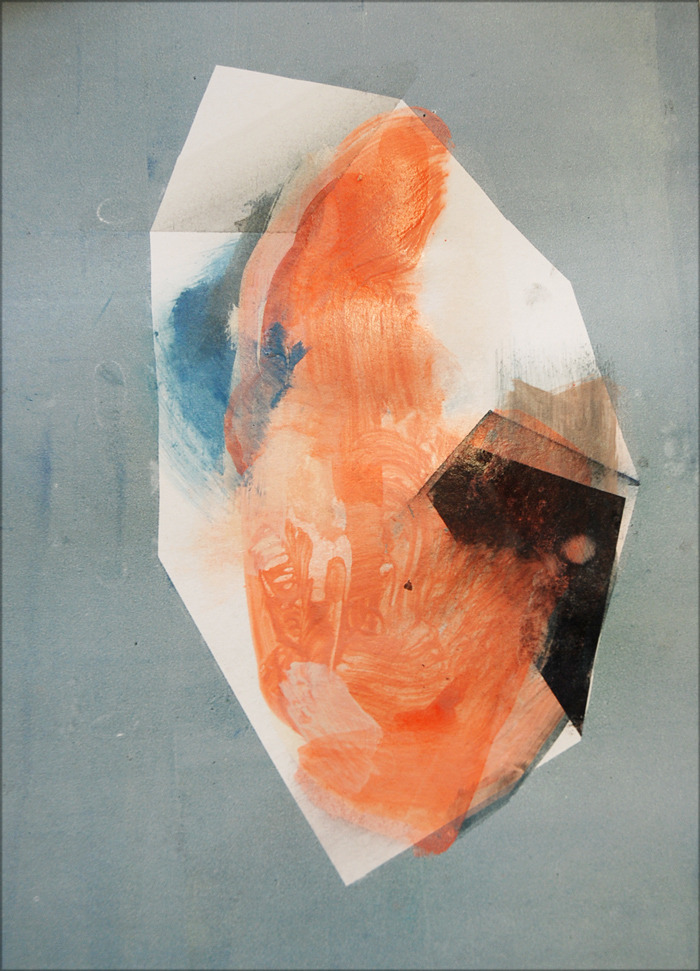
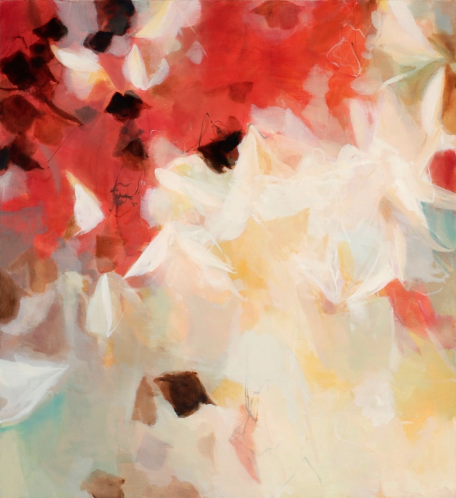
When an artist chooses to concentrate their attention on one certain subject, I’m always amazed by the diversity of ways in which they explore that form. Especially when an artist is seeking to look beyond representation to abstraction. In this series of Minerale paintings by Italian artist Sara Maragotto, the artist delves into the world of rocks, examining their opposing qualities of solidity and vulnerability.
We think of mountains and rocks as solid, immovable objects. But they have their vulnerabilities, just like everything else on this earth. Rocks can break and erode, sometimes quickly, but more often slowly over long periods of time.
In this series of mixed media paintings, I see Sara Maragotto, examining these characteristics in an abstract way. She retains the hard, sharp lines and surfaces, yet diffuses them with soft brushstrokes and washes of color. We can see what may be a weaker area beneath the surface, ready for exploitation by water or wind. I have no idea if this is what the artist had in mind when creating these works, but it is what my own eye has found. What do you see?
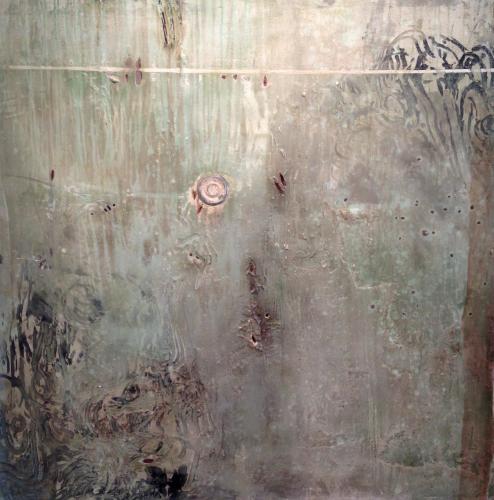
I have to stop myself from running my fingers over paintings in galleries and museums. I’m such a sucker for the texture of paint and the way it informs and enhances a piece of work. Sometimes, the texture is merely a by-product of the artist’s process, but for artists like Patricia Larsen, the texture is the star.
I know that often, for me, when I’m painting, I get caught up in the deliciousness of the juxtapositions of texture and color. There is a certain zen like state that happens when an artist surrenders to what is happening on a canvas. A kind of stream-of-consciousness type of painting tempered with a thoughtful composition results in a wonderful tension.
To see more work by Patricia Larsen, please visit her website. If you happen to be in the Tulsa area, you can see her work in person in the current exhibition at Exhibit by Aberson.
December is here! Mr. F and I are back living in Idaho ( Moscow, ID to be exact ) for the next three months. As we were driving up, we were treated to a spectacular display of snow juxtaposed against the evergreens, rocks and rushing waters. These pieces by this month’s Featured Artist, Casey Matthews remind me of that wintery palette I love so much.
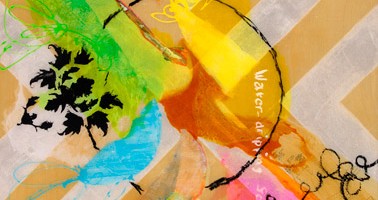
I’ve been in love with Casey’s work for a long time and she was one of the first artists I featured on Artsy Forager. Her work is full of luscious texture and lots of delicious little details that don’t always come through in digital form. Orbs and circles are a large part of her visual language and some of her latest work, she’s exploring a whirlpoolish composition in addition to her characteristic floating shapes and drips. And I’m especially enamored of the way she is overlaying linear elements, adding yet another intriguing dimension.
Casey lives in North Florida, so its pretty doubtful that her inspiration would have come from the snow and evergreens of Northern Idaho. Yet these pieces have much of the atmospheric feel I was imagining as we drove through snow covered canyons and delighted in patches of white dotting the rocks along the river. Isn’t it amazing how an artist’s work can resonate your own imagination?
If you’d like to see Casey’s work in person, you can do so at a number of representing galleries, a list can be found here. If you’re in North Florida, Casey will be showing work at the Ponte Vedra Inn & Club during the month of December, with a holiday reception on December 12th. Or if you happen to be in the Atlanta area, her work will be a part of the annual Masterpiece & Its Minis show at Gregg Irby Fine Art, where you could snatch up a sweet smaller Casey Matthews original, what an amazing gift one would make!
Mr. Forager and I are spending this week celebrating Thanksgiving, so I decided to show my thanks to this month’s Featured Artist by re-running a few of her previous posts! This feature first ran in November 2011. Enjoy!
Many artists will paint multiple paintings on the same canvas, one on top of the other. But while most are painting over work that they’ve tired of or that was unsatisfactory, Vancouver artist M.A. Tateishi, layers her paintings in order to later reveal what is hidden underneath.
Pink Is The Navy Blue Of India, mixed media and resin on board, 36×48
In her Excavations series, she layers 10 to 20 underpaintings onto her panel, then begins her process of excavation to reveal the varied surfaces underneath. A final coat of resin seals the surface and enhances the visual depth of each work.
Neon City, mixed media with resin, 36×48
To me, there is something really beautiful and moving about work that utilizes this process of selective revelation. After the artist has created a visual history, to then go back and unearth those hidden gems must be a bit like the excitement of opening gifts on Christmas mornings. Oh, what treasures may be found! What happy surprises lurk just beneath the surface!
Spiral Joy, mixed media on panel, 36×36
M.A.’s Transparency Series offers an even more fluid experience of each work’s visual history, as each layer is transparent and clearly visible in the finished work, as well as the underlayer of the wood panel, adding a wonderful organic texture against the pops of bright color.
Fire Snake, mixed media on panel, 40×40Free Bird, mixed media and resin on board, 36×48
M.A. once told me that she often feels like a piece isn’t complete without a little touch of pink. This is an artist that definitely embraces the power of pink and isn’t afraid to unearth what is hidden.
To see more of M.A.’s revealing work, check out her website and Facebook page. If you happen to be in the Vancouver, BC area, MA Tateishi will be participating in the Eastside Culture Crawl this weekend. See her website for more details!
Featured image is Thrush Song, mixed media on panel, 36×36. All images are via that artist’s website.
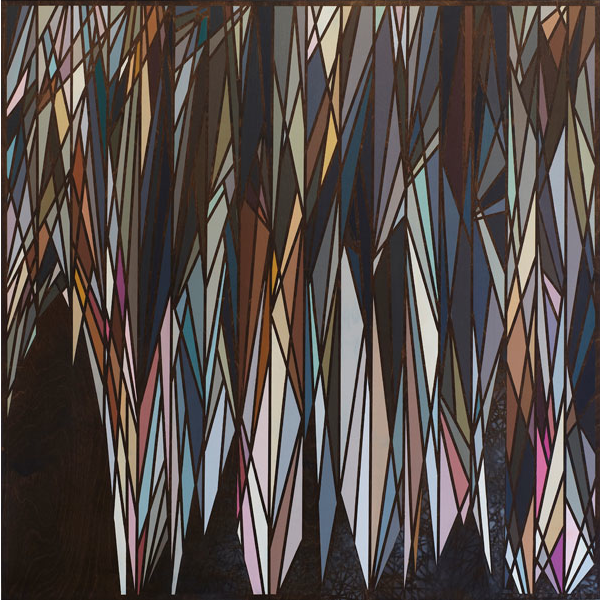
Light has an amazing way of transforming shapes, creating shadows and distorting forms. In her Fractal Facet paintings, Toronto artist Catto Houghton continues using her signature geometric chards to create abstract compositions filled with movement and light.
Prismatic shapes dance around her canvases, just as light bounces across a room. She’s exploring the character of light– how it moves and gives shape to the objects it illuminates and by keeping the compositions abstract, we’re able to concentrate on the forms, colors, and shifts. The work has a gem-like quality, with nods to Art Deco shapes and futuristic worlds. What we see depends entirely on how we interpret the artist’s use of color, shape and light. I don’t know about you, but I see some disco dancing goin’ on.
It’s funny how the shorter days of winter effect our psyche. Less daylight has us longing to curl up and hibernate until the spring. When the sun is out and shining, we turn our faces toward it, soaking up every precious ounce that we can. For artist Elise Morris, seeking and finding the light is a part of her process, resulting in paintings that are positively luminous.
In Morris’s paintings, the light fairly flutters across the canvas, darting in and out of the shadows like a firefly. Those flickers of light shine through to give her paintings the magic of light being filtered through a forest canopy– alluring and glowing, giving us reassurance that the light will find its way through the darkness.
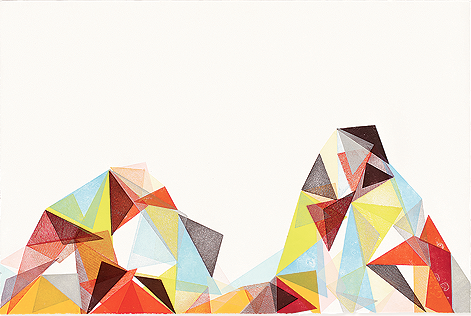
The snow is beginning to fall in the upper elevations on the Olympic Mountains here in Washington. Something about the steep crags covered in snow melts my heart and captures by soul every time I see it. I love that Mr. F always points it out to me, when the snow begins to appear, to make sure I don’t miss it. In her woodblock prints, Melbourne artist Ellie Malin reduces the mountainous landscape to their most simple pointed forms.
The way she uses opaque and translucent shapes to echo the varying planes of the mountains captures the mysterious layers perfectly. These prints make me want to hike through each canyon and over each peak! There is always something about breaking forms down to their very simplest shapes and planes that I find so satisfying.
I’ve always been fascinated by the way our minds inform our eyes. How our brains connect the proverbial dots to tell us that when we see certain shapes configured this way or that, we’re seeing three dimensional planes out of what is actually two dimensional surface. In the abstract paintings of artist Agnes Barley, we see that by placing certain shapes against one another just so, the illusion of three dimensional space is created.
Her shapes twist and turn and create shadows of themselves upon the painted surface, further reinforcing the dimensionality of the forms. The objects created by putting these pieces together feel so architectural, they seem as if they could be studies for structures or sculpture. I kind of want to climb on one and sit atop it, taking in the view.
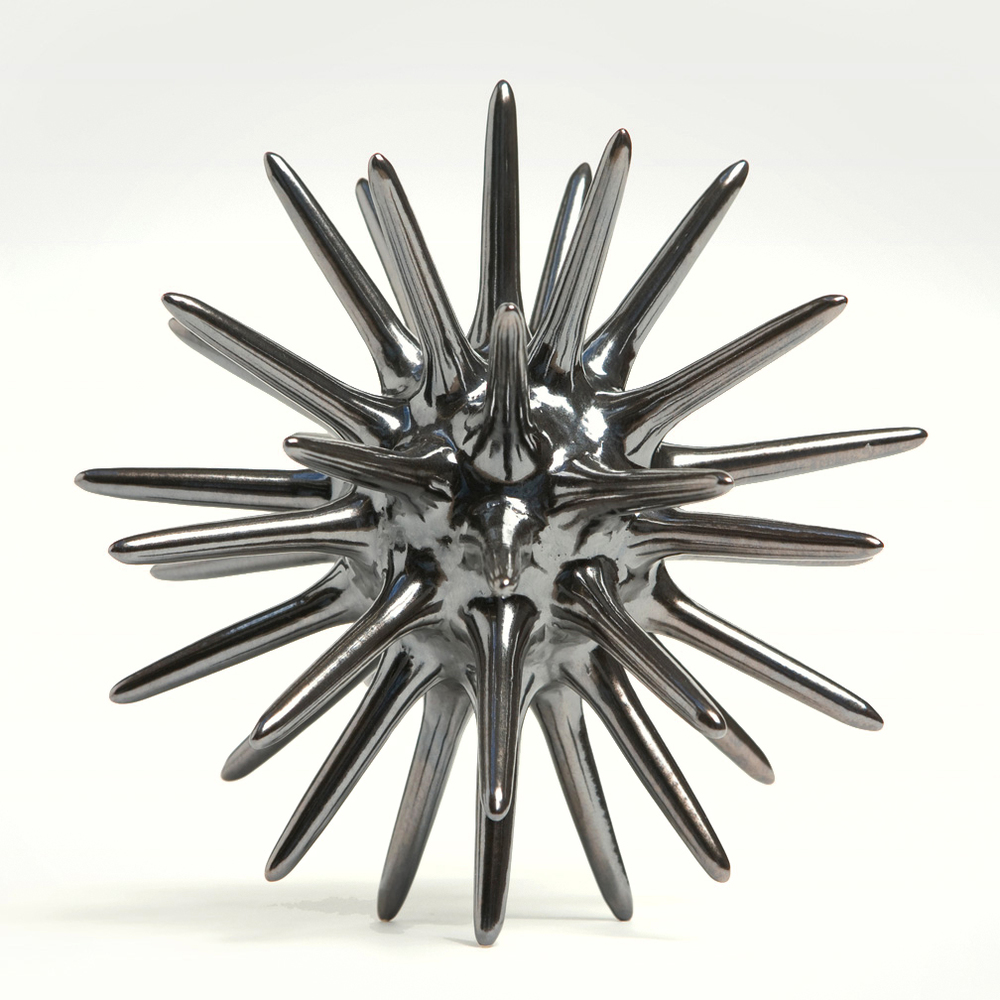
I’m always fascinated by artists who find inspiration in nature. What excites me even more is coming across an artist who interprets organic forms into work that is decidedly modern. Brooklyn artist Pamela Sunday creates contemporary ceramic sculptures that nod to the biological forms found all around and inside us.
Out of clay, the artist sculpts these magnificently strong yet delicate forms, so much like the environmental elements from which they take their inspiration. Our bodies and the nature around us can withstand so much, but we still have to keep reminding ourselves that each body, each habitat has its own tipping point. Life really is such a precarious balance, isn’t it?